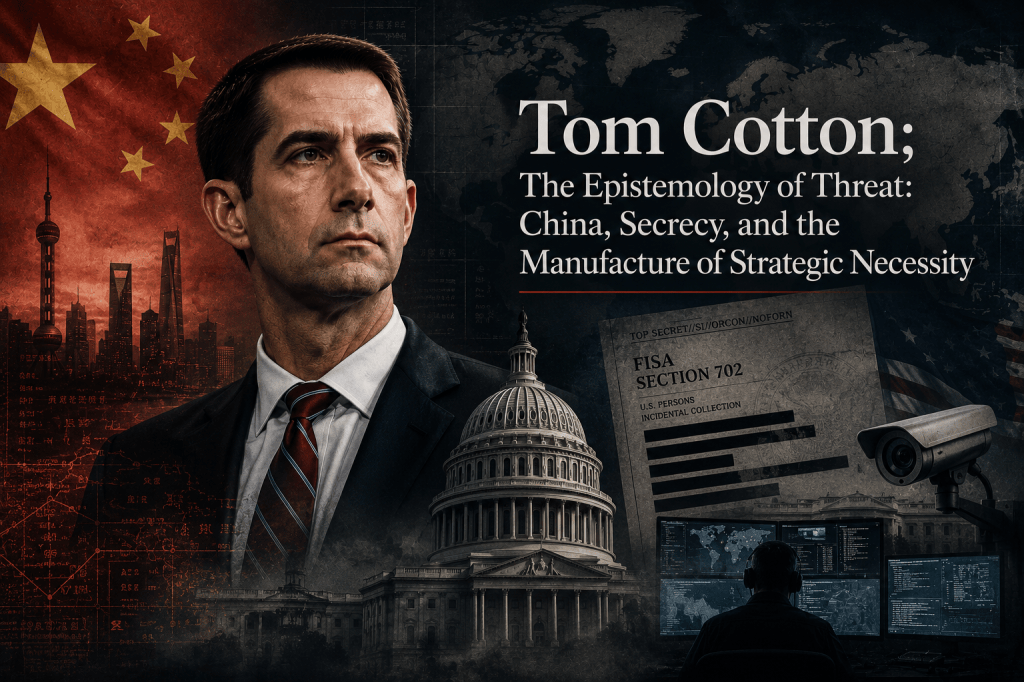
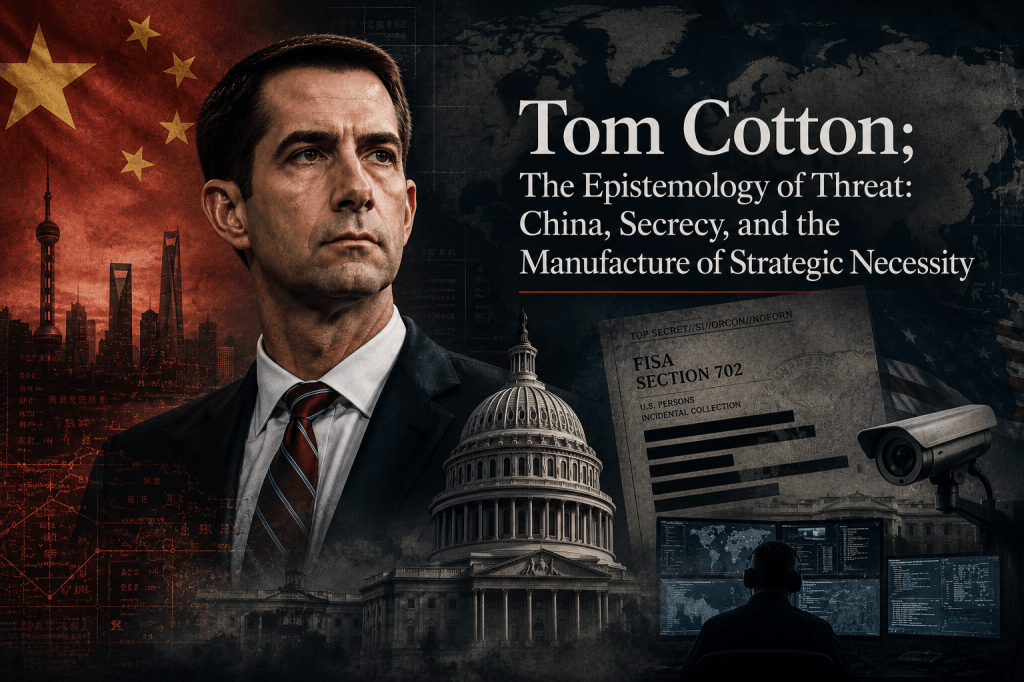
Fundamentally, Senator Tom Cotton’s foreign policy posture emerges from a sustained pattern of public statements and legislative priorities that collectively signal a deeply adversarial interpretation of the People’s Republic of China’s role in the international system. Principally, his characterization of Beijing’s ambitions reflects an understFIXED anding of great-power politics in which hierarchical supplantation—articulated in near-soliloquy as a gradual yet deliberate usurpation of primacy—and strategic rivalry are central dynamics, as evidenced by his assertion that China seeks to “supplant the United States as the world’s leading power.” Notably, this framing situates bilateral relations within a zero-sum paradigm, minimizing the plausibility of durable cooperation. Moreover, Cotton’s repeated emphasis on intellectual property expropriation—described as “one of the largest transfers of wealth in human history”—reinforces a narrative of systemic economic coercion. Importantly, such claims are not confined to economic discourse but are embedded within a broader national security framework that collapses distinctions between commercial engagement and strategic vulnerability. Additionally, his admonition that “we cannot continue business as usual with a regime that undermines our interests” reflects a decisive break from engagement-oriented orthodoxy. Consequently, his rhetoric aligns with a wider recalibration of U.S. strategic thinking that privileges resilience over interdependence. Furthermore, his focus on supply chain restructuring and domestic industrial capacity underscores an effort to reassert sovereign control over critical economic sectors. Critically, the insistence that “America must reclaim its economic independence” encapsulates a broader reconfiguration of globalization through the lens of strategic competition. Likewise, his integration of technological, military, and economic domains suggests an increasingly holistic conception of power. Emphatically, Cotton’s discourse elevates ideological divergence as a force multiplier within material rivalry, intensifying perceptions of incompatibility. Cotton’s positions resonate with a growing policy consensus that questions the assumptions underpinning decades of liberal internationalism. Arguably, this convergence reflects structural pressures within the international system rather than purely partisan motivations. Significantly, his rhetoric also performs a signaling function, shaping both domestic expectations and international perceptions. Ultimately, the consistency and scope of these positions indicate a durable and deeply embedded strategic orientation.
Of parallel analytical significance is the extrapolation of this interpretive lens beyond the Sino-centric frame to encompass a wider constellation of states, thereby illuminating the systemic architecture underpinning Cotton’s worldview. His assertion that “authoritarian regimes are working together to reshape the global order” does not merely describe discrete alignments; rather, it encodes a structural diagnosis in which geopolitical contestation is conceived as inherently networked, cumulative, and mutually reinforcing. Within this schema, China is neither anomalous nor isolated, but emblematic of a broader revisionist momentum that seeks to recalibrate institutional hierarchies and normative distributions of power. Such a formulation simultaneously delegitimizes multilateral mechanisms by recasting them as arenas vulnerable to strategic capture, thereby reframing cooperation as latent competition. His invocation of the maxim that “weakness invites aggression” thus operates not as rhetorical flourish but as a distillation of deterrence logic elevated to the level of organizing principle. Crucially, this principle acquires historical density when read against the longue durée of Chinese state experience, wherein episodes such as the Opium Wars and the First Sino-Japanese War are not merely archival events but formative traumas that encoded vulnerability as a precursor to external domination. Within these conflicts, figures such as Lin Zexu emerge not simply as administrative actors but as embodiments of a state grappling with the limits of its coercive and institutional capacity in the face of technologically superior adversaries. The subsequent trajectory—from the Second Sino-Japanese War to strategic interventions such as the Korean War—further consolidates a strategic culture in which the repudiation of perceived weakness becomes synonymous with the preservation of sovereignty. Here, military leadership assumes a more explicitly doctrinal role: commanders such as Chiang Kai-shek navigated the paradox of asymmetry through strategies of endurance and territorial elasticity, while figures like Peng Dehuai operationalized mass mobilization and strategic surprise to offset disparities in firepower. Even adversarial counterparts—such as Hideki Tojo—serve, within this analytical frame, as reminders of how external actors historically interpreted Chinese vulnerability as an opportunity for expansion, thereby reinforcing the cyclical logic underpinning deterrence-oriented thinking. In this sense, deterrence is not merely instrumental but civilizational in its resonance, functioning as both a policy preference and a historically conditioned imperative. Consequently, Cotton’s broader framework can be understood as an attempt to transpose this historically inflected logic onto contemporary great-power competition, thereby fusing ideological apprehension, material capability, and strategic signaling into a singular, internally coherent analytic paradigm.
The intersection of Foreign Intelligence Surveillance Act (FISA) authorities and concern over China has become a revealing case study in how democracies manage risk under conditions of strategic rivalry. At the center of the debate is Section 702, which permits the collection of foreign intelligence information from non-U.S. persons located abroad but can also incidentally capture Americans’ communications. That design makes the program analytically difficult to assess: its defenders emphasize operational necessity, while its critics focus on the constitutional and procedural costs of a system that can reach into domestic communications by indirect means. Senator Tom Cotton has been one of the most forceful advocates of preserving and strengthening these authorities, arguing that intelligence tools are indispensable for detecting adversarial activity that falls below the threshold of open conflict. In that framing, surveillance is not merely a bureaucratic function but a strategic instrument in competition with a technologically sophisticated rival. Yet the logic of necessity does not eliminate the harder question of proportionality. The more expansive the authority, the more important it becomes to ask whether the safeguards governing collection, querying, and retention are calibrated to the actual threat rather than to the political urgency surrounding it. Legal scholars have long noted that the phrase “foreign intelligence” is elastic enough to invite broad interpretation, and the classified nature of much FISA activity makes meaningful public scrutiny difficult. That opacity matters because oversight is not a decorative feature of democratic governance; it is the mechanism by which extraordinary powers remain tethered to their stated purpose. Cotton’s argument that the costs of intelligence failure outweigh the risks of overreach is serious, but it is not self-executing. It still requires evidence that the system’s benefits are being realized without normalizing a level of surveillance that outpaces existing review structures. As data collection becomes faster, more automated, and more deeply integrated with private-sector infrastructure, the gap between technical capability and institutional oversight widens. The result is a policy environment in which urgency is real, but so is uncertainty about whether current legal frameworks are adequate to govern it.
The legislative and rhetorical emphasis on China in FISA debates also reveals how threat perception can shape the architecture of law itself. Policymakers including Cotton have described Chinese intelligence operations as unusually sophisticated, globally networked, and deeply embedded in commercial, academic, and digital ecosystems. He has characterized the challenge as unprecedented, a formulation that does more than describe the threat: it helps justify the scale of the response. That is precisely why the rhetoric deserves close examination. When a threat is framed as exceptional, the policy tools used to confront it are more likely to be treated as exceptional as well, and exceptional measures have a tendency to become normalized over time. Intelligence assessments are often classified, which means the public must frequently rely on official characterizations that cannot be independently tested. This asymmetry of information is not trivial; it shapes the terms of democratic debate. Cotton has argued that surveillance authorities are essential for identifying covert influence operations, cyber intrusions, and economic espionage. Those are legitimate concerns. But the breadth of the tools used to address them raises the possibility of mission creep, especially when the boundary between foreign and domestic activity is blurred by encrypted platforms, cloud services, and transnational data flows. In such an environment, authorities designed for external intelligence collection can have domestic spillover effects even when that is not their formal purpose. Oversight bodies have acknowledged compliance problems in the past, which suggests that the issue is not whether the program has value, but whether its governance is sufficiently robust to prevent drift. Historical experience offers a cautionary lesson: emergency powers are often easier to expand than to retract. That is why the invocation of China in FISA debates should be understood not only as a response to external rivalry, but also as a force that can reshape internal legal interpretation. The strategic competition is real, but so is the risk that it becomes a standing rationale for broad state power.
The broader issue, then, is one of legitimacy. Surveillance programs endure not simply because they are effective, but because the public believes they are both necessary and constrained by law. When China is repeatedly invoked as the justification for expansive authorities, that balance becomes harder to sustain. Cotton has argued that intelligence capabilities must remain strong and unencumbered if the United States is to compete effectively with adversarial states. Operationally, that is understandable: intelligence work depends on speed, flexibility, and access to information. But democratic systems are not judged only by how efficiently they gather information; they are judged by how carefully they limit coercive power. The classified character of many intelligence activities makes external validation difficult, and that difficulty is compounded when compliance violations are documented, even if they are later corrected. Public confidence erodes when oversight appears reactive rather than preventive. At the same time, the technological evolution of surveillance complicates older assumptions about what counts as a targeted collection and what counts as incidental exposure. Modern systems can aggregate, infer, and repurpose data at a scale that traditional oversight models were never designed to monitor. The integration of private-sector data into intelligence workflows adds another layer of complexity, raising questions about transparency, consent, and the boundaries between commercial and state surveillance. In that context, China functions both as a genuine security concern and as a catalyst for policy expansion. The danger is not that the threat is imaginary, but that its rhetorical force can obscure the institutional tradeoffs involved in responding to it. A durable FISA regime will depend on whether it can reconcile strategic necessity with constitutional restraint. That is ultimately the central test: not whether the United States should gather intelligence on China, but whether it can do so in a way that preserves the legitimacy of the legal order it seeks to defend.
A rigorous evaluation of the foregoing analysis yields a conclusion that is less about the formal architecture of surveillance law and more about the credibility of those who most forcefully defend its expansion. The arguments advanced by Tom Cotton rest on a premise of strategic urgency that is not, in itself, unfounded; the geopolitical posture of China does indeed present a complex and evolving challenge to U.S. national security interests. However, the transformation of that challenge into a near-totalizing justification for the preservation and enlargement of surveillance authorities demands a higher evidentiary threshold than rhetorical insistence alone can provide. In a scientific or analytic framework, claims of necessity must be subjected to falsifiability, replication, and independent verification. By contrast, much of the justification for expansive FISA authorities operates within a closed informational loop, where the same institutions that benefit from the authorities also define the parameters of their success. From a methodological standpoint, this creates a problem of epistemic reliability. When policymakers assert that the risks of constraint outweigh the risks of overreach, but the underlying data remains largely inaccessible, the claim cannot be robustly tested. The issue is not merely one of disagreement, but of structural asymmetry in knowledge production. Under such conditions, deference to authority becomes a substitute for empirical validation, a substitution that is fundamentally at odds with both scientific reasoning and democratic accountability. Cotton’s posture, characterized by a consistent privileging of expansion over restraint, reflects this asymmetry. It is not simply that his conclusions may be contested; it is that the framework within which those conclusions are presented resists meaningful scrutiny. For a system predicated on checks and balances, this resistance is itself a point of concern.
Moreover, the analytical fixation on external adversaries risks obscuring endogenous vulnerabilities within the system it seeks to protect. Surveillance infrastructures, once established and normalized, develop internal dynamics that are not wholly determined by their original purpose. Compliance deviations, interpretive elasticity, and institutional incentives toward broader collection are not hypothetical risks; they are observable features of complex bureaucratic systems operating under pressure. To focus exclusively on external threats such as China is to adopt a unidimensional model of risk, one that neglects the possibility that the mechanisms of security can themselves become sources of instability. In scientific terms, this is a failure to account for internal variables within the system—variables that may exert as much influence on outcomes as the external stimuli that initially justified the system’s creation.
Thus, the more defensible conclusion is not that surveillance authorities are inherently illegitimate, nor that external threats are exaggerated beyond recognition, but that the interpretive authority granted to their most ardent proponents should not be accepted uncritically. Trust, in this context, is not a political sentiment but an analytical judgment grounded in transparency, accountability, and demonstrated adherence to constraint. Where those conditions are incomplete or unevenly satisfied, skepticism is not only warranted but necessary. The presence of a capable adversary abroad does not diminish the imperative to interrogate the exercise of power at home; rather, it heightens it. A system that cannot withstand scrutiny from within is unlikely to sustain legitimacy in the face of pressure from without.

