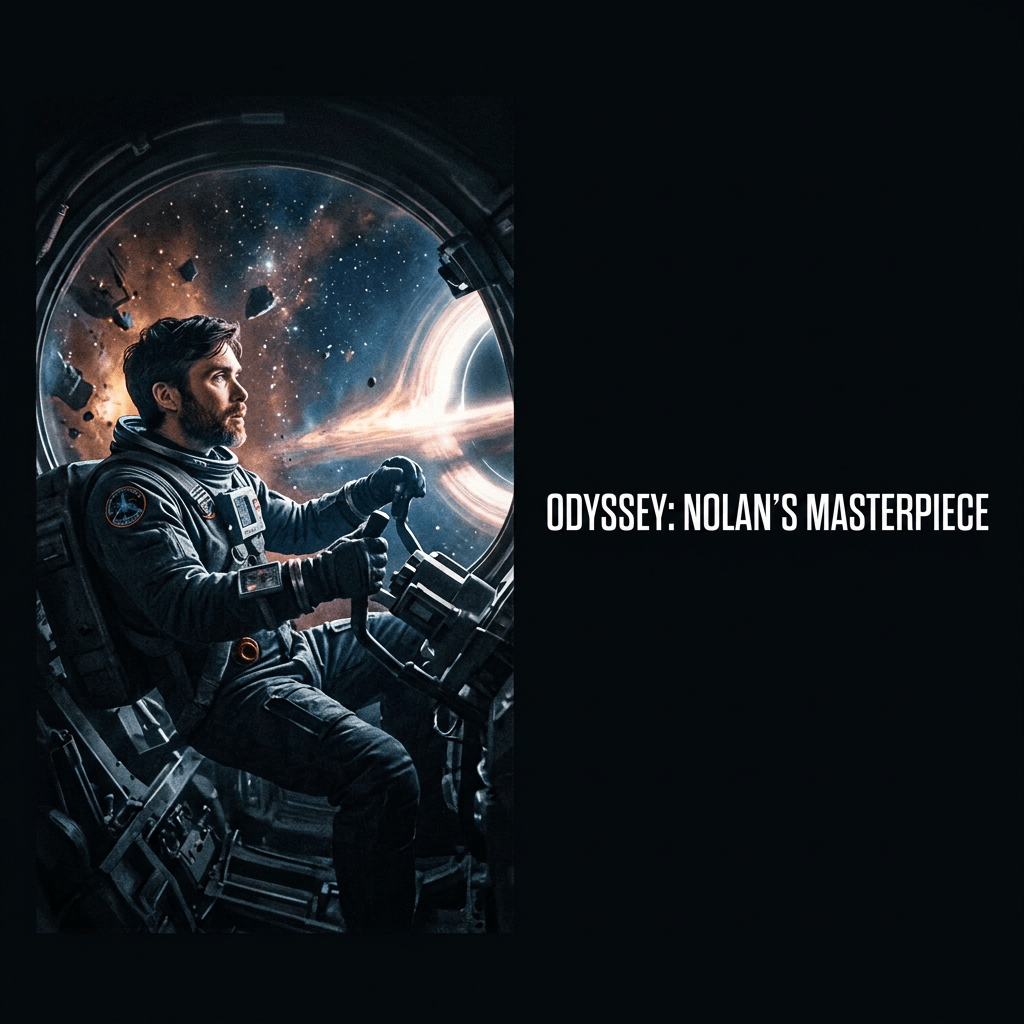
The machinery behind The Odyssey reflects something larger about the modern cinematic landscape: the transformation of film from a singular artistic experience into a carefully orchestrated cultural event. A production of this scale does not simply arrive in theaters; it arrives surrounded by an atmosphere of expectation. The audience encounters the film long before the first frame appears, through months of anticipation, conversations surrounding Nolan’s return to epic storytelling, the symbolic weight of adapting one of humanity’s oldest surviving narratives, and the collective curiosity generated by a cast whose combined presence represents multiple generations of cinematic identity. Matt Damon carries decades of dramatic credibility into the role of Odysseus, while Anne Hathaway brings emotional depth to the figure of Penelope, a character whose strength exists not through conquest but through endurance. Tom Holland represents the uncertainty of inherited legacy through Telemachus, while Zendaya’s Athena introduces a mythic presence that connects ancient symbolism with contemporary cultural power. The supporting ensemble, including Robert Pattinson, Lupita Nyong’o, Charlize Theron, Jon Bernthal, Benny Safdie, Mia Goth, Samantha Morton, and John Leguizamo, creates the impression of a world too expansive to belong to a single character. The film’s cast became part of its mythology before audiences ever experienced its story, creating a rare intersection where performance, reputation, and expectation merged into one enormous cultural force. However, the significance of Nolan choosing The Odyssey extends beyond the practical elements of production. His interest in the story reflects a larger artistic philosophy that has defined his career: the belief that cinema can still function as a modern form of mythology. Throughout his work, Nolan has repeatedly explored individuals trapped between human limitation and impossible circumstances. His characters often exist within systems larger than themselves—time, memory, war, technology, social structures, or existential uncertainty. The Odyssey represents perhaps the most ancient version of that conflict. Odysseus is not simply a warrior attempting to return home; he is a figure confronting the instability of identity itself. After years of conflict, separation, temptation, and transformation, the central question becomes not merely whether he can reach Ithaca, but whether he can still recognize himself when he arrives. That question aligns closely with Nolan’s recurring fascination with human perception. His films frequently examine the distance between reality and interpretation, asking audiences to consider how people construct meaning when certainty becomes impossible. In The Odyssey, mythology provides the perfect foundation for such exploration because mythology has never existed as a fixed narrative. Myths survive precisely because each generation reshapes them according to its own anxieties and desires. The ancient Greeks did not preserve Homer’s epic because every detail remained unchanged; they preserved it because every era discovered something new within it. The story became a vessel capable of carrying different meanings across centuries.
This is the unique challenge of adapting mythology in the modern era. A filmmaker is not simply adapting a text; they are entering a conversation that began thousands of years before cameras existed. The responsibility is therefore different from adapting a contemporary novel or historical event. The filmmaker is not introducing an audience to something unfamiliar but attempting to reveal something familiar in an unfamiliar way. The question surrounding The Odyssey is not whether audiences know the journey of Odysseus. Many already understand the basic outline. The question is whether Nolan can make audiences feel the uncertainty, isolation, sacrifice, and emotional weight of that journey as if they are experiencing it for the first time.
Yet the very elements that create an event of this magnitude also introduce the central challenge of modern blockbuster filmmaking. When a film becomes surrounded by so much anticipation, the audience is no longer approaching an unknown experience; they are approaching a conclusion they have already begun imagining. The spectacle begins before the story begins. The conversation begins before the interpretation begins. The expectations become so large that the film must compete not only with other works of cinema but with the idea of itself. In many ways, The Odyssey entered theaters carrying the burden of being both a film and a symbol—a symbol of theatrical revival, of Nolan’s creative ambition, and of Hollywood’s ability to still create global moments that feel communal rather than fragmented. That distinction matters because cultural significance is not created simply through scale. Scale can create attention, but only meaning can create permanence.
Hollywood has become increasingly skilled at producing anticipation. The modern blockbuster is no longer simply a movie; it is an ecosystem. Trailers, interviews, social media discussions, merchandise, fan theories, premium formats, and international marketing campaigns transform a release into a cultural cycle that begins months or even years before opening day. In this environment, films are not only consumed; they are experienced as events. Audiences participate in the construction of a movie’s identity before they ever enter a theater. The financial architecture behind The Odyssey illustrates the magnitude of this transformation. Built upon an estimated $250 million production budget, the film represented one of the most ambitious theatrical investments of Nolan’s career. The scale of that investment was matched by the audience response, as The Odyssey generated a $264 million global opening weekend, surpassing The Dark Knight Rises, which previously held Nolan’s record with a $249 million worldwide debut.
The achievement transformed the film into Nolan’s largest global opening ever, demonstrating how a filmmaker-driven project could still command worldwide attention at a moment when Hollywood has increasingly relied on established franchises and recognizable intellectual properties. The film’s opening also revealed the continued power of theatrical cinema when audiences are given a reason to gather. The Odyssey achieved the largest opening for a live-action and non-sequel release of 2026, proving that original cinematic experiences can still compete within a marketplace dominated by interconnected universes and familiar brands. The film ranked as the third-largest global and domestic opening of the year overall, following Toy Story 5 and The Super Mario Galaxy Movie. These achievements were not simply measurements of revenue; they represented evidence of collective participation. Millions of viewers chose to experience the same story at the same time, reinforcing the idea that cinema can still function as a shared cultural ritual.
Nolan occupies a fascinating position within this landscape because he represents both the traditional values of cinema and the modern machinery surrounding blockbuster filmmaking. On one hand, his commitment to theatrical presentation, practical effects, large-scale photography, and immersive sound reflects a belief that cinema remains a communal experience. On the other hand, the scale of his productions requires enormous industrial coordination, global financing, and sophisticated marketing. His films exist at the intersection of artistic ambition and commercial reality. That tension is precisely what makes The Odyssey such an important cultural moment: it asks whether a massive Hollywood production can still function as personal expression. The film’s release also reinforced Nolan’s long-standing belief that the physical experience of cinema remains central to storytelling. The demand for premium formats became one of the defining elements of its theatrical performance. IMAX screenings generated $51.8 million of the film’s global opening, accounting for approximately 19.6 percent of the worldwide total, while 70mm presentations contributed another $6.1 million. Those figures represented more than additional revenue streams; they revealed a cultural desire for immersion. Audiences were not simply interested in seeing the story of Odysseus unfold. They were interested in experiencing the scale, sound, and visual magnitude that Nolan designed specifically for the theatrical environment.
This distinction matters because The Odyssey exists within a period when the relationship between audiences and cinema has fundamentally changed. The rise of streaming platforms has altered viewing habits, shortening theatrical windows and transforming many films into disposable pieces of content within an endless digital library. Nolan’s work has consistently challenged that movement by treating theatrical presentation not as a secondary option but as the foundation of the experience itself. The success of IMAX and 70mm screenings demonstrated that audiences remain willing to seek out a physical cinematic experience when a film provides a compelling reason to leave the home. The commercial achievements of The Odyssey therefore represent a complicated contradiction. The film succeeded because of the same industrial machinery that defines modern Hollywood: enormous budgets, global marketing campaigns, international distribution networks, recognizable stars, and technological spectacle. Yet the film’s identity was also built around elements that resist industrial calculation: mythology, human emotion, philosophical questioning, and the enduring mystery of a story thousands of years old. The tension between those two forces represents the central challenge facing contemporary filmmaking. A movie must be large enough to capture attention but meaningful enough to survive beyond the moment of its release. This is where the difference between immediate success and enduring impact becomes most visible. A record-breaking opening weekend measures anticipation, accessibility, and collective curiosity, but it does not measure emotional survival. The history of cinema is filled with films that arrived as unstoppable forces, dominated conversations, and became temporary landmarks of their moment. Yet the works that remain decades later are rarely remembered because of their opening numbers. They are remembered because audiences discovered something within them that exceeded the circumstances of their release.
The $264 million opening of The Odyssey confirmed the strength of its arrival. It established the film as a major cultural event, secured Nolan’s largest global debut, and demonstrated the commercial power of a filmmaker whose name itself has become associated with theatrical ambition. However, box office records represent only the first chapter of a film’s relationship with history. The records explain why audiences showed up. They do not explain why audiences return.
The greatest films do not merely occupy attention; they reshape how audiences understand something about themselves. They become reference points through which people interpret their own experiences. A truly lasting film becomes more than an object of entertainment; it becomes part of cultural memory. Certain images, performances, and themes survive because they attach themselves to universal human concerns. They become shared language between generations.
For The Odyssey, that responsibility carries an even greater weight because the story itself has survived longer than any medium currently used to tell it. Homer’s epic endured not because it was the largest story of its era, but because it captured universal tensions that continue to define human existence: the struggle between duty and desire, the conflict between identity and destiny, the pain of separation, and the longing for a place that can still be called home. Every adaptation of such a work inherits not only its narrative but its legacy. The journey of Odysseus has remained powerful because it represents something beyond adventure. Beneath the monsters, gods, battles, and voyages exists a deeply human story about returning changed. The person who leaves is not always the person who comes home. Time transforms individuals. Experience alters identity. Memory becomes uncertain. Home itself becomes something that must be rediscovered rather than simply reached. These ideas explain why mythology continues to matter in a modern world dominated by technology. Ancient stories survive because human nature has changed far less than human tools. That distinction reveals the deeper contrast between something engineered to succeed and something destined to endure. Modern filmmaking has become remarkably skilled at constructing moments of arrival. Studios understand audience behavior, global markets, premium formats, star power, and the psychology of anticipation with unprecedented precision. The opening weekend of The Odyssey represents the highest form of that achievement: a convergence of artistry, technology, marketing, and cultural awareness operating together with extraordinary efficiency. The film’s $250 million production cost, record-breaking global debut, dominance among live-action releases, and extraordinary premium-format performance demonstrate Hollywood’s ability to construct an event of remarkable scale. Yet those achievements also raise a deeper question: whether a film built through such careful calculation can still produce the unpredictable emotional connection that defines enduring art. The machinery can create visibility. It can create conversation. It can create a moment. But it cannot manufacture meaning.
But endurance requires a different kind of architecture. It cannot be fully calculated. It cannot be completely optimized. It emerges from ambiguity, emotional honesty, and the ability of a work to reveal new meaning each time it is revisited. A film survives because audiences find themselves reflected within it. They return not because they remember how expensive it was or how large the production became, but because something about the human experience contained within the story remains unresolved. This is where the legacy of The Odyssey will eventually be determined. The film has already achieved what many productions spend years attempting to accomplish. It generated worldwide attention, created a sense of theatrical urgency, surpassed previous benchmarks established within Nolan’s own career, and demonstrated that audiences will still gather for a singular cinematic experience. The $264 million global opening, the record-breaking position as Nolan’s largest worldwide debut, and the unprecedented response to IMAX and 70mm presentations prove that the film successfully captured the imagination of the present moment. Yet history evaluates cinema differently than the marketplace. Commercial success records what audiences chose to experience at a particular time. Cultural endurance measures what audiences continue to discover long afterward. A film can dominate a weekend and disappear from memory. Another can arrive quietly and grow in influence over decades. The difference between those outcomes is not determined by budget, marketing, technology, or even immediate popularity. It is determined by whether the work contains a truth that remains meaningful after the circumstances surrounding its release have faded. This is why the first version carried a different kind of strength. Its power was not found in immediate perfection but in its willingness to leave space. It allowed the audience to participate rather than simply observe. It created room for discovery, uncertainty, and interpretation—the same qualities that allow great works of art to continue changing as the audience changes. The second revision, like a perfectly executed opening weekend, demonstrates control and confidence. It communicates its purpose clearly and achieves its intended effect. But the danger of absolute precision is that it can remove the very imperfections that create emotional connection. Sometimes the moments that remain with audiences are not the moments that are most polished, but the moments that feel most human.
The paradox of The Odyssey is therefore the same paradox facing modern cinema itself: the ability to create something immediately undeniable while still preserving something quietly unforgettable. The film has already accomplished the first half of that equation. It has proven its ability to dominate the present. It has broken records, commanded global attention, and demonstrated the continued power of theatrical storytelling. The question now belongs to the future. Will audiences return because they remember the scale of the opening weekend, or will they return because something within the story continues calling them back? Will they remember the spectacle surrounding the film, or the emotional journey contained within it? Will The Odyssey be remembered as a moment when cinema demonstrated its power, or as a work that used that power to reveal something lasting about humanity?
Because history does not preserve the loudest arrivals. It preserves the works that continue speaking after the noise disappears. A record can announce significance, but only resonance can confirm it. The true measure of The Odyssey will never be limited to the size of its debut, the strength of its cast, the magnitude of its production, or the technological achievement behind its presentation. Those elements explain why the world looked toward it. The $250 million investment explains the scale of the undertaking. The $264 million opening explains the power of its arrival. The $51.8 million IMAX contribution and $6.1 million from 70mm screenings explain the audience’s desire to experience cinema as something larger than a screen. The records explain why the world gathered. But only its ability to endure will explain why the world continues looking back.
The ultimate legacy of The Odyssey will not be determined by whether it became one of the biggest openings of its era, although that achievement places it among the defining theatrical events of its time. Its legacy will emerge from whether future audiences discover within its journey the same questions that have kept Homer’s epic alive for thousands of years. The struggle between identity and destiny. The longing for home. The consequences of survival. The challenge of returning to a world that has changed while discovering that the traveler has changed even more. That is the true measure of mythology and the true measure of cinema. The greatest stories do not survive because they were large enough to overwhelm their audience. They survive because they were human enough to remain with them. The Odyssey arrived as an event. It arrived as a record. It arrived as a demonstration of what modern Hollywood can still accomplish when ambition, technology, artistry, and audience desire converge. But the difference between a successful film and a lasting film exists beyond the opening weekend. It exists in the quiet moments after the crowds leave, after the numbers are recorded, after the conversation begins to fade. That is where history begins. And that is where The Odyssey will ultimately be judged.


Leave a comment