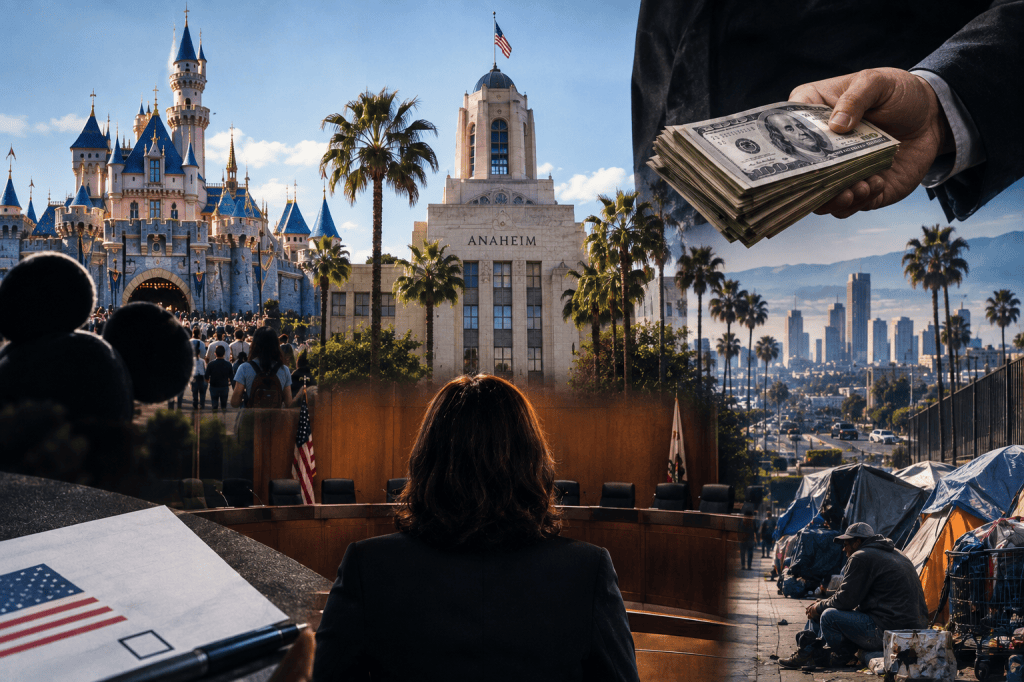
Anaheim presents a peculiar puzzle in American civic life, because the city that markets “the happiest place on earth” to the planet has spent much of the past decade quarrelling over who actually writes the rules by which that happiness is hosted, taxed, policed, and expanded. On November 3, voters will fill the mayor’s seat from a ballot listing incumbent Ashleigh Aitken, Imran Sharief, who describes himself as a doctor and businessman, and Alfredo Rodriguez, who manages teams across California for a services firm, while three council seats, in Districts 2, 3, and 6, hang in the balance beside that contest. Such a ballot invites a tidy question, and tidy questions about Disneyland tend to attract tidy answers: either the company owns the place, or the company is one valued neighbor among many. Neither slogan survives contact with the record. Control in a city of roughly 350,000 residents, a $2.6 billion budget, and 25 million visitors each year is spread across a council majority, a permanent staff, public safety unions, hotel and business coalitions, courts, prosecutors, and a resort whose gravity bends decisions long before any vote is cast. Notably, the mayor holds a part-time post that pays roughly $16,450 a year, according to a voter-information site, and presides over a body in which six district members hold six more votes, which means the most visible officer in the city occupies a seat of modest authority.
Moreover, the resort’s most dependable instrument of influence has historically been the council rather than the mayoralty, a pattern this essay traces through a representation dispute, campaign committees, an FBI probe, a sweeping development agreement, and a manager search now underway. Consequently, the argument advanced here is that the mayor’s contest matters less as a verdict on a single officeholder than as a test of whether the reform energy released in 2022 can harden into lasting institutions, and that the honest answer to the question in the title is qualified rather than absolute: nobody controls Anaheim completely, but some actors control the terms on which everybody else must bargain, and identifying those actors requires following money, land, and staff time rather than speeches. The pages ahead weigh four competing theories of control against the documented record, examine what each candidate promises, and close by asking what evidence a skeptical voter should demand before trusting any claim, including the claims made here.Any serious account must begin with the arithmetic of dependence. The city’s own statement explaining a major resort agreement noted that visitors supply more than half the revenue used to pay for police, fire protection, libraries, community services, and the retirement of debt, and Voice of OC has described Disneyland as the largest employer in Orange County. Figures of that kind describe a relationship in which the company need not threaten anyone to be heard, because every council member can read a budget. Importantly, dependence operates as a standing incentive rather than a conspiracy: a council that fears slower hotel bookings, delayed construction, or a shift of building dollars toward Orlando, Tokyo, Shanghai, or Paris will tend to interpret requests through that fear whether or not a lobbyist ever raises the subject. A defender of the resort would reply, with some justice, that reliance runs in both directions, since the company anchored a flagship in this specific place, owns land that cannot be moved, and gains when roads, sewers, and public safety function well. Both observations hold. The decisive question concerns bargaining power at the margin, and here the record suggests that the company’s patience, expert staff, and capacity to point toward other investment sites give the resort genuine leverage during negotiations, while the city’s leverage rests on zoning authority, infrastructure responsibilities, and the ability of residents to elect representatives who read agreements closely. Tellingly, a Disney-focused fan blog covering the 2024 expansion vote argued that the company would otherwise have slowed spending in Anaheim, partly because earlier projects had met resistance from the city, and a publication that depends on the goodwill of the resort has little reason to exaggerate the point. Months before that vote, the parks chairman, Josh D’Amaro, said the company had “enough room to build another Disneyland” in Anaheim, a sentence that reads as promise and reminder at once, since land and money that can fund a second park here can be redirected elsewhere.
Consequently, any candidate who pledges independence from the resort must explain how the city would replace the revenue and jobs that make independence expensive, a question that none of the three published candidate statements addresses.Dependence has a history, and that history explains why subsidies saturate Anaheim’s politics. The lead author of Measure L argued that bond financing used to expand the resort in 1996 amounted to a tax rebate, since taxes generated by the resort were diverted from the city’s main operating fund to pay for public infrastructure, according to OC Weekly, and that argument animated Measure L, a 2018 ballot measure raising the minimum wage for businesses that receive city subsidies. The city maintained that the measure did not reach the Disneyland Resort, while other parties disagreed, and Laughing Place, a fan site, predicted that labor unions would challenge the city’s reading. During that period the company also walked away from subsidy agreements it had earlier pursued, a retreat that a consultant for the then-mayor described to Voice of OC as an effort to soften an unpopular public image, and a Disney spokeswoman told the outlet that “Anaheim has been our home for more than 60 years.” Spending against particular candidates followed a related logic. Voice of OC, citing the Los Angeles Times, reported that committees affiliated with Disney had spent $85,683 against Councilman Jose Moreno in 2016, and Moreno speculated in 2018 that the company wanted to recapture the council so that subsidies could again be requested. Voters, in turn, approved Measure L over the opposition of a campaign run by the Chamber of Commerce and supported with Disney money, which demonstrates that resort-aligned positions can lose at the ballot box. The pattern, taken together, shows a company that employs positive and negative spending, retreats when public sentiment turns hostile, and pursues favorable majorities again when conditions improve. Whether such conduct counts as ordinary civic participation or as capture depends on how much weight one assigns to a single corporation’s voice in a city whose revenue that corporation substantially underwrites.Structure shapes obligation, and the method by which Anaheim elects a council has long been contested. More than a decade ago, the American Civil Liberties Union sued the city on behalf of Latino residents, arguing that at-large council elections violated the California Voting Rights Act in a city whose population was roughly 53 to 54 percent Latino and whose five council members were each white, with four living in Anaheim Hills, according to reporting from that period. The plaintiffs’ reasoning was practical as well as principled: Jose Moreno, then a school board member and one of the named plaintiffs, told reporters that running citywide cost between $300,000 and $500,000 and that candidates without ties to established business interests received little support, while an activist complained that the council needed members who would stop being “puppets for Disney.” Opponents of districts countered that dividing the council into territories would balkanize the body and replace citywide stewardship with a scramble for neighborhood resources. The council’s first response was to reject district elections in a pair of 3-2 votes and to offer instead a residency requirement under which candidates would live in districts but still win citywide, an arrangement that the ACLU’s attorney characterized as identical to the old system apart from candidate qualifications, and the dispute eventually yielded the structure visible on this year’s ballot, with a mayor chosen citywide and council members chosen from districts. The lesson that matters here concerns money rather than demographics. A citywide campaign demands a donor base wide enough to reach hundreds of thousands of residents, which favors candidates with connections to business interests, whereas a district race can be won with far smaller sums, which should in principle weaken any single donor’s ability to purchase a majority. Yet the 2022 results complicate that hope, because a resort committee spent more than $379,000 on one district race and more than $546,000 on another, demonstrating that races small enough to be cheap are likewise small enough for concentrated money to dominate. Districts changed who sits on the council; they did not remove the incentive to court whoever can finance a campaign.Money reaches Anaheim campaigns through two channels, and distinguishing them clarifies a great deal. The first consists of direct contributions to candidates, which the city caps; the cap stood at $2,700 per contributor as of January 2025, according to the city clerk. The second consists of independent committees such as Support Our Anaheim Resort, known as SOAR, which serves as Disney’s chief campaign vehicle and can spend on behalf of candidates without comparable restraint, because spending uncoordinated with a campaign escapes contribution caps under long-standing American election doctrine. Consequently, the headline cap says little about the resort’s influence, and the revealing numbers come from committee filings. In 2018, labor groups spent about $1.9 million on candidates and Measure L against roughly $1.6 million from the resort, and Disney still emerged with a favorable council majority after Harry Sidhu, Jordan Brandman, and Trevor O’Neil won, according to Laughing Place. In 2022, the company again put more than $1 million into SOAR, a sum Voice of OC reported as $1.3 million, and the outlet noted that Disney had spent over $1 million in each of the two preceding elections as well. The committee’s advantage lies less in outspending any given opponent than in choosing where to spend. In both 2018 and 2022 the money concentrated on council seats, where a few hundred thousand dollars can decide a district, and avoided the mayor’s race, where voters pay closer attention and where open alignment with a corporation can generate unfavorable headlines.
One commentator quoted by Voice of OC in 2022 speculated that the mayor’s race had become too high-profile and contentious for the company to back a friendly candidate without courting bad press, which fits the pattern. Moreover, the decision to abstain is informative: a committee that expects to be punished for backing a candidate has, in effect, acknowledged that voters hold views of the company different from the views held by the council members the committee funds.The year 2022 tested those theories under unusual pressure. In May, FBI agents disclosed a corruption probe centered on the proposed sale of Angel Stadium, which the city had owned since 1966, to the owner of the Angels, Arte Moreno; Mayor Harry Sidhu resigned shortly afterward, and the council voted to cancel the sale. Aitken, an attorney who had lost the 2018 race to Sidhu, ran on a platform of reform, and when counting advanced she captured about 43 percent of the vote against roughly 35 percent for Trevor O’Neil among 66,205 ballots counted at that stage, becoming the first woman elected mayor of the city. Her victory carried an irony that analysts noticed immediately: because SOAR had stayed out of the mayor’s race, the resort could not be said to have lost a contest the resort never entered, and because SOAR had spent heavily elsewhere, the new mayor arrived facing a council on which Voice of OC had counted six resort-backed members in the days after the vote. The committee devoted more than $546,000 to Natalie Meeks in District 6 and over $379,000 to Natalie Rubalcava in District 3, and Jodi Balma, a Fullerton College elections expert, argued that SOAR had made sure Aitken would not enjoy a friendly council. Meanwhile, the police and firefighter associations rather than the resort supplied her largest institutional backing, spending more than $91,000 and $72,000 respectively, and a committee spent over $271,000 against her. Notably, Aitken’s father chairs the board of Voice of OC, which disclosed that fact when covering her campaign, a detail worth remembering whenever that outlet’s reporting appears in this essay.The courtroom aftermath deserves care, because loose talk of corruption has obscured what prosecutors established. In 2023, Sidhu pleaded guilty to wire fraud, obstruction of justice, and false statements to the FBI and to the FAA, and in 2025 a judge sentenced him to two months in prison, a year of supervised release, and a $55,000 fine, well below the eight months prosecutors had requested and well above the probation his attorneys sought. According to the plea agreement as summarized by The Stadium Business, Sidhu sought a seat on the city’s negotiating team for the stadium sale, deleted messages and documents to impede investigators, and lied when agents questioned him, and FBI recordings captured him speaking about a $1 million campaign contribution he expected after the sale closed. A business-group executive named Ament, who later pleaded guilty to wire fraud, was recorded describing a small circle of business leaders and consultants as the people who ran the city. Significantly, Sidhu was never charged with bribery or honest-services fraud, and his filings denied that he asked for or received any such contribution, a distinction his defenders stressed and that critics found less reassuring than the defenders hoped. Prosecutors, for their part, wrote that he betrayed the city of Anaheim. A resident activist said the sentence was too light to teach public servants that lying to the FBI carries consequences. Neither Disney nor SOAR appears among the defendants in the sources I reviewed, and the plea papers concerned the stadium and the Angels rather than the resort, so the episode proves less about Disneyland than about the vulnerability of civic decisions to a small circle of insiders working with little public scrutiny. Voice of OC nonetheless characterized the probe as having exposed the “outsized influence” of resort interests at City Hall, a characterization that expresses the outlet’s reading rather than a finding of any court, and a careful reader will keep the distinction in view.The most consequential decision of Aitken’s term came in spring 2024, when the council approved DisneylandForward, a multidecade plan for new theme park, hotel, entertainment, and retail development on land the company owns or operates, by 7-0 votes on April 17 and again on May 7. Under the development agreement, Disney must invest at least $1.9 billion over ten years, with one tourism blog reporting a range of $1.9 billion to $2.5 billion, and the company must provide $30 million for affordable housing in Anaheim, $10 million for sewer improvements on Katella Avenue, and $8 million for parks, while the city transfers responsibility for a service road, Magic Way, that mainly serves Disney’s own hotel and parking facilities. Aitken called the second vote “a milestone moment for Anaheim,” and the council’s stated rationale rested on the share of city revenue that visitors generate. Critics raised two concerns: that future construction authorizations could proceed through staff review without returning to the planning commission or the council, and that the unanimity signaled a council too eager to please. A Disney-focused outlet described the outcome as close to a foregone conclusion given a council it called friendly to the company. Here the competing theories collide in a single episode. Under the capture theory, a reform mayor presiding over a unanimous embrace of the resort’s expansion shows that reform stops at the property line. Under the bargaining theory, a signed agreement that legally obligates billions in private investment, housing dollars, and sewer upgrades shows a city extracting terms that earlier councils never secured. Both readings can be partly right, and distinguishing them requires information the public record supplies only in fragments, namely what the city demanded and abandoned during talks, whether the resort conceded anything beyond what market conditions would have required anyway, and how often staff decisions will occur outside public hearings once construction begins.
Any inquiry into control should ask for whom control is exercised, and Anaheim’s geography answers with unusual bluntness. More than a decade ago, residents and commentators described a sharp contrast between the affluent hills, where most council members then lived, and the working-class flatlands, where families crowd into apartments near the tourist corridor; a southern Anaheim resident told Voice of OC that the absence of Latino representation produced an uneven spread of city resources between those areas, and a Fox News Latino report observed that few visitors ever see the neighborhoods where much of the city’s working population lives. Those descriptions predate Aitken’s term, and the district system has changed who sits on the council, yet the concerns persist in new forms. The DisneylandForward agreement directs $30 million toward affordable housing and $8 million toward parks, sums that look substantial in a press release and modest beside a $2.6 billion budget and an expansion that the resort’s president, Ken Potrock, said could enlarge the resort by 50 percent. Aitken’s statement reports rent assistance for more than 6,300 households and an 11 percent drop in homelessness, achievements that would matter greatly if verified, since they address neighborhoods rather than the tourist corridor. Sharief likewise speaks of areas that residents feel have been overlooked, a phrase that quietly concedes the persistence of the same geography. The question for voters, then, is whether the gains of the tourist economy reach the neighborhoods at a rate proportional to the burdens that economy imposes, such as traffic, noise, housing costs, and wear on public facilities, and whether any candidate will publish metrics sufficient to answer.Measuring Aitken’s record requires separating what she claims from what independent evidence confirms. Her candidate statement, a document the city publishes but does not verify, lists transparency reforms, lobbying restrictions, a reset of stadium negotiations, and the appointment of a city ethics officer; a 14 percent drop in crime, faster emergency response, and two new fire stations; an 11 percent reduction in homelessness with expanded outreach and street medicine; rent assistance for more than 6,300 households; and work on Beach Boulevard, parks, libraries, and roads, and she promises to keep focusing on “kitchen table issues.” Each claim is testable, and none is frivolous. The reform items bear most directly on the question of control, because lobbying restrictions and an ethics officer change the channels through which the resort and other interests reach decision makers, and an ethics officer who publishes findings would give voters a measurement they currently lack. The service claims, by contrast, track outcomes that mayors of any stripe seek, and a careful voter should ask how much of the achievement belongs to a part-time mayor in a council-manager system where the city manager runs daily operations. Equally pertinent is timing: a reform record built while U.S. prosecutors were still pursuing the Sidhu case and while the council worked under public scrutiny may reflect pressure as much as conviction, and the decisive test arrives when scrutiny fades. Meanwhile, her statement says she reset stadium negotiations, a claim that cannot be evaluated without access to the negotiating record, which the sources available to me do not provide. Voters should therefore ask the incumbent to publish what has changed in practice: how many lobbyists registered, how many meetings were logged, how many complaints reached the ethics officer, and how many ended with findings.The two challengers offer different answers to the question of control, though the sources I reviewed describe no elected record for either. Sharief, who says he was born and raised in Karachi, Pakistan, works as a doctor, has chaired community organizations, and has four children who attended Anaheim schools, frames his campaign around a pledge to “restore trust in City Hall,” along with public safety, investment in neglected areas, partnerships with the business community to encourage growth, and a homelessness approach that pairs empathy with enforcement. He argues that results for the community are practical rather than partisan, which signals a campaign built on competence and coalition-building instead of ideology. Rodriguez, who says he came from humble beginnings and now manages teams across California for a services company, promises a mayor who listens and shows up, stresses public safety, compassion and accountability on homelessness, support for businesses, responsible infrastructure investment, and a City Hall that is transparent and fiscally responsible, and pledges to earn trust “through action, not promises.” A reader searching both statements for the word Disney will come away empty. Neither document mentions the resort, DisneylandForward, the stadium, lobbying restrictions, or campaign finance, which is striking in a race where those subjects define the stakes. Consequently, voters know the challengers’ priorities and temperaments but not their intended relationship with the largest private actor in town, and that omission matters because a candidate who promises business partnerships without describing guardrails invites exactly the suspicion that animated 2022. Structurally, a three-person field likewise favors the incumbent: Aitken won in 2022 with under 43 percent, which indicates that a plurality suffices, and challengers who divide opposition votes face an arithmetic obstacle that no biography can overcome.Because the mayor holds one vote of seven, the council races matter at least as much as the contest that attracts headlines, and the 2026 roster is revealing. The city clerk’s list of qualified candidates shows Carlos Leon in District 2 and Natalie Meeks in District 6 as the only named candidates, each marked as an incumbent, while in District 3 incumbent Natalie Rubalcava faces Elia Renteria-Garcia, who lists nonprofit development director as her occupation. If those listings hold through election day, two of three seats will be decided without a competitive contest, and the single competitive race will occur in the district where SOAR spent more than $379,000 to elect Rubalcava four years earlier. Meeks and Rubalcava owe their 2022 victories in part to heavy spending by the resort committee; Leon, by contrast, trailed narrowly in early counts against Councilwoman Gloria Ma’ae, whom SOAR backed with over $302,000 together with the police and firefighter associations, and now holds the seat according to the city’s list. Reporting around the 2022 election described a mayor isolated among resort-backed council members, though Leon’s District 2 result complicates any clean count of the current bloc. Because each seat carries a four-year term, the 2026 outcomes will run through 2030, a period that covers most of the ten-year DisneylandForward investment window, which means that the council elected this fall will supervise the first half of the agreement’s implementation. A mayor without a friendly majority can still shape the agenda through the visibility of the office, a single vote, and the ability to force public debate, yet cannot pass anything without three colleagues, and the sources I reviewed give no indication that a mayor can unilaterally block or enact an agreement of that scale. Moreover, the city describes the mayor as chosen at large, so the mayor’s office carries a citywide mandate that district members lack, a persuasive advantage that proves valuable mainly when voters pay attention.Beneath the elected layer sits a permanent staff, and arguably no appointment in the next four years will matter more than the one now under recruitment. Anaheim operates under a council-manager arrangement in which the city manager runs daily operations across 13 departments, including utilities, police, fire and rescue, and the convention center, and carries out the policy direction set by the mayor and council.
The post opened after Jim Vanderpool retired in February, assistant manager Greg Garcia serves on an interim basis, and the city has engaged a Sacramento consulting firm to run a nationwide search. The posted job description is revealing, naming DisneylandForward, OCVibe, mobility and infrastructure investments, future Angel Stadium opportunities, and economic development as initiatives the next manager will help shape, and seeking an executive who is “politically astute.” Read plainly, that language admits that the job involves brokering among powerful interests, of which the resort is the largest. Staff control matters for a reason that rarely appears in campaign literature: the DisneylandForward agreement leaves separate projects to review by city departments, so the daily application of the agreement, rather than the headline vote, will determine what is built, when, and under what public conditions. Therefore the council that selects the manager, and the mayor who can influence that selection through one vote and considerable persuasive weight, indirectly decides how closely the agreement will be policed. Predictably, a manager hired by a council that the resort helped elect will face different pressures than a manager hired by a council that campaigned on enforcement, and voters who care about the terms of the agreement should treat the selection process as a campaign issue rather than a personnel matter.The strongest defense of the resort deserves a hearing, because the critique of influence can slide into a caricature that ignores what the company contributes. Disneyland employs a vast workforce, anchors a regional tourism economy that supplies more than half of the revenue the city uses for essential services, and under the 2024 agreement accepted binding obligations that included a minimum investment of $1.9 billion, millions of dollars for housing, sewers, and parks, reimbursement of traffic control costs, and continued operation of a jobs and workforce development program in Anaheim. The resort’s president urged the council to “be bold” and to dream, and a defender could argue that a city with such a partner would be foolish to treat generosity as a threat. A defender could add that spending on candidates is an ordinary form of civic participation in a democracy, that unions, developers, and police associations do the same, and that a company with thousands of employees living in the region has legitimate interests in zoning, safety, and infrastructure. Further, the 2024 agreement binds the company to obligations in writing, which a purely captured council would hardly have bothered to negotiate. The rebuttal rests not on denying these points but on observing that the same facts that make the resort a valuable partner make the council’s independence difficult to verify: when one company supplies jobs, tax revenue, and a large share of campaign money in the same city, a favorable vote cannot easily be distinguished from a purchased vote or a bargained vote without access to the negotiating record. That epistemic problem, more than any single villain, explains why trust in City Hall appears as the common theme in each of the three candidates’ statements, whether phrased as integrity, trust, or transparency.With the evidence assembled, four theories of control can be weighed. The first, the resort-capture theory, holds that Disney effectively selects the council through committee spending, and the strongest support for this view lies in the pattern of concentrated district spending, the 2018 outcome despite labor’s larger outlay, and the unanimous 2024 votes. The weakness is that capture implies stability, whereas the record shows volatility: Aitken won in 2022 without the committee’s money, Leon prevailed against a SOAR-supported council member, and voters approved Measure L in 2018 over the opposition of the resort and the Chamber of Commerce. The second theory, pluralist bargaining, treats Anaheim as a contest among organized groups, such as the resort, labor unions, police and firefighters, hoteliers, developers, and neighborhood activists, and support for this view lies in the visible clashes between labor and the resort and in the fact that the police and firefighter associations backed both Aitken, a reform candidate, and resort-supported council candidates, which suggests that these groups follow their own interests rather than a single patron. The weakness here is that pluralism assumes no group commands decisive resources, whereas one corporation anchors the city’s finances. The third theory, built-in dependence, holds that no conspiracy is required because the city’s revenue base creates the same incentives for any council; the strength of this account lies in explaining why even reform-minded leaders voted for DisneylandForward, and the weakness is that the theory can excuse any outcome and offers no result that would disprove the claim. The fourth theory, democratic accountability, holds that voters can discipline every actor through elections, and support comes from 2022; the weakness lies in turnout, information costs, and the cheapness of district races. The most defensible synthesis blends the second and third: dependence sets the boundaries within which bargaining occurs, committee spending influences the composition of the bargainers, and elections can move the boundaries only at the margins. Crucially, that synthesis predicts that the 2026 election will not change the broad direction of resort policy, since the council, the manager search, and the ten-year investment window each point toward continuity, but may change the transparency and enforcement terms under which that direction is pursued.A skeptical voter can convert these abstractions into observable indicators. First, independent spending: committee filings, which the city makes available through a public records system, will show whether SOAR concentrates money on the District 3 race again and whether any committee spends in the mayor’s contest, a decision that would reveal the resort’s assessment of each candidate’s prospects. Second, the ethics officer: reports, investigations, and any published statistics about lobbyist registrations will show whether the reforms Aitken lists restrict access in practice or exist mainly on paper. Third, the DisneylandForward pipeline: the number of projects approved through staff review, the number brought to public hearings, and the portion of the committed $1.9 billion actually spent each year will show whether the agreement binds the company as tightly as supporters claim. Fourth, the stadium: Aitken’s statement says she reset negotiations, and the city’s job description refers to future stadium opportunities, so the terms of any new arrangement, the identity of any bidder, and the role of lobbyists in the talks will provide a direct test of whether the lessons of 2022 endured. Fifth, the manager hire: a nationwide search that concludes with a candidate known for independence rather than transactional bargaining will tell voters more about the next four years than any debate answer. Practically, each indicator is observable by ordinary residents with modest effort, provided the city publishes the data in usable form, which is a demand worth making of every candidate on the ballot.
Ultimately, the credibility of each claim in this debate deserves the scrutiny that the debate demands of public servants, and the evidentiary foundation for this essay is thinner than the subject deserves. Much of the detailed reporting on SOAR, the 2022 campaign, and the Sidhu case comes from one nonprofit outlet whose board chair is the mayor’s father, a conflict the outlet disclosed; that disclosure does not impugn the accuracy of the reporting, since the sentencing details appear consistently in outlets with no such tie, including Courthouse News Service, yet the phrase “outsized influence” expresses a journalistic judgment rather than a court finding, and a careful reader will weigh such phrases accordingly. Disney-focused fan sites, the source of other details, tend to depend on access and goodwill, so their descriptions of council behavior, including the suggestion that adoption of the 2024 plan was nearly preordained, reflect opinion rather than measurement. Candidate statements are self-reported and unverified by the city, which means that Aitken’s crime and homelessness percentages and her list of reforms require confirmation from independent data, and the challengers’ biographies likewise rest on their own words. I found no 2026 campaign finance totals for SOAR, labor committees, or any candidate, so this essay cannot say who is funding the current contest, and any confident prediction, including those implied above, should be treated as provisional. The Sidhu prosecution established crimes by a former mayor who obstructed an investigation; that record does not show that the resort purchased anything, and a writer who claims otherwise exceeds the evidence just as surely as one who claims the resort lacks an outsized voice. Accountability, then, cannot rest on slogans in either direction. Accountability demands published data that voters can check: independent expenditures reported within days rather than months, lobbying contacts logged in searchable form, ethics findings released with names attached, and every DisneylandForward construction authorization recorded in a public ledger. In that sense, the 2026 ballot offers a referendum less on a person than on a standard, namely whether Anaheim will treat transparency as a permanent condition of governance or as a short-lived reaction to a crisis. Voters who demand that standard from whoever wins, and who keep demanding the standard after the headlines fade, hold the only form of control that no committee can purchase, and the only form that does not depend on the favor of a single company.
Anaheim presents a peculiar puzzle in American civic life, because the city that markets “the happiest place on earth” to the planet has spent much of the past decade quarrelling over who actually writes the rules by which that happiness is hosted, taxed, policed, and expanded. On November 3, voters will fill the mayor’s seat from a ballot listing incumbent Ashleigh Aitken, Imran Sharief, who describes himself as a doctor and businessman, and Alfredo Rodriguez, who manages teams across California for a services firm, while three council seats, in Districts 2, 3, and 6, hang in the balance beside that contest. Such a ballot invites a tidy question, and tidy questions about Disneyland tend to attract tidy answers: either the company owns the place, or the company is one valued neighbor among many. Neither slogan survives contact with the record. Control in a city of roughly 350,000 residents, a $2.6 billion budget, and 25 million visitors each year is spread across a council majority, a permanent staff, public safety unions, hotel and business coalitions, courts, prosecutors, and a resort whose gravity bends decisions long before any vote is cast. Notably, the mayor holds a part-time post that pays roughly $16,450 a year, according to a voter-information site, and presides over a body in which six district members hold six more votes, which means the most visible officer in the city occupies a seat of modest authority. Moreover, the resort’s most dependable instrument of influence has historically been the council rather than the mayoralty, a pattern this essay traces through a representation dispute, campaign committees, an FBI probe, a sweeping development agreement, and a manager search now underway. Consequently, the argument advanced here is that the mayor’s contest matters less as a verdict on a single officeholder than as a test of whether the reform energy released in 2022 can harden into lasting institutions, and that the honest answer to the question in the title is qualified rather than absolute: nobody controls Anaheim completely, but some actors control the terms on which everybody else must bargain, and identifying those actors requires following money, land, and staff time rather than speeches. The pages ahead weigh four competing theories of control against the documented record, examine what each candidate promises, and close by asking what evidence a skeptical voter should demand before trusting any claim, including the claims made here.
Any serious account must begin with the arithmetic of dependence. The city’s own statement explaining a major resort agreement noted that visitors supply more than half the revenue used to pay for police, fire protection, libraries, community services, and the retirement of debt, and Voice of OC has described Disneyland as the largest employer in Orange County. Figures of that kind describe a relationship in which the company need not threaten anyone to be heard, because every council member can read a budget. Importantly, dependence operates as a standing incentive rather than a conspiracy: a council that fears slower hotel bookings, delayed construction, or a shift of building dollars toward Orlando, Tokyo, Shanghai, or Paris will tend to interpret requests through that fear whether or not a lobbyist ever raises the subject. A defender of the resort would reply, with some justice, that reliance runs in both directions, since the company anchored a flagship in this specific place, owns land that cannot be moved, and gains when roads, sewers, and public safety function well. Both observations hold. The decisive question concerns bargaining power at the margin, and here the record suggests that the company’s patience, expert staff, and capacity to point toward other investment sites give the resort genuine leverage during negotiations, while the city’s leverage rests on zoning authority, infrastructure responsibilities, and the ability of residents to elect representatives who read agreements closely. Tellingly, a Disney-focused fan blog covering the 2024 expansion vote argued that the company would otherwise have slowed spending in Anaheim, partly because earlier projects had met resistance from the city, and a publication that depends on the goodwill of the resort has little reason to exaggerate the point. Months before that vote, the parks chairman, Josh D’Amaro, said the company had “enough room to build another Disneyland” in Anaheim, a sentence that reads as promise and reminder at once, since land and money that can fund a second park here can be redirected elsewhere. Consequently, any candidate who pledges independence from the resort must explain how the city would replace the revenue and jobs that make independence expensive, a question that none of the three published candidate statements addresses.
Dependence has a history, and that history explains why subsidies saturate Anaheim’s politics. The lead author of Measure L argued that bond financing used to expand the resort in 1996 amounted to a tax rebate, since taxes generated by the resort were diverted from the city’s main operating fund to pay for public infrastructure, according to OC Weekly, and that argument animated Measure L, a 2018 ballot measure raising the minimum wage for businesses that receive city subsidies. The city maintained that the measure did not reach the Disneyland Resort, while other parties disagreed, and Laughing Place, a fan site, predicted that labor unions would challenge the city’s reading. During that period the company also walked away from subsidy agreements it had earlier pursued, a retreat that a consultant for the then-mayor described to Voice of OC as an effort to soften an unpopular public image, and a Disney spokeswoman told the outlet that “Anaheim has been our home for more than 60 years.” Spending against particular candidates followed a related logic. Voice of OC, citing the Los Angeles Times, reported that committees affiliated with Disney had spent $85,683 against Councilman Jose Moreno in 2016, and Moreno speculated in 2018 that the company wanted to recapture the council so that subsidies could again be requested. Voters, in turn, approved Measure L over the opposition of a campaign run by the Chamber of Commerce and supported with Disney money, which demonstrates that resort-aligned positions can lose at the ballot box. The pattern, taken together, shows a company that employs positive and negative spending, retreats when public sentiment turns hostile, and pursues favorable majorities again when conditions improve. Whether such conduct counts as ordinary civic participation or as capture depends on how much weight one assigns to a single corporation’s voice in a city whose revenue that corporation substantially underwrites.
Structure shapes obligation, and the method by which Anaheim elects a council has long been contested. More than a decade ago, the American Civil Liberties Union sued the city on behalf of Latino residents, arguing that at-large council elections violated the California Voting Rights Act in a city whose population was roughly 53 to 54 percent Latino and whose five council members were each white, with four living in Anaheim Hills, according to reporting from that period. The plaintiffs’ reasoning was practical as well as principled: Jose Moreno, then a school board member and one of the named plaintiffs, told reporters that running citywide cost between $300,000 and $500,000 and that candidates without ties to established business interests received little support, while an activist complained that the council needed members who would stop being “puppets for Disney.” Opponents of districts countered that dividing the council into territories would balkanize the body and replace citywide stewardship with a scramble for neighborhood resources. The council’s first response was to reject district elections in a pair of 3-2 votes and to offer instead a residency requirement under which candidates would live in districts but still win citywide, an arrangement that the ACLU’s attorney characterized as identical to the old system apart from candidate qualifications, and the dispute eventually yielded the structure visible on this year’s ballot, with a mayor chosen citywide and council members chosen from districts. The lesson that matters here concerns money rather than demographics. A citywide campaign demands a donor base wide enough to reach hundreds of thousands of residents, which favors candidates with connections to business interests, whereas a district race can be won with far smaller sums, which should in principle weaken any single donor’s ability to purchase a majority. Yet the 2022 results complicate that hope, because a resort committee spent more than $379,000 on one district race and more than $546,000 on another, demonstrating that races small enough to be cheap are likewise small enough for concentrated money to dominate. Districts changed who sits on the council; they did not remove the incentive to court whoever can finance a campaign.
Money reaches Anaheim campaigns through two channels, and distinguishing them clarifies a great deal. The first consists of direct contributions to candidates, which the city caps; the cap stood at $2,700 per contributor as of January 2025, according to the city clerk. The second consists of independent committees such as Support Our Anaheim Resort, known as SOAR, which serves as Disney’s chief campaign vehicle and can spend on behalf of candidates without comparable restraint, because spending uncoordinated with a campaign escapes contribution caps under long-standing American election doctrine. Consequently, the headline cap says little about the resort’s influence, and the revealing numbers come from committee filings. In 2018, labor groups spent about $1.9 million on candidates and Measure L against roughly $1.6 million from the resort, and Disney still emerged with a favorable council majority after Harry Sidhu, Jordan Brandman, and Trevor O’Neil won, according to Laughing Place. In 2022, the company again put more than $1 million into SOAR, a sum Voice of OC reported as $1.3 million, and the outlet noted that Disney had spent over $1 million in each of the two preceding elections as well. The committee’s advantage lies less in outspending any given opponent than in choosing where to spend. In both 2018 and 2022 the money concentrated on council seats, where a few hundred thousand dollars can decide a district, and avoided the mayor’s race, where voters pay closer attention and where open alignment with a corporation can generate unfavorable headlines. One commentator quoted by Voice of OC in 2022 speculated that the mayor’s race had become too high-profile and contentious for the company to back a friendly candidate without courting bad press, which fits the pattern. Moreover, the decision to abstain is informative: a committee that expects to be punished for backing a candidate has, in effect, acknowledged that voters hold views of the company different from the views held by the council members the committee funds.
The year 2022 tested those theories under unusual pressure. In May, FBI agents disclosed a corruption probe centered on the proposed sale of Angel Stadium, which the city had owned since 1966, to the owner of the Angels, Arte Moreno; Mayor Harry Sidhu resigned shortly afterward, and the council voted to cancel the sale. Aitken, an attorney who had lost the 2018 race to Sidhu, ran on a platform of reform, and when counting advanced she captured about 43 percent of the vote against roughly 35 percent for Trevor O’Neil among 66,205 ballots counted at that stage, becoming the first woman elected mayor of the city. Her victory carried an irony that analysts noticed immediately: because SOAR had stayed out of the mayor’s race, the resort could not be said to have lost a contest the resort never entered, and because SOAR had spent heavily elsewhere, the new mayor arrived facing a council on which Voice of OC had counted six resort-backed members in the days after the vote. The committee devoted more than $546,000 to Natalie Meeks in District 6 and over $379,000 to Natalie Rubalcava in District 3, and Jodi Balma, a Fullerton College elections expert, argued that SOAR had made sure Aitken would not enjoy a friendly council. Meanwhile, the police and firefighter associations rather than the resort supplied her largest institutional backing, spending more than $91,000 and $72,000 respectively, and a committee spent over $271,000 against her. Notably, Aitken’s father chairs the board of Voice of OC, which disclosed that fact when covering her campaign, a detail worth remembering whenever that outlet’s reporting appears in this essay.
The courtroom aftermath deserves care, because loose talk of corruption has obscured what prosecutors established. In 2023, Sidhu pleaded guilty to wire fraud, obstruction of justice, and false statements to the FBI and to the FAA, and in 2025 a judge sentenced him to two months in prison, a year of supervised release, and a $55,000 fine, well below the eight months prosecutors had requested and well above the probation his attorneys sought. According to the plea agreement as summarized by The Stadium Business, Sidhu sought a seat on the city’s negotiating team for the stadium sale, deleted messages and documents to impede investigators, and lied when agents questioned him, and FBI recordings captured him speaking about a $1 million campaign contribution he expected after the sale closed. A business-group executive named Ament, who later pleaded guilty to wire fraud, was recorded describing a small circle of business leaders and consultants as the people who ran the city. Significantly, Sidhu was never charged with bribery or honest-services fraud, and his filings denied that he asked for or received any such contribution, a distinction his defenders stressed and that critics found less reassuring than the defenders hoped. Prosecutors, for their part, wrote that he betrayed the city of Anaheim. A resident activist said the sentence was too light to teach public servants that lying to the FBI carries consequences. Neither Disney nor SOAR appears among the defendants in the sources I reviewed, and the plea papers concerned the stadium and the Angels rather than the resort, so the episode proves less about Disneyland than about the vulnerability of civic decisions to a small circle of insiders working with little public scrutiny. Voice of OC nonetheless characterized the probe as having exposed the “outsized influence” of resort interests at City Hall, a characterization that expresses the outlet’s reading rather than a finding of any court, and a careful reader will keep the distinction in view.
The most consequential decision of Aitken’s term came in spring 2024, when the council approved DisneylandForward, a multidecade plan for new theme park, hotel, entertainment, and retail development on land the company owns or operates, by 7-0 votes on April 17 and again on May 7. Under the development agreement, Disney must invest at least $1.9 billion over ten years, with one tourism blog reporting a range of $1.9 billion to $2.5 billion, and the company must provide $30 million for affordable housing in Anaheim, $10 million for sewer improvements on Katella Avenue, and $8 million for parks, while the city transfers responsibility for a service road, Magic Way, that mainly serves Disney’s own hotel and parking facilities. Aitken called the second vote “a milestone moment for Anaheim,” and the council’s stated rationale rested on the share of city revenue that visitors generate. Critics raised two concerns: that future construction authorizations could proceed through staff review without returning to the planning commission or the council, and that the unanimity signaled a council too eager to please. A Disney-focused outlet described the outcome as close to a foregone conclusion given a council it called friendly to the company. Here the competing theories collide in a single episode. Under the capture theory, a reform mayor presiding over a unanimous embrace of the resort’s expansion shows that reform stops at the property line. Under the bargaining theory, a signed agreement that legally obligates billions in private investment, housing dollars, and sewer upgrades shows a city extracting terms that earlier councils never secured. Both readings can be partly right, and distinguishing them requires information the public record supplies only in fragments, namely what the city demanded and abandoned during talks, whether the resort conceded anything beyond what market conditions would have required anyway, and how often staff decisions will occur outside public hearings once construction begins.
Any inquiry into control should ask for whom control is exercised, and Anaheim’s geography answers with unusual bluntness. More than a decade ago, residents and commentators described a sharp contrast between the affluent hills, where most council members then lived, and the working-class flatlands, where families crowd into apartments near the tourist corridor; a southern Anaheim resident told Voice of OC that the absence of Latino representation produced an uneven spread of city resources between those areas, and a Fox News Latino report observed that few visitors ever see the neighborhoods where much of the city’s working population lives. Those descriptions predate Aitken’s term, and the district system has changed who sits on the council, yet the concerns persist in new forms. The DisneylandForward agreement directs $30 million toward affordable housing and $8 million toward parks, sums that look substantial in a press release and modest beside a $2.6 billion budget and an expansion that the resort’s president, Ken Potrock, said could enlarge the resort by 50 percent. Aitken’s statement reports rent assistance for more than 6,300 households and an 11 percent drop in homelessness, achievements that would matter greatly if verified, since they address neighborhoods rather than the tourist corridor. Sharief likewise speaks of areas that residents feel have been overlooked, a phrase that quietly concedes the persistence of the same geography. The question for voters, then, is whether the gains of the tourist economy reach the neighborhoods at a rate proportional to the burdens that economy imposes, such as traffic, noise, housing costs, and wear on public facilities, and whether any candidate will publish metrics sufficient to answer.
Measuring Aitken’s record requires separating what she claims from what independent evidence confirms. Her candidate statement, a document the city publishes but does not verify, lists transparency reforms, lobbying restrictions, a reset of stadium negotiations, and the appointment of a city ethics officer; a 14 percent drop in crime, faster emergency response, and two new fire stations; an 11 percent reduction in homelessness with expanded outreach and street medicine; rent assistance for more than 6,300 households; and work on Beach Boulevard, parks, libraries, and roads, and she promises to keep focusing on “kitchen table issues.” Each claim is testable, and none is frivolous. The reform items bear most directly on the question of control, because lobbying restrictions and an ethics officer change the channels through which the resort and other interests reach decision makers, and an ethics officer who publishes findings would give voters a measurement they currently lack. The service claims, by contrast, track outcomes that mayors of any stripe seek, and a careful voter should ask how much of the achievement belongs to a part-time mayor in a council-manager system where the city manager runs daily operations. Equally pertinent is timing: a reform record built while U.S. prosecutors were still pursuing the Sidhu case and while the council worked under public scrutiny may reflect pressure as much as conviction, and the decisive test arrives when scrutiny fades. Meanwhile, her statement says she reset stadium negotiations, a claim that cannot be evaluated without access to the negotiating record, which the sources available to me do not provide. Voters should therefore ask the incumbent to publish what has changed in practice: how many lobbyists registered, how many meetings were logged, how many complaints reached the ethics officer, and how many ended with findings.
The two challengers offer different answers to the question of control, though the sources I reviewed describe no elected record for either. Sharief, who says he was born and raised in Karachi, Pakistan, works as a doctor, has chaired community organizations, and has four children who attended Anaheim schools, frames his campaign around a pledge to “restore trust in City Hall,” along with public safety, investment in neglected areas, partnerships with the business community to encourage growth, and a homelessness approach that pairs empathy with enforcement. He argues that results for the community are practical rather than partisan, which signals a campaign built on competence and coalition-building instead of ideology. Rodriguez, who says he came from humble beginnings and now manages teams across California for a services company, promises a mayor who listens and shows up, stresses public safety, compassion and accountability on homelessness, support for businesses, responsible infrastructure investment, and a City Hall that is transparent and fiscally responsible, and pledges to earn trust “through action, not promises.” A reader searching both statements for the word Disney will come away empty. Neither document mentions the resort, DisneylandForward, the stadium, lobbying restrictions, or campaign finance, which is striking in a race where those subjects define the stakes. Consequently, voters know the challengers’ priorities and temperaments but not their intended relationship with the largest private actor in town, and that omission matters because a candidate who promises business partnerships without describing guardrails invites exactly the suspicion that animated 2022. Structurally, a three-person field likewise favors the incumbent: Aitken won in 2022 with under 43 percent, which indicates that a plurality suffices, and challengers who divide opposition votes face an arithmetic obstacle that no biography can overcome.
Because the mayor holds one vote of seven, the council races matter at least as much as the contest that attracts headlines, and the 2026 roster is revealing. The city clerk’s list of qualified candidates shows Carlos Leon in District 2 and Natalie Meeks in District 6 as the only named candidates, each marked as an incumbent, while in District 3 incumbent Natalie Rubalcava faces Elia Renteria-Garcia, who lists nonprofit development director as her occupation. If those listings hold through election day, two of three seats will be decided without a competitive contest, and the single competitive race will occur in the district where SOAR spent more than $379,000 to elect Rubalcava four years earlier. Meeks and Rubalcava owe their 2022 victories in part to heavy spending by the resort committee; Leon, by contrast, trailed narrowly in early counts against Councilwoman Gloria Ma’ae, whom SOAR backed with over $302,000 together with the police and firefighter associations, and now holds the seat according to the city’s list. Reporting around the 2022 election described a mayor isolated among resort-backed council members, though Leon’s District 2 result complicates any clean count of the current bloc. Because each seat carries a four-year term, the 2026 outcomes will run through 2030, a period that covers most of the ten-year DisneylandForward investment window, which means that the council elected this fall will supervise the first half of the agreement’s implementation. A mayor without a friendly majority can still shape the agenda through the visibility of the office, a single vote, and the ability to force public debate, yet cannot pass anything without three colleagues, and the sources I reviewed give no indication that a mayor can unilaterally block or enact an agreement of that scale. Moreover, the city describes the mayor as chosen at large, so the mayor’s office carries a citywide mandate that district members lack, a persuasive advantage that proves valuable mainly when voters pay attention.
Beneath the elected layer sits a permanent staff, and arguably no appointment in the next four years will matter more than the one now under recruitment. Anaheim operates under a council-manager arrangement in which the city manager runs daily operations across 13 departments, including utilities, police, fire and rescue, and the convention center, and carries out the policy direction set by the mayor and council. The post opened after Jim Vanderpool retired in February, assistant manager Greg Garcia serves on an interim basis, and the city has engaged a Sacramento consulting firm to run a nationwide search. The posted job description is revealing, naming DisneylandForward, OCVibe, mobility and infrastructure investments, future Angel Stadium opportunities, and economic development as initiatives the next manager will help shape, and seeking an executive who is “politically astute.” Read plainly, that language admits that the job involves brokering among powerful interests, of which the resort is the largest. Staff control matters for a reason that rarely appears in campaign literature: the DisneylandForward agreement leaves separate projects to review by city departments, so the daily application of the agreement, rather than the headline vote, will determine what is built, when, and under what public conditions. Therefore the council that selects the manager, and the mayor who can influence that selection through one vote and considerable persuasive weight, indirectly decides how closely the agreement will be policed. Predictably, a manager hired by a council that the resort helped elect will face different pressures than a manager hired by a council that campaigned on enforcement, and voters who care about the terms of the agreement should treat the selection process as a campaign issue rather than a personnel matter.
The strongest defense of the resort deserves a hearing, because the critique of influence can slide into a caricature that ignores what the company contributes. Disneyland employs a vast workforce, anchors a regional tourism economy that supplies more than half of the revenue the city uses for essential services, and under the 2024 agreement accepted binding obligations that included a minimum investment of $1.9 billion, millions of dollars for housing, sewers, and parks, reimbursement of traffic control costs, and continued operation of a jobs and workforce development program in Anaheim. The resort’s president urged the council to “be bold” and to dream, and a defender could argue that a city with such a partner would be foolish to treat generosity as a threat. A defender could add that spending on candidates is an ordinary form of civic participation in a democracy, that unions, developers, and police associations do the same, and that a company with thousands of employees living in the region has legitimate interests in zoning, safety, and infrastructure. Further, the 2024 agreement binds the company to obligations in writing, which a purely captured council would hardly have bothered to negotiate. The rebuttal rests not on denying these points but on observing that the same facts that make the resort a valuable partner make the council’s independence difficult to verify: when one company supplies jobs, tax revenue, and a large share of campaign money in the same city, a favorable vote cannot easily be distinguished from a purchased vote or a bargained vote without access to the negotiating record. That epistemic problem, more than any single villain, explains why trust in City Hall appears as the common theme in each of the three candidates’ statements, whether phrased as integrity, trust, or transparency.
With the evidence assembled, four theories of control can be weighed. The first, the resort-capture theory, holds that Disney effectively selects the council through committee spending, and the strongest support for this view lies in the pattern of concentrated district spending, the 2018 outcome despite labor’s larger outlay, and the unanimous 2024 votes. The weakness is that capture implies stability, whereas the record shows volatility: Aitken won in 2022 without the committee’s money, Leon prevailed against a SOAR-supported council member, and voters approved Measure L in 2018 over the opposition of the resort and the Chamber of Commerce. The second theory, pluralist bargaining, treats Anaheim as a contest among organized groups, such as the resort, labor unions, police and firefighters, hoteliers, developers, and neighborhood activists, and support for this view lies in the visible clashes between labor and the resort and in the fact that the police and firefighter associations backed both Aitken, a reform candidate, and resort-supported council candidates, which suggests that these groups follow their own interests rather than a single patron. The weakness here is that pluralism assumes no group commands decisive resources, whereas one corporation anchors the city’s finances. The third theory, built-in dependence, holds that no conspiracy is required because the city’s revenue base creates the same incentives for any council; the strength of this account lies in explaining why even reform-minded leaders voted for DisneylandForward, and the weakness is that the theory can excuse any outcome and offers no result that would disprove the claim. The fourth theory, democratic accountability, holds that voters can discipline every actor through elections, and support comes from 2022; the weakness lies in turnout, information costs, and the cheapness of district races. The most defensible synthesis blends the second and third: dependence sets the boundaries within which bargaining occurs, committee spending influences the composition of the bargainers, and elections can move the boundaries only at the margins. Crucially, that synthesis predicts that the 2026 election will not change the broad direction of resort policy, since the council, the manager search, and the ten-year investment window each point toward continuity, but may change the transparency and enforcement terms under which that direction is pursued.
A skeptical voter can convert these abstractions into observable indicators. First, independent spending: committee filings, which the city makes available through a public records system, will show whether SOAR concentrates money on the District 3 race again and whether any committee spends in the mayor’s contest, a decision that would reveal the resort’s assessment of each candidate’s prospects. Second, the ethics officer: reports, investigations, and any published statistics about lobbyist registrations will show whether the reforms Aitken lists restrict access in practice or exist mainly on paper. Third, the DisneylandForward pipeline: the number of projects approved through staff review, the number brought to public hearings, and the portion of the committed $1.9 billion actually spent each year will show whether the agreement binds the company as tightly as supporters claim. Fourth, the stadium: Aitken’s statement says she reset negotiations, and the city’s job description refers to future stadium opportunities, so the terms of any new arrangement, the identity of any bidder, and the role of lobbyists in the talks will provide a direct test of whether the lessons of 2022 endured. Fifth, the manager hire: a nationwide search that concludes with a candidate known for independence rather than transactional bargaining will tell voters more about the next four years than any debate answer. Practically, each indicator is observable by ordinary residents with modest effort, provided the city publishes the data in usable form, which is a demand worth making of every candidate on the ballot.
Ultimately, the credibility of each claim in this debate deserves the scrutiny that the debate demands of public servants, and the evidentiary foundation for this essay is thinner than the subject deserves. Much of the detailed reporting on SOAR, the 2022 campaign, and the Sidhu case comes from one nonprofit outlet whose board chair is the mayor’s father, a conflict the outlet disclosed; that disclosure does not impugn the accuracy of the reporting, since the sentencing details appear consistently in outlets with no such tie, including Courthouse News Service, yet the phrase “outsized influence” expresses a journalistic judgment rather than a court finding, and a careful reader will weigh such phrases accordingly. Disney-focused fan sites, the source of other details, tend to depend on access and goodwill, so their descriptions of council behavior, including the suggestion that adoption of the 2024 plan was nearly preordained, reflect opinion rather than measurement. Candidate statements are self-reported and unverified by the city, which means that Aitken’s crime and homelessness percentages and her list of reforms require confirmation from independent data, and the challengers’ biographies likewise rest on their own words. I found no 2026 campaign finance totals for SOAR, labor committees, or any candidate, so this essay cannot say who is funding the current contest, and any confident prediction, including those implied above, should be treated as provisional. The Sidhu prosecution established crimes by a former mayor who obstructed an investigation; that record does not show that the resort purchased anything, and a writer who claims otherwise exceeds the evidence just as surely as one who claims the resort lacks an outsized voice. Accountability, then, cannot rest on slogans in either direction. Accountability demands published data that voters can check: independent expenditures reported within days rather than months, lobbying contacts logged in searchable form, ethics findings released with names attached, and every DisneylandForward construction authorization recorded in a public ledger. In that sense, the 2026 ballot offers a referendum less on a person than on a standard, namely whether Anaheim will treat transparency as a permanent condition of governance or as a short-lived reaction to a crisis. Voters who demand that standard from whoever wins, and who keep demanding the standard after the headlines fade, hold the only form of control that no committee can purchase, and the only form that does not depend on the favor of a single company.


Leave a comment