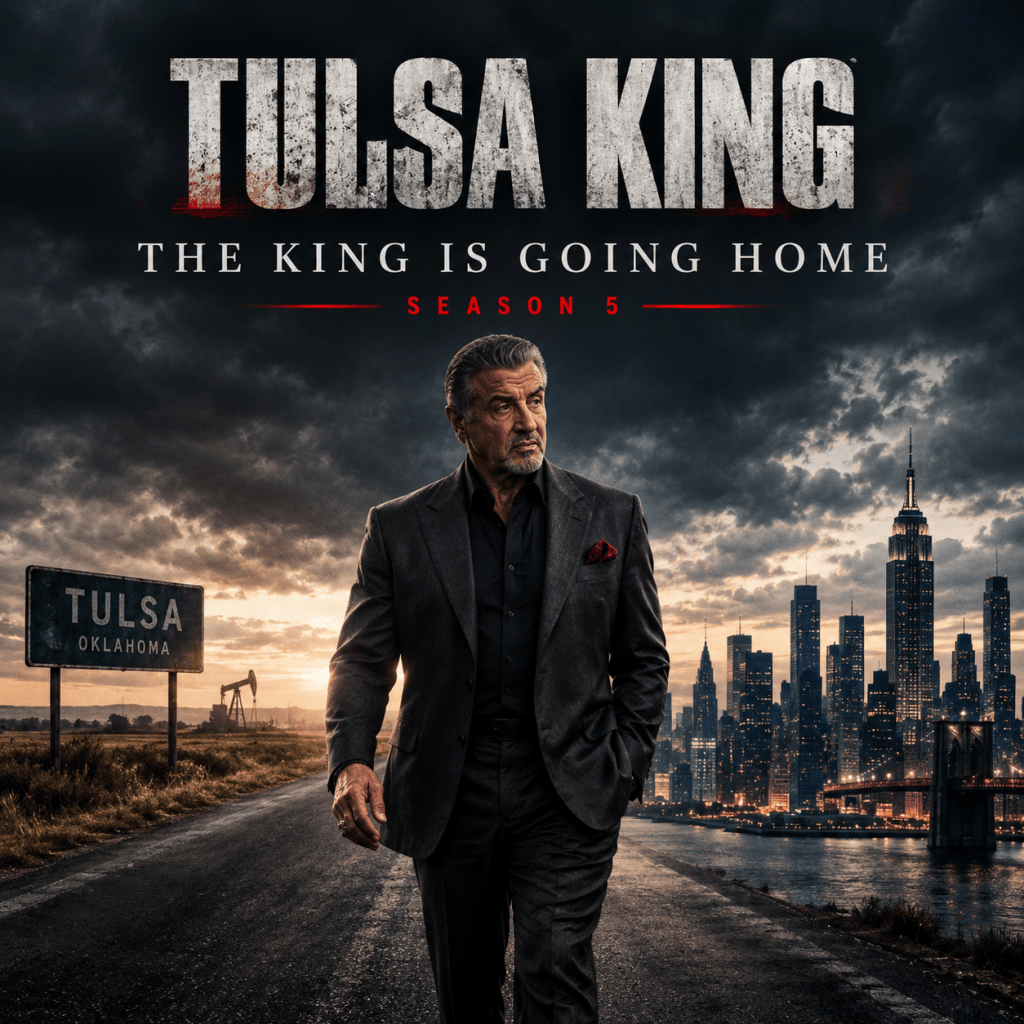
There is a certain irony embedded in the title Tulsa King. The series began with a man who had lost his kingdom, arrived in a city that was never supposed to become his home, and slowly transformed exile into an opportunity. Dwight “The General” Manfredi was not sent to Tulsa because anyone believed he could flourish there. He was sent because New York had moved on without him. After spending 25 years in federal prison, Dwight emerged into a criminal world that no longer regarded him as indispensable, and his former associates effectively pushed him toward the geographic margins of the American underworld. Tulsa represented punishment, irrelevance and displacement. Yet the central joke of the series quickly became the foundation of its dramatic identity: the man who was supposed to disappear became more powerful than anyone anticipated. Now, with Paramount+ renewing Tulsa King for a fifth season and production moving to New York, the series is preparing to reverse the premise that made it distinctive in the first place. Dwight is going home. That does not simply represent a change in scenery. It represents a fundamental shift in the mythology of the character, the structure of the series and the larger ambitions of the television universe surrounding him. Season 5 will return Dwight to the environment that originally defined him, placing an aging New York mobster back inside the culture, institutions and criminal hierarchies that shaped his identity before Oklahoma forced him to reinvent himself. Paramount+ announced the renewal on October 5, ahead of the October 16 premiere of Season 4, while also confirming that production has moved from Atlanta to New York and that Erik Palladino, Glenn Fleshler, Anthony Skordi and Nickola Shreli are joining the ensemble. Scarlet Rose Stallone, who plays Spencer, has also been promoted to series regular.The significance of the New York move becomes clearer when the history of Tulsa King is considered. The series was never really about Oklahoma in the conventional sense. Tulsa was a narrative device, a pressure chamber designed to remove Dwight from everything familiar and force him to confront a society he did not understand. Taylor Sheridan and Terence Winter deliberately constructed the premise around displacement. Winter explained when the series launched that the challenge of another mob drama was finding a fresh way into a genre saturated with New York and New Jersey stories.The original concept had been set in Kansas City, but Winter believed Tulsa offered something more surprising because the city had comparatively little association with the Italian-American Mafia.
The point was not merely to make a fish-out-of-water comedy. The geographical separation allowed the writers to examine what happens when an old criminal worldview collides with an entirely different American culture. Dwight arrived believing that respect came from reputation, intimidation and tradition. Tulsa taught him that power could also come through entrepreneurship, relationships, adaptability and an ability to understand people outside his own tribe.That transformation became the engine of the series. Dwight’s most interesting quality has never been his ability to threaten people. Crime television has produced countless characters capable of violence. What makes Dwight compelling is his capacity to negotiate between worlds. He possesses the instincts of an old-school gangster but increasingly operates like an entrepreneur. He understands loyalty as something personal while simultaneously treating business as an ecosystem. He can be brutal and sentimental within the same conversation. He is capable of extortion, murder and intimidation, yet he also develops genuine affection for people who initially have nothing to do with his criminal life. Tulsa gave those contradictions room to breathe. The city became more than a backdrop; it became the environment in which Dwight discovered that the identity he had spent decades cultivating was incomplete. That makes the return to New York potentially explosive because Season 5 will force him to bring everything he learned in Oklahoma back into the world that created him.The move therefore should not be interpreted as the series abandoning Tulsa so much as completing a circle. Dwight’s exile was originally supposed to be permanent in every meaningful sense. New York had decided that he belonged to the past. Tulsa gave him the opportunity to build something new because no one there knew what he was supposed to be. By the time the series reaches its fifth season, however, Dwight is no longer simply a New York gangster living in Oklahoma. He has become an individual with a power base, a reputation and a business empire of his own. The man returning to New York will not be the same man who left it. That distinction could become the central dramatic question of Season 5: can Dwight return to the old world without becoming the old Dwight?That question matters because Tulsa King has always played with the tension between reinvention and nostalgia. Sylvester Stallone is perhaps uniquely suited to that tension. His entire screen career has been built around characters who refuse to surrender their identities to time. Rocky Balboa, John Rambo and now Dwight Manfredi are variations on the same cultural archetype: men who belong to an earlier era but continue to insist upon their relevance in a world that has changed around them. Stallone’s age is not something the series needs to conceal. It is one of its greatest dramatic assets. Dwight looks like a man who has survived multiple versions of America. He carries the physical presence of the classic gangster while confronting a contemporary culture filled with technologies, social attitudes and economic systems that have evolved during his absence. His comedy often comes from that collision, but the comedy conceals something more melancholy. Dwight is constantly negotiating with time.At 80, Stallone has also become an unusually powerful bridge between Hollywood’s past and the contemporary streaming era.
His career stretches across decades of American popular culture, from Rocky and Rambo to The Expendables and now television’s increasingly franchise-driven environment. His involvement gives Tulsa King a recognizable movie-star center in a streaming landscape that often relies on ensemble casts and serialized intellectual property. The series was not merely another Taylor Sheridan production when it launched. It was an experiment in taking a major theatrical star and building an ongoing television franchise around him. That experiment worked. Paramount+ has repeatedly cited the series as one of its major performers, and its commercial trajectory helps explain why the company is willing to send Dwight into a new phase rather than allow the character to conclude after a conventional television run.The numbers provide important context. Tulsa King became one of Paramount+’s defining originals remarkably quickly. Paramount said in 2024 that the series ranked among its most-watched shows, while the Season 2 premiere generated 5.4 million global active subscriber households in its first seven days and approximately two million global viewers on premiere day, establishing a new Paramount+ premiere-day record at the time. The company’s subsequent reporting said Season 2 reached 21.1 million global streaming viewers for its premiere episode and generated 159 million views alongside 6.1 million social engagements. Paramount also identified Tulsa King as the number-one global Paramount+ original series of 2024 and said the show ranked among the top ten original series across subscription video-on-demand platforms during the fourth quarter. Those figures explain why Season 5 is more than a routine renewal. The show has become one of the properties through which Paramount+ can demonstrate that its original programming can create sustained audience behavior around a character and franchise rather than merely generate temporary attention around a single season.That commercial performance also places Tulsa King in a fascinating position inside Taylor Sheridan’s broader television empire. Sheridan’s shows have become a recognizable ecosystem on Paramount+, with Yellowstone, 1883, 1923, Mayor of Kingstown, Special Ops: Lioness, Landman and Tulsa King representing different variations on his preferred themes: power, loyalty, masculinity, institutional corruption, economic struggle, violence, family and American identity. But Tulsa King occupies a distinct corner of that universe.
It is less interested in ranch mythology than Yellowstone, less militarized than Lioness, and more deliberately comic than many of Sheridan’s dramas. Its premise is inherently absurd in a way that the series understands and exploits. An elderly New York gangster landing in Oklahoma and attempting to build a criminal empire from scratch sounds like the setup for a broad comedy, yet Sheridan and Winter use the absurdity to explore serious questions about aging, displacement and American reinvention.Season 5 potentially takes that experiment into its most interesting phase. Oklahoma represented Dwight’s education. New York represents his examination.The first several seasons asked whether a New York gangster could survive outside his natural habitat. The fifth season can ask whether he can return to that habitat without losing everything he gained by leaving it. The distinction is crucial because Dwight has changed. His relationship with his crew has changed. His understanding of business has changed. His connection to his family has changed. His relationship with violence has changed. Most importantly, his understanding of himself has changed. He no longer needs New York to tell him that he is important. He has demonstrated his importance elsewhere.That could make the New York setting far more dangerous than Tulsa ever was. In Tulsa, Dwight could create his own rules because he was operating on relatively open terrain. In New York, he will be stepping back into a dense network of established relationships and institutional memory. People know who he is. People know where he came from. People know the mistakes he made. They know the people who betrayed him. They know the hierarchy he once served. They may also know that he has spent years building something outside their control. In other words, New York is not simply home. New York is unfinished business.The symbolism of that return is particularly strong because Dwight’s original exile was a rejection of his identity by the very people who created it.
He spent decades inside an organization only to discover that the organization could discard him once he had served his purpose. That experience informs nearly every decision he makes in Tulsa. His obsession with building his own empire is partially financial but also deeply psychological. Dwight does not simply want money. He wants autonomy. He wants to create a structure that cannot remove him as easily as his old organization did. The criminal empire he builds becomes a declaration of independence. Returning to New York therefore creates a confrontation between two models of power: the inherited authority of the old Mafia and the entrepreneurial authority Dwight developed in Tulsa.That conflict could also deepen the show’s generational themes. Dwight represents an older criminal tradition built around personal loyalty, physical presence and face-to-face intimidation. The newer world is more corporate, technologically connected and financially sophisticated. The series has repeatedly used Dwight’s discomfort with contemporary life for comic effect, but his return to New York may turn that discomfort into something more consequential. He will have to determine whether the old rules still work. More importantly, he will have to decide which parts of those rules deserve to survive.The Season 5 casting announcement reinforces the idea that the series is entering a new chapter rather than simply continuing the same formula. Erik Palladino, Glenn Fleshler, Anthony Skordi and Nickola Shreli have joined the main cast, while Scarlet Rose Stallone has been elevated to series regular. Paramount and trade reports have not yet disclosed the complete shape of the returning ensemble, meaning the status of several characters associated with Dwight’s Tulsa operation remains less certain. That uncertainty may ultimately be important. A return to New York should create consequences for the people Dwight has accumulated around himself. If everyone simply follows him from Tulsa to Manhattan, the relocation risks becoming cosmetic.If the move forces Dwight to leave certain relationships behind while establishing new ones, the setting change can actually reshape the narrative.Scarlet Rose Stallone’s promotion is particularly interesting because it gives the series another avenue into the question of legacy. Spencer has existed at the intersection of Dwight’s criminal life and his family life, and elevating the character to series regular status potentially allows Season 5 to examine what Dwight’s influence means for the next generation. Tulsa King has always been fascinated with succession even when it has not explicitly called itself a succession drama. Dwight is an aging king. Every empire eventually requires someone to inherit it, challenge it or dismantle it. The presence of his daughter within the central ensemble creates an opportunity to explore whether Dwight can build something that survives him without turning the people he loves into extensions of his criminal identity.The show’s relocation also has a practical Hollywood dimension that should not be ignored. The first four seasons were primarily filmed in Atlanta, while Season 5 moves production to New York. Trade reports note that the relocation coincides with the storyline’s return to Dwight’s mafia roots and also takes advantage of New York’s production incentives. Paramount has simultaneously emphasized its appreciation for Georgia as an important production location, underscoring the fact that the decision is not simply a rejection of Atlanta. The distinction matters because modern television production is increasingly shaped by economic geography.
A show may be set in one city, filmed in another and financially structured around a third. In this case, however, the production move has unusually strong narrative value because the actual geography of New York can become part of the show’s texture.For a series about an old-school gangster, New York offers an enormous reservoir of cinematic associations. The city carries decades of American crime-film mythology. Its streets have been transformed into shorthand for organized crime through generations of movies and television programs, from The Godfather to Goodfellas, The Sopranos and countless lesser-known crime dramas. Tulsa King deliberately avoided that mythology during its early seasons. Dwight’s absence from New York was part of what made the premise fresh. Now the series can return to that visual language with a character who has experienced something outside it. The result could be a fascinating collision between familiar gangster iconography and a protagonist who no longer fits comfortably inside it.That may also allow Stallone to play Dwight with greater dramatic weight. In Tulsa, the character frequently functioned as an outsider who could be funny because he did not understand the environment. In New York, the joke disappears. He understands the environment too well. Every street, restaurant, neighborhood and relationship can carry history. The character cannot dismiss his surroundings as foreign. He is returning to the place that made him. That creates a different performance challenge for Stallone.The character’s confidence may become more complicated because he is no longer proving himself to strangers. He is confronting people who remember him before he became the man viewers know.The fourth season arriving before this transformation makes the timing especially strategic. Paramount+ has positioned Season 4 as a higher-stakes chapter in which Dwight attempts to legitimize his empire while confronting political corruption, dangerous enemies and personal loss. The official promotional material describes the season as a period in which Dwight’s hard-won gains are threatened and his leadership is tested. The season premieres October 16, meaning audiences will enter the fourth season knowing that the story already has another destination waiting on the other side. That knowledge changes the way viewers may interpret Season 4. The season can function not merely as another installment but as the final stage of Dwight’s Tulsa era, the point at which the empire he built reaches a level of complexity that makes his eventual return to New York possible.This creates an unusual storytelling advantage. Most television series announce renewals without revealing a fundamental geographical transformation. Tulsa King has essentially announced that its fifth season will change the show’s identity before viewers have even watched Season 4. That creates anticipation but also establishes a creative obligation. The writers cannot simply transplant the existing formula to New York. They need to explain why Dwight leaves Tulsa, why he returns to New York and what he hopes to accomplish there.
The relocation needs to feel inevitable in retrospect. Otherwise, the move risks looking like a marketing gimmick rather than the next logical chapter in the character’s story.The best version of Season 5 would therefore treat New York not as a replacement for Tulsa but as a mirror of it. Tulsa showed Dwight who he could become. New York can show him who he was. The tension between those identities is where the richest material lies. He can walk through familiar neighborhoods and encounter ghosts of his former life while simultaneously recognizing that he has become someone those ghosts could not have predicted. The old Dwight believed power came from belonging to an organization. The new Dwight believes power comes from owning something of his own. The old Dwight measured loyalty through obedience. The new Dwight has learned that loyalty can be earned through mutual respect. The old Dwight thought survival required toughness. The new Dwight has discovered that survival also requires adaptation.This is ultimately why the Season 5 renewal matters beyond the immediate question of whether fans will get another ten or more episodes of Stallone’s mobster. Tulsa King has reached a point where the premise has begun to outgrow its original geography. The show was built around the absurdity of exile, but exile cannot remain the central conflict forever. Eventually, the exile must have consequences. Dwight has spent enough time in Tulsa to establish roots, build relationships and develop an identity independent of New York. Returning him to his old world creates a new dramatic equation: he is no longer the man trying to find his place. He is the man deciding whether he still wants the place he once lost.There is also a broader industrial story unfolding here. Paramount+ needs franchises that can sustain attention across multiple years, generate recognizable characters and support expansion into adjacent projects. Tulsa King has already demonstrated that capability. The existence of Frisco King, the upcoming Samuel L. Jackson-led spinoff, indicates that Paramount and Sheridan’s production ecosystem see these crime stories as potentially interconnected properties rather than isolated shows. Tulsa King therefore sits inside a larger strategy in which recognizable actors, recurring themes and overlapping creative talent can create an identifiable television brand.The challenge will be maintaining quality while expanding the universe. A franchise can grow its audience through familiarity, but familiarity can also produce creative exhaustion if every new chapter simply reproduces the previous one.The move to New York offers a solution to that problem. Instead of giving Dwight another enemy in another Oklahoma business dispute, the series can fundamentally change his social and cultural environment. New characters can emerge organically from that environment. Old relationships can return with new complications. The Mafia can become more central without turning the series into a conventional mob drama. Dwight can confront the institutions that once rejected him while simultaneously confronting the possibility that he has become precisely the kind of person he once wanted to escape. In that sense, Season 5 can use the return home as a form of narrative pressure.There is an especially compelling contradiction at the heart of Dwight’s story: he spent his life wanting respect, only to discover that respect inside the Mafia could disappear the moment he became inconvenient.
In Tulsa, he found something different. People did not initially respect him because of his name. He had to earn their attention. That distinction matters. The power Dwight accumulated in Oklahoma has a different emotional foundation from the power he possessed in New York. His return could therefore become an experiment in whether earned authority can defeat inherited authority.The answer will depend partly on how the series handles Dwight’s relationships. Martin Starr’s Bodhi, Jay Will’s Tyson, Garrett Hedlund’s Mitch, Annabella Sciorra’s Joanne and other recurring figures have become important pieces of the emotional architecture surrounding Dwight. Their stories have helped prevent Tulsa King from becoming solely a Stallone showcase. They represent different aspects of the life Dwight created after exile. Any major shift away from them carries emotional consequences. Paramount has not yet provided a complete picture of which existing characters will remain central in Season 5, so it would be premature to assume exactly how much of the Tulsa ensemble will travel with Dwight. That uncertainty, however, makes the coming transition more intriguing rather than less.There is also the question of whether New York can preserve the strange tonal balance that made Tulsa King successful. The series has never been pure gangster drama. It is part crime saga, part character comedy, part fish-out-of-water story and part aging-star vehicle. Tulsa allowed the writers to play those elements against one another because the environment itself was inherently unexpected. New York removes the fish-out-of-water element. The challenge will be finding a new source of contrast. The obvious answer is to make Dwight himself the contrast. He can be physically back where he belongs while emotionally remaining a product of the years he spent away. New York can become the unfamiliar place precisely because Dwight is no longer the same person who once lived there.That approach would also fit the show’s broader fascination with American identity. Dwight’s story has never really been about organized crime alone. It is about a man encountering different versions of America and trying to understand how power operates within each. Tulsa represented a changing American landscape where traditional institutions coexist with entrepreneurship, technology and new forms of social mobility. New York represents the dense historical infrastructure from which Dwight emerged. Moving between those worlds makes him a kind of cultural intermediary. He understands the old America because he came from it, but he has learned enough about the new America to survive within it. That tension could become one of the show’s most distinctive themes as it enters its fifth season.The renewal also reinforces the extraordinary staying power of Sheridan’s television model. Few contemporary creators have managed to build such a recognizable collection of shows across one platform. Sheridan’s projects often revolve around characters who occupy spaces between institutions: ranchers versus corporations, soldiers versus bureaucracies, criminals versus legitimate businesses, old money versus new money, individuals versus systems. Tulsa King fits that philosophy almost perfectly. Dwight is a man permanently positioned between worlds. He is criminal and businessman, father and gangster, outsider and insider, relic and entrepreneur. The New York move does not erase those contradictions. It intensifies them.For Stallone, the series represents something equally significant: a late-career role that does not simply ask him to repeat his movie-star persona but allows that persona to become part of the character’s meaning. Dwight is charismatic because Stallone is charismatic. Dwight is physically imposing because Stallone carries decades of cultural associations with toughness. Dwight’s age matters because the actor’s age matters. Rather than treating those facts as obstacles, the series turns them into narrative material. Stallone’s presence gives Dwight the authority of someone who has already lived several cinematic lifetimes, and Season 5 can use that authority to ask what happens when a legendary figure returns to the place where his legend began.That makes the renewal more than a vote of confidence in a successful streaming show. It is a vote of confidence in the idea that audiences will continue following a character through substantial changes rather than demanding that a successful series freeze itself in place.
The safest decision would have been to keep Dwight in Tulsa indefinitely, introduce another rival, create another business conflict and preserve the basic formula. Paramount has instead authorized a significant change in geography and cast. The company is betting that viewers are invested in Dwight himself, not merely the location surrounding him.That is the most important test Season 5 will face. If Tulsa King works in New York, the series will prove that its true franchise asset is not Tulsa, Oklahoma, but Dwight Manfredi. If it does not, the experiment will reveal how dependent the show’s identity was on the unlikely contrast between an old-school gangster and an unexpected American city.Either outcome will tell audiences something important about the series. Yet the opportunity is substantial because the return to New York creates a rare possibility in long-running television: a protagonist can come home without actually returning to where he started.Dwight left New York as an obsolete man. He returns as a king. That single distinction contains the dramatic premise of Season 5. He was once sent away because the people above him believed his usefulness had expired. Now he has spent years constructing an empire of his own, developing relationships that do not depend upon the old Mafia hierarchy and proving that he can survive outside the world that once defined him. When he steps back into New York, everyone who underestimated him will have to confront the consequences of that mistake. But Dwight will face a different problem. He will have to determine whether defeating the people who rejected him actually means reclaiming his old world or finally proving that he no longer needs it.That is where Tulsa King has the potential to become more than a stylish crime series built around one of America’s most recognizable movie stars. The show’s central question has always been deceptively simple: what happens when a man is forced to start over? Season 5 turns that question around. What happens when the man who successfully started over is given the opportunity to return to the life he left behind? The answer cannot simply be another empire-building exercise. Dwight has already built an empire.
The next chapter needs to examine what that empire means, what it costs and whether the king can survive without becoming a prisoner of the kingdom.For a series built around exile, there may be no more appropriate development than a return home. But home, in Tulsa King, has never been a physical location. Home is the identity Dwight has spent the series trying to construct. Tulsa gave him the space to become someone different. New York will test whether that transformation was real. The fifth season therefore arrives with an unusually rich dramatic premise: a gangster returning to the city that made him, carrying the lessons of the city that remade him. If the series can preserve its humor, deepen its character work and use New York as more than a backdrop, the relocation could become the creative reset Tulsa King needs at exactly the moment its commercial success gives it the freedom to take a larger swing.And that is ultimately what makes today’s renewal significant. Paramount+ is not merely ordering another season. It is changing the question at the center of the show. For four seasons, the question has essentially been whether Dwight Manfredi can build a kingdom somewhere he was never supposed to belong. Season 5 asks something considerably more complicated: whether a man who has built his own kingdom can return to the place that once rejected him and remain his own man. The answer will determine not only the future of Dwight’s story but potentially the future shape of one of Paramount+’s most durable original franchises. The king is going home. The real question is whether New York still belongs to him.PoliticsEntertainmentSPORTSCOLUMNSLVBGMagazineHurrah


Leave a comment