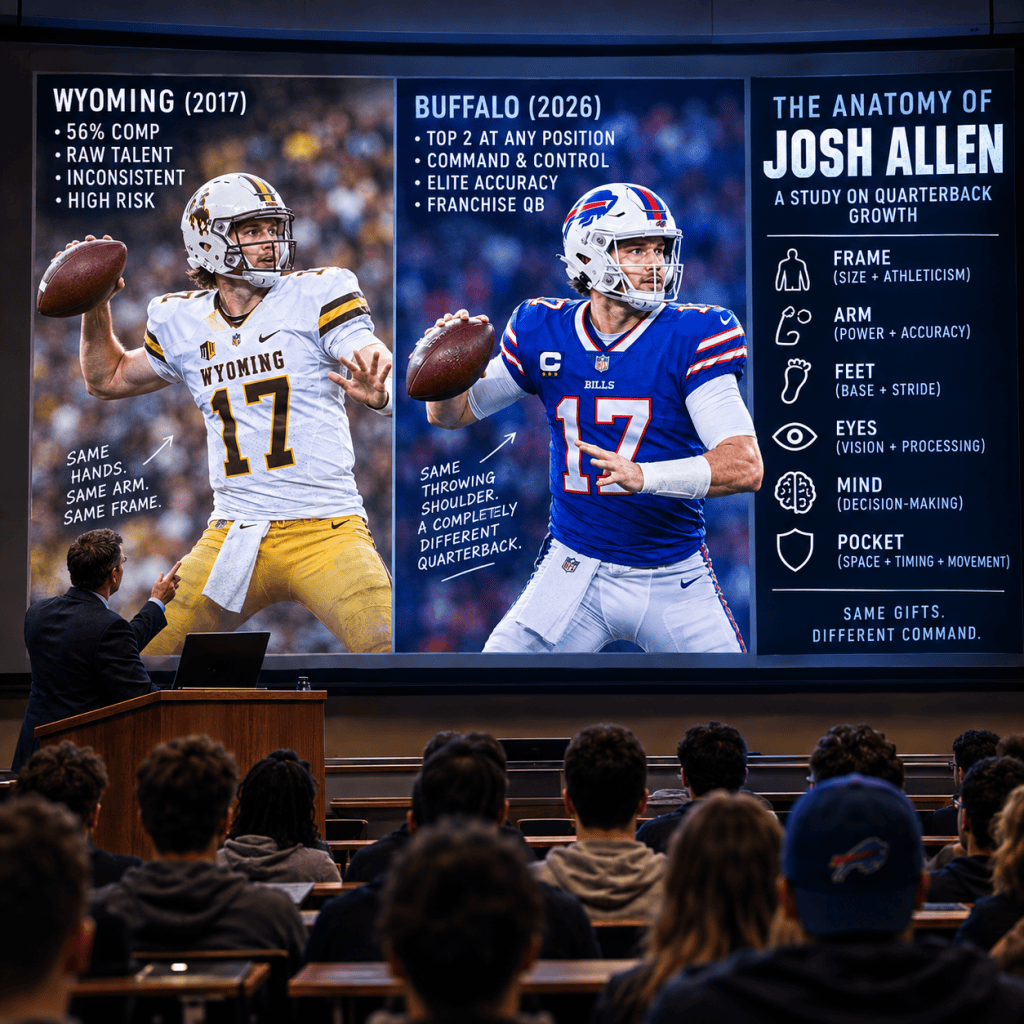
Picture a lecture hall, a projector, and two clips loaded side by side. On the left screen: a young passer from Wyoming, a program far from the sport’s bright lights, throwing rockets that sail off target as often as they find a receiver’s chest. On the right screen: a Buffalo franchise passer in September 2026, ranked by the league among the two best players at any position, orchestrating an offense with a command that looks nothing like the raw, chaotic tape from six years earlier. Same jersey number. Same hands. Same throwing shoulder. And yet the two men on screen barely resemble one another in behavior, even though every measurable trait — the height, the arm strength, the sprinter’s stride — stayed constant the whole way through.
That contrast is the subject of this lecture: not a highlight reel, not a résumé of achievements, but a study of transformation. Josh Allen did not become a better quarterback because a coach discovered a hidden gift. Every gift he owns today, he owned coming out of college. What changed was organization — the capacity to summon those gifts on command rather than by accident. This lecture works through the anatomy piece by piece: frame, arm, feet, eyes, mind, and the pocket that binds every part together, before landing on what a modern scouting department would say about him now that the projection has become documented history.
When evaluators studied Allen before the 2018 draft, they were not debating whether raw talent existed. They were debating whether raw talent, absent a longer track record of production, could be trusted to convert into career-grade output. Wyoming did not offer him a marquee opponent every Saturday, and his career completion mark hovered around fifty-six percent — a number that, taken alone, would sink most draft grades. Analysts pointed to shaky footwork under duress and pressed the question of whether he could hold up against defenses built to erase exactly the kind of freelancing that had bailed him out in college.
But strip away the surface number and a scout finds a body that looked engineered for the position: roughly six foot five, near two hundred forty pounds, a combine that produced a thirty-five-inch upward leap and a broad jump stretching past nine feet. Numbers like those describe an athlete, not merely a passer, and that duality is where the difficulty of grading him began. A committee has an easier task when a prospect’s tape and measurables tell the same story. Allen’s tape and measurables told two different stories, and reconciling them required scouts to separate two questions that sound similar but are not: what can a body do, and what does a player consistently do right now? His capacity for greatness was obvious to anyone who watched him throw sixty yards flat-footed. His week-to-week output was uneven, streaky, occasionally careless. That gap between capacity and output is the entire draft debate compressed into one sentence, and no amount of measurable athleticism could close that gap.
A lecture on quarterback anatomy properly begins with the body, because the body sets the outer boundary of what movement is even available. A passer built along standard lines — trim, compact, built for a tight pocket — plays a different geometric game than a passer built like Allen, whose size gives him a builder’s toolkit most peers never touch. A defender closing on Allen is not simply closing on a thrower. The defender is closing on someone who can absorb a hit, keep his feet, accelerate through contact, and continue a play that should have ended the moment the rush arrived. That single fact reorders how a defensive coordinator has to script pressure, because standard geometry — angles that work against an average-sized quarterback — collapses against a passer who shrugs off first contact.
Size alone does not guarantee vision downfield, but a tall passer who carries disciplined posture through a drop can see throwing windows that shorter passers never glimpse. Size does, however, create a coordination problem that smaller athletes rarely face. A frame that large cannot rely on arm strength as a shortcut around footwork, because a body that big needs the lower half to organize the mass above the frame. Hips must rotate on schedule. Shoulders must stay linked to the base beneath them. A stride has to match the throw being demanded, and — this is the key piece — the eyes must be able to move independently from the legs, tracking coverage while the feet are still busy solving a separate problem. Learning to separate vision from footwork so that neither interrupts the other became one of the quiet, unglamorous engines behind Allen’s growth.
The easiest trait to describe in Allen’s game is also the trait most responsible for muddying his early evaluation: the arm. Few passers in league history can generate the velocity he produces from a poor base, a rushed platform, or a body twisted sideways mid-scramble. He can drive a ball forty yards with his weight moving backward. He can throw across his frame and still put mustard on the pass. That gift is undeniably an asset, yet the same gift also functions as a trap, because an arm that strong rescues footwork that would sink an ordinary passer.
Consider two throwers who both plant a foot wrong on a given down. An ordinary arm punishes the mistake instantly — a weak, wobbling pass that a coach can point to on film without argument. Allen’s arm often erases that immediate cue. A poor base can still produce a missile. A compromised platform can still find a receiver forty yards downfield. The lesson gets buried, because the outcome looks fine even though the process was flawed. Growth for a passer like this cannot mean dulling the arm or coaching away the aggression that makes him dangerous. Growth has to mean teaching him precisely when the extraordinary throw is worth the risk and when the boring, structurally sound throw serves the offense better. That lesson — knowing the difference between what a body can do and what a down actually calls for — sits near the center of everything else covered in this lecture.
If the arm is the flashiest trait, footwork is the unglamorous foundation that determines whether the flashy trait shows up on schedule. Pre-draft assessments repeatedly flagged Allen’s base as unsettled — a tendency to overstride by many inches, sending throws sailing high, followed by a compensating understride that dragged throws low and behind the target. A viewer might assume footwork is a minor mechanics-based wrinkle compared to arm strength, but the opposite is closer to the truth. Throwing power does not begin in the shoulder. Force begins at the ground, travels up through the legs, transfers through the hips, rotates through the torso, and only then reaches the arm for delivery. When that chain fires in sequence, a passer throws efficiently, without wasted motion or unnecessary strain. When the chain breaks — when the base is off by even a few inches — the arm has to compensate for work the rest of the body should have shared, and over the course of a sixteen- or seventeen-game season, that kind of compensation adds up in missed throws and, eventually, in wear on the body doing the compensating.
Allen’s transformation on this front was never about reinventing his throwing style from scratch. Coaches were not trying to build a different quarterback. They were trying to get the quarterback already present to cooperate with his own lower half — narrowing the gap between his overstride and understride, teaching his feet to reset quickly after he moved off a spot, and building the habit of syncing drop, gather, base, and stride into one connected motion rather than four separate events strung loosely together.
Move now from the feet to the eyes, because a lecture on quarterback growth eventually has to reach the sense organ that decides where the feet even go. A passer facing pressure has to answer two questions in the same instant: where is the rusher, and where is the open man? Inexperienced quarterbacks let the rusher hijack their focus — eyes drop to the pass-rush, and the coverage picture vanishes the moment focus shifts away. A seasoned quarterback keeps that coverage picture intact even while his side awareness tracks the encroaching threat, which is a much harder cognitive skill than the phrase suggests.
This distinction helps explain why completion percentage is a misleading shorthand for describing Allen’s growth. Accuracy did not improve because of one isolated fix. Accuracy improved because many linked systems improved together. Better footwork produced a more stable platform. A more stable platform bought an extra half-second of time. That extra time allowed better recognition of coverage. Better recognition produced sharper decisions. Sharper decisions cut down on desperate, low-percentage throws. Each improvement fed the next, in a loop that reinforced across repetition after repetition, across seasons rather than weeks. Quarterback growth, described honestly, almost never resembles a straight line on a graph. Quarterback growth resembles a network of habits improving in concert.
No study of Allen’s evolution can skip the mind, because his bodily gifts, left unchecked, actively encourage risk. A body that strong invites aggression. Athleticism this rare invites improvisation. Those instincts can produce highlight-reel plays that no coaching staff could ever draw up on a whiteboard, and they can just as easily produce turnovers that a coaching staff spends the following week trying to erase from memory. The heart of quarterback maturity, at the highest career-grade level, is learning to separate what a body is capable of from what a given down actually requires — the gap between possibility and probability.
Allen can attempt nearly any throw a football field allows. That does not mean every throw available to him is the right choice on third down with a game hanging in the balance, since capacity and correctness are separate questions. At the speed the career-grade game moves, a passer has only a sliver of a second to judge whether a window is genuinely open or merely tempting. Growth here did not mean suppressing Allen’s competitive instinct — an instinct that, by every account, defines him as a leader and a closer. Growth meant sharpening his judgment so the instinct could be trusted more often than second-guessed. He did not become a passive, conservative decision-maker over time. He became a more selective one, choosing his spots for the extraordinary throw rather than reaching for such a throw out of habit.
Aggression, properly understood, is not a flaw to coach out of a competitor like Allen — aggression is a resource, one that has to be spent wisely rather than hoarded or squandered. Some quarterbacks manage risk by avoiding difficult throws altogether, playing a conservative brand of football that minimizes turnovers at the cost of explosive production. Allen manages risk differently, leaning on his own bodily capacity to make throws that would be foolish for a passer without his gifts. He might attempt an angle a lesser thrower would rule out entirely. He might hold the ball a beat longer than textbook teaching recommends because experience tells him his legs can buy the extra half-second. He might challenge a cornerback through a window most passers would concede, trusting velocity to beat a closing defender to the spot.
None of that can be judged as simply good or bad in isolation, because every decision lives inside a larger context — down, distance, score, clock, field position, coverage shell, pressure package, and the separation a receiver has actually earned. The best version of Allen treats aggression as a resource to spend deliberately rather than a reflex fired on every snap, and that distinction — calculated boldness rather than constant impulse — separates the mature version of this quarterback from the electric but occasionally reckless prospect scouts debated back in 2018.
A complete anatomy of Allen has to reach beyond the passing game, because he functions as a rushing weapon in a way that changes defensive math even on downs where he never carries the ball. A coordinator facing this offense has to account for a passer who can turn a broken play, a designed keeper, or a simple scramble into meaningful yardage, and that threat alone forces defenders to hedge. A defensive end crashing too hard on the run can open an escape lane on the very next snap. A linebacker sinking too deep in coverage can surrender a rushing gain he never saw develop. A safety overreacting to the run threat can hand a receiver behind him a throwing window that would not exist against a stationary passer.
The 2025 season underscored just how genuine that dimension remains: Allen produced nearly six hundred rushing yards and fourteen rushing touchdowns across the regular season, numbers that belong to a genuine complementary rushing weapon rather than a now-and-then scrambler padding his stat line. That output is not a footnote tucked beneath his passing numbers. Such production is a load-bearing part of why defenses cannot simply drop eight defenders into coverage and dare him to run — because when he runs, he wins that bet often enough to make the whole defensive plan collapse.
Now the lecture reaches the true center of the study: the pocket. Pocket presence is routinely misdescribed as simply standing still inside a collapsing structure, absorbing whatever punishment arrives. That definition is too blunt for what actually separates good quarterbacks from great ones. Pocket presence is a relationship — between space, timing, vision, and movement — and mastering that relationship requires a passer to understand where pressure originates, which defenders can genuinely reach him, and the difference between a pocket that is truly collapsing and one that merely feels uncomfortable for a beat.
That last distinction is where careers are separated. Young quarterbacks react to pressure the instant pressure arrives. Seasoned quarterbacks anticipate pressure well before the rush fully closes. The best quarterbacks manipulate pressure, subtly influencing where a rusher aims his pursuit without ever abandoning their own throwing structure. Picture a rusher bearing down from the right edge. A green passer bolts left immediately, giving up the play before the design has a chance to develop. A more experienced passer slides two steps, buying a beat without sacrificing his readiness to throw. A truly refined passer barely moves at all — a single step, a subtle shoulder turn, just enough to redirect the rusher’s angle — while never losing sight of his coverage read, delivering the ball before the rush ever fully closes. The bodily movement across those three versions might look nearly the same to a quick viewer. The cognitive gap between them is enormous, and Allen’s career traces a path directly through those three stages, moving from reaction toward manipulation across seasons of career-grade repetition.
A lecture on pocket craft needs a working scale, not just a mood board, so consider a three-level grading system a film room could actually apply down after down. Tier one is escape: a rusher approaches, and the passer simply runs. Every mobile prospect owns this tier already; Allen carried this skill into the league from Wyoming, and no coach ever had to teach a passer this athletic how to flee danger. Tier two is the slide: a rusher threatens, and rather than abandoning the down, the passer takes a couple of steps sideways while staying a genuine thrower, buying a beat without conceding the play. Tier three is manipulation: the passer senses the rush, nudges the defender’s aiming point through a subtle shift of weight or shoulder, keeps his throwing posture intact, and continues reading coverage the whole way through. Tier three is the rare, sought-after skill, and Allen’s career shows a passer sliding steadily from tier one toward tiers two and three across seasons of repetition.
Think of the difference across a career timeline in terms of the sentence a passer would say to himself mid-down. Early Allen thinks, in effect, danger has arrived, so leave. Growing Allen thinks, danger has arrived, so shift. Mature Allen thinks, danger has arrived, so shift exactly enough to open the throwing lane and nothing more. Same sensation of pressure, three completely different responses, and the gap among those responses is the whole story of pocket maturity compressed into a single word choice.
Sizing up why footwork carries such weight for a passer this large adds another dimension worth teaching directly. A shorter passer can shift his weight two inches and completely change a throwing lane. Allen carries a body many degrees larger, so relocating that mass demands proportionally more coordination, which means a shuffle that looks small on tape can represent a genuinely meaningful shift in space underneath the surface. His athletic gift lets him move the whole frame while keeping the throwing motion intact behind him, which explains why his throws delivered mid-movement carry so much danger for a defense — few bodies that size can hold a stable delivery while covering that much ground.
A useful teaching method for a film-room setting reverses the habit most fans bring to a broadcast: rather than tracking the ball, a student should track the feet first. Four checkpoints matter most. First, the drop — does depth arrive quickly and cleanly off the snap? Second, base width — do the feet stay roughly beneath the shoulders, or do they spread beyond a workable frame? Third, the pressure reaction — does a slide-and-reset pattern show up, or does a passer panic, spin away, and bail before the play demands a bailout? Fourth, and most telling of the four, the reset — once Allen shifts off a spot, can his feet climb back underneath his hips before he actually throws?
That fourth checkpoint separates a merely mobile passer from a passer who owns genuine command of the pocket. A body that moves without ever resetting the base underneath produces throws that look like scrambling attempts even on downs meant to stay a passing down. A body that resets cleanly after every shift produces a passer capable of using legs as a tool for buying a cleaner platform rather than as an excuse to abandon structure altogether. Coaching staffs graded Allen’s foundation as promising even coming out of college — willing to stand tall through an incoming hit, comfortable maneuvering around the pocket rather than standing frozen — while flagging the habit of leaving a clean pocket sooner than the down actually demanded. That flaw and that promise sat side by side in the same prospect, and reconciling the two became the entire growth-driven assignment Buffalo signed up for.
A lecture hall benefits from a rubric a student can carry straight into a film session, so consider six traits worth scoring on every dropback:
Pocket feel — Sensing pressure building before contact ever arrives
Sideways movement — Sliding off a spot without surrendering the down
Reset speed — Getting the base back underneath the hips after a shift
Base discipline — Holding a throwing-ready alignment through contact
Escape timing — Knowing the exact down when leaving is genuinely correct
On-the-move accuracy — Holding a throw’s precision while the whole body keeps moving
The last three traits on that list are where Allen separates from ordinary mobile passers around the league. Standing him up is difficult enough on this measure alone, but forcing him into a compromised, mechanics-broken throw is a taller order still, because his combination of size, balance, arm strength, and body control lets him keep functioning even after a pocket begins folding around him.
One comparison scouts leaned on before the draft is worth revisiting here: an assessment linking Allen’s pressure tolerance to Ben Roethlisberger, a passer famous for shrugging off contact rather than surrendering a down the moment a defender got a hand on him. The comparison never claimed Allen moves the way Roethlisberger moved. The comparison pointed at something narrower and more useful for a scouting rubric — a passer able to absorb the physicality of a crowded pocket without immediately losing the down to the defense, which is a blend of balance, sense of space, body command, anticipation, and sheer toughness working together rather than any single measurable trait working alone.
No study of Allen’s pocket craft can skip past a stubborn mechanics-based habit that survives to this day in some form: throwing off the back foot, especially once he drifts outside a clean pocket. Scouting assessments flagged this tendency directly before the draft, warning that accuracy suffered whenever he failed to step properly into a throw. The reason this habit proves so hard to fully coach away traces back to the same trap covered earlier in this lecture — his arm makes the mistake survivable in a way that would sink a passer with ordinary velocity.
Picture two passers who both throw from a poor base off the back foot. One produces a weak, sailing pass that a coach can circle on film without a shred of argument. The other, Allen, produces a sixty-yard missile that lands in stride. The second passer gets away with a flaw the first passer cannot hide, and getting away with a flaw is not the same as correcting one. His bodily gifts occasionally mask an error in process, and a coaching staff studying this habit has to remember that a completed pass does not always mean the process behind the completion was sound — sometimes a gifted body simply outran the consequence that should have followed a broken sequence.
Rare mobility creates a strange snag in a passer’s growth: a passer who can escape does not always have to solve the pocket the hard way, and that shortcut, tempting in the moment, becomes a habit that career-grade defenses eventually punish. Why fight through traffic within a shrinking pocket when a gifted athlete can simply outrun the whole problem? Because defenders get faster every season. Contain rules sharpen. Coverage defenders learn to stay glued to a receiver a beat longer, anticipating the scramble. Rushers learn the escape lanes a mobile passer favors and shut them down deliberately.
The lesson a mobile quarterback eventually has to absorb is that movement and escape are not the same act, even though they look similar from a distance. Movement can preserve a pocket, buying a passer room to keep operating as a thrower. Escape destroys the pocket outright, converting a passing down into a scrambling down whether or not that conversion was actually necessary. Allen’s maturation runs directly through this lesson — learning to shift laterally without instantly becoming a runner, using his legs to create room for his arm rather than abandoning his arm the moment his legs found daylight.
A classic passer wants a stable platform before releasing the ball: feet aligned, hips squared, shoulders organized, weight rolling forward through the throw. Allen throws successfully from positions that violate every part of that classic picture — off his back foot, sideways, mid-escape, with a defender’s hand a few inches from his jersey. The ability, standing alone among peers, is remarkable, and the same ability is also, once again, a temptation, because comfort operating from unstable positions can quietly become a crutch rather than a now-and-then emergency tool.
Growth on this front meant learning when the unstable platform genuinely served the play and when returning to a stable base would serve the down better. The aim of any sideways movement was never movement for the sake of movement — three yards of drift accomplish nothing without a cleaner throwing lane, while three inches of adjustment can accomplish everything when the lane opens. The right questions for a film study session are simple to state and hard to answer at full speed: did the movement create a better throwing opportunity, did the route stay live, did the coverage picture stay visible, did the passer remain a genuine threat to throw rather than merely a runner who happened to be holding a football?
Pressure exposes a quarterback’s true level of development faster than any other variable, because a clean pocket flatters almost everyone. A collapsing pocket, by contrast, strips away the flattery and shows exactly what a passer has built underneath the surface. Allen’s bodily strength grants him a rare advantage under duress — absorbing contact, staying upright, escaping cleanly, throwing through a hit, and turning a busted play into positive yardage where a smaller passer would simply go down. But strength alone does not answer the harder question pressure asks, which concerns discipline rather than durability.
Sometimes the correct answer to pressure is no movement at all. Sometimes the correct answer is a short slide. Sometimes the correct answer is an immediate release before the rush fully arrives. Sometimes, honestly, escape is the correct call and holding structure would be the mistake. A seasoned passer identifies which answer a given rush demands, and the growing sophistication Allen shows here — increasing comfort remaining within structure rather than bailing at the first sign of trouble — marks one of the clearest through-lines of his career.
Statistics rarely capture growth on their own, but they do offer a useful checkpoint against which a narrative can be tested. In 2025, Allen completed just under seventy percent of his passes, threw for roughly thirty-seven hundred yards and twenty-five touchdowns, and posted a passer rating above one hundred, all while adding nearly six hundred rushing yards and fourteen rushing scores. Compare that against a college completion rate hovering around fifty-six percent, and the gap between those two versions of the same player becomes difficult to explain through a single mechanics-based fix. A jump of that size across a career requires improvement stacked across footwork, timing, pressure recognition, chemistry with receivers, route command, decision-making under duress, anticipation, and simple accumulated repetition. Growth of that scale is systemic rather than singular — not one skill sharpened in isolation, but the relationships among many skills sharpened together.
As of September 2026, the question surrounding Allen has fundamentally changed shape. In 2018, evaluators asked whether he could become a viable career-grade passer at all. That question no longer applies to a quarterback ranked among the two best players in the league heading into the season, trailing only a dominant defensive force and standing as the highest-ranked passer on that same list. The conversation has shifted from projection to refinement — no longer whether he can drive a ball sixty yards, whether he can hurt a defense with his legs, or whether his frame can withstand career-grade collisions, because years of documented evidence have already answered each of those questions. The refined questions now concern optimization: can anticipation keep sharpening year over year, can he protect his body across a long career built partly on contact, can aggression stay controlled rather than reckless, can he continue manipulating pressure before a snap even occurs, and can he win without leaning on improvisation as a crutch when the offense around him is functioning as designed.
Every thread in this lecture eventually converges on a single word, and that word is control. Control of the feet. Control of the pocket. Control of the eyes. Control of the rush. Control of aggression. Control of an entire offense operating at career-grade speed. The young passer scouts debated in 2018 possessed enormous raw power — an arm, a frame, a competitive streak, a running threat — but power without command is unpredictable, thrilling in flashes and costly in others. The mature quarterback taking the field in September 2026 possesses that same raw power alongside a far greater command over when and how the power gets deployed, and that added command, rather than any newly discovered gift, explains the distance between Wyoming and Buffalo.
The honest conclusion a scouting professor should offer a lecture hall is not that a flawed prospect became a flawless quarterback — no such player exists at this level, and framing the story that way would flatten what makes the study worthwhile. The more accurate conclusion is that a passer whose greatest strengths and greatest weaknesses were always intertwined learned, through repetition, coaching, and accumulated career-grade experience, to summon those strengths on command while managing the weaknesses that once rode alongside them. The arm that once bailed out sloppy footwork now cooperates with footwork built to support the throw. The legs that once tempted premature escapes now buy time for a pocket built to hold. The competitive fire that once produced careless throws now produces calculated ones, chosen rather than forced.
A quarterback, described honestly from a lecture podium, is never a simple checklist of isolated traits graded on a scouting sheet. He is a connected system, where a foot adjustment shapes a throw, a throw shapes defensive behavior, defensive behavior shapes pocket movement, pocket movement buys or costs time, time shapes recognition, recognition shapes a decision, and every decision compounds into outcomes that feed confidence forward into the next down. Josh Allen’s decade-long path from a raw, streaky college passer to a franchise cornerstone stands as one of the clearest working examples of that system maturing in front of an audience — proof that extraordinary bodily gifts, left undirected, produce spectacle, but extraordinary bodily gifts paired with command produce a passer capable of carrying a franchise on a genuinely sustained basis, year after year, down after down.


Leave a comment