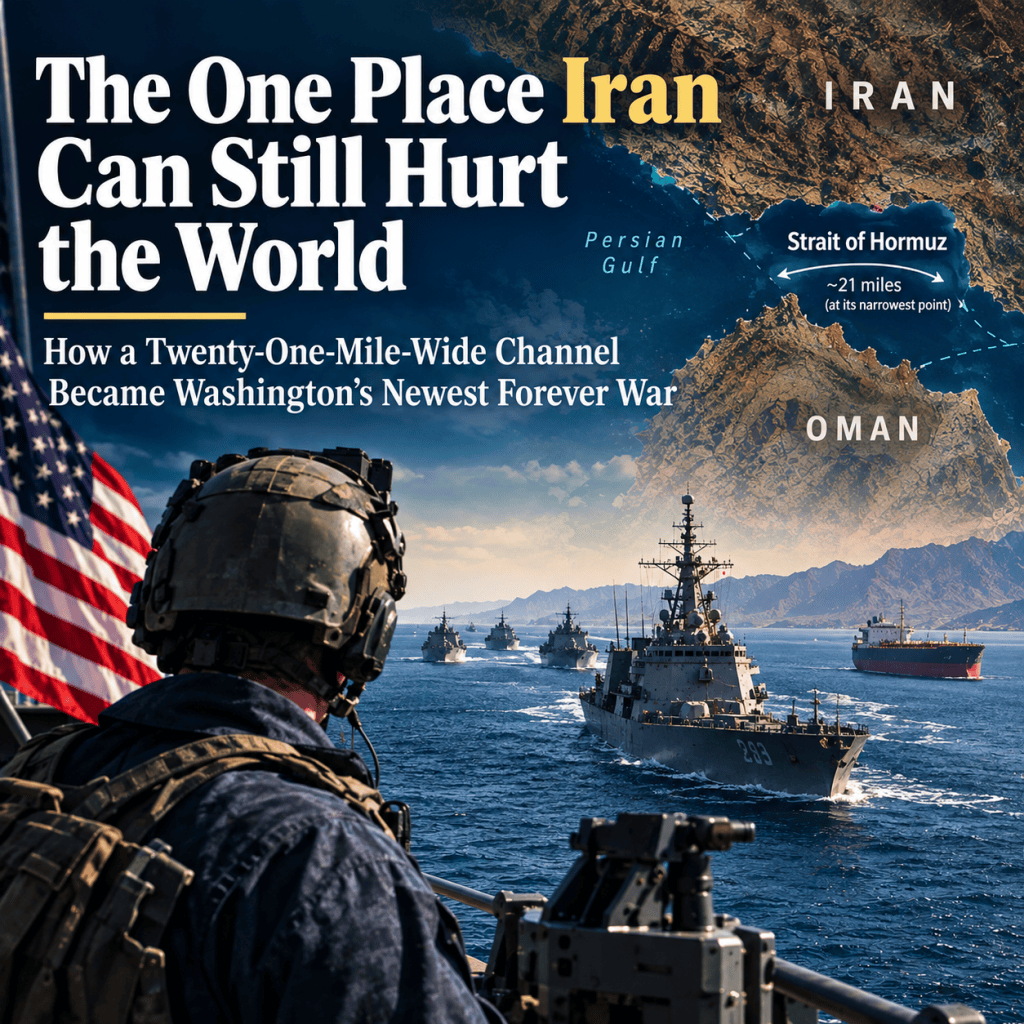
How a Twenty-One-Mile-Wide Channel Became Washington’s Newest Forever War
There is a particular kind of American war that does not announce itself with a declaration, a mobilization, or even a name that fits neatly on a headline. It arrives instead as a series of “operations” — a blockade here, an airstrike there, a naval escort mission that quietly becomes permanent. By the time anyone in Washington asks how long this is supposed to last, the answer is already unknowable, because the war was never designed to end. It was designed to be managed. Iraq was such a war. Afghanistan was such a war. And by the autumn of 2026, the campaign to keep the Strait of Hormuz open is fast becoming another one.
The proximate facts are, by now, grimly familiar. On February 28, 2026, the United States and Israel launched a surprise bombing campaign against Iran, killing Supreme Leader Ali Khamenei along with dozens of senior officials in the opening hours. Iran’s response was not to sue for peace. It was to shut the tap. Within days, the Islamic Revolutionary Guard Corps Navy declared the Strait of Hormuz closed to vessels bound to or from the United States, Israel, and their allies, and began mining the waterway, boarding merchant ships, and firing on tankers. The United States, in turn, launched an aerial campaign to reopen the strait, dropped bunker-buster bombs on Iranian missile sites along the coast, sank Iranian minelayers, and — when a ceasefire and the subsequent Islamabad talks collapsed — imposed its own naval blockade on Iranian ports in mid-April. Iran blockading the Gulf, the United States blockading Iran: The Guardian’s phrase for it, a “dual blockade,” has aged into simple description rather than analysis.
Six months later, the guns have not gone quiet. What Al Jazeera has taken to calling a “tanker war” is now the organizing fact of life in the Gulf: Iranian forces striking American warships and merchant vessels, American forces striking Iranian tankers and coastal targets, and a waterway that carries roughly a quarter of the world’s seaborne oil and a fifth of its liquefied natural gas trade operating, when it operates at all, under armed escort. A member of the Iranian parliament’s national security committee did not mince words to Al Jazeera in early September, describing the fighting as an existential struggle against Washington and insisting the American blockade should never have existed in the first place. He added, pointedly, that because America sits an ocean away, it does not experience this as an existential war. He is right about that asymmetry, and it is precisely that asymmetry — geographic, political, and economic — that should worry anyone hoping this conflict resolves itself.
Allow me to make a blunt argument: the Strait of Hormuz is not a crisis to be resolved. It is becoming a fixture — a recurring, low-grade, high-consequence conflict that will outlast this administration, the next one, and possibly the government in Tehran that started it. The reasons are structural, not incidental. Geography makes the strait impossible to defend cheaply and impossible for Iran to abandon as a lever. Iran’s post-Khamenei leadership has more incentive to keep the pressure on than to fold. Washington’s own domestic politics reward decisive-sounding strikes far more than they reward the patient, boring work of de-escalation. And the region’s other stakeholders — the Gulf monarchies, Israel, China, India, and the shipping companies that move the world’s energy — have interests so divergent that no coalition exists capable of imposing a settlement. What follows is an attempt to explain why, and to map the allies, quasi-allies, and reluctant bystanders whose choices will determine how long this goes on.
Every generation of American strategists rediscovers the same uncomfortable fact: the Strait of Hormuz is a hostage situation with global reach, and Iran holds the knife. The strait narrows to about twenty-one miles at its tightest point, with shipping lanes on each side barely two miles wide, separated by a two-mile buffer. It is flanked on its northern shore by the Iranian coastline — a coastline studded, after decades of investment, with anti-ship cruise missile batteries, fast-attack craft bases, drone launch sites, and the tunnels and caves that the IRGC has spent a generation building specifically to survive an American air campaign. This is not incidental infrastructure. It is a strategy made concrete: since Iran cannot match the United States Navy carrier for carrier, it has built an arsenal designed to make the strait too expensive to use rather than impossible to close.
That distinction matters enormously for how this war will be fought and for how long. Iran does not need to sink an American carrier to win a given week of this conflict. It needs only to make insurers nervous, sink or damage the occasional tanker, fire a missile that an American destroyer must spend a quarter-million-dollar interceptor to shoot down, and force Washington to keep carrier strike groups on station indefinitely. This is the economic logic of asymmetric warfare, and it inverts the usual calculus of great-power conflict. In most wars, the stronger side wins by attrition. In the Strait of Hormuz, attrition favors Tehran, because every interception is expensive for the United States and nearly free for Iran. A Chinese-designed anti-ship missile or a maritime drone costs a fraction of the interceptor fired to stop it. Multiply that arithmetic across months of continuous low-intensity conflict, and the fiscal logic of the war starts to look less like a battle Washington can win and more like a subscription it cannot easily cancel.
The Pentagon’s own numbers illustrate the stakes on the other side of the ledger. By early May, the Department of Defense estimated that the closure and blockade had already cost Iran nearly five billion dollars in lost oil revenue. That is a real and painful cost to an economy already battered by sanctions. But it has not produced capitulation, and there is little reason to think further economic pain will. Regimes under this kind of pressure — with their supreme leader assassinated, their military leadership decapitated, their legitimacy threatened at home — often calculate that backing down is more dangerous than continuing to fight. Surrender in the Strait of Hormuz would not just be a strategic retreat; for whatever leadership structure survives in Tehran, it would be an admission that the state can no longer protect the one asset that gives it real leverage over the global economy. States facing existential legitimacy questions do not typically make that admission voluntarily.
Americans of a certain age will recognize this movie, because they have already seen it. During the so-called Tanker War of 1984 to 1988 — itself a subplot of the Iran-Iraq War — Iranian and Iraqi forces attacked more than four hundred merchant vessels in the Gulf, and the United States eventually launched Operation Praying Mantis, sinking or crippling a significant portion of Iran’s operational navy in a single day. That operation is remembered in American military history as a clean, decisive victory. What is remembered less often is that it did not end Iranian harassment of Gulf shipping; it simply changed its character, pushing Iran toward the asymmetric mine-and-missile posture that defines its naval doctrine to this day. The lesson Tehran drew from 1988 was not “stop provoking the Americans.” It was “never again fight the U.S. Navy ship-for-ship.” Every Iranian naval investment since has been an application of that lesson, and the 2026 war is its logical culmination: fast boats, smart mines, coastal missile batteries, and now drones, deployed precisely because they let Iran contest a waterway it cannot control outright.
There is a second historical echo worth naming plainly, because it is the one editors will want cut and the one that matters most: the United States has now spent a quarter-century treating Middle Eastern conflicts as problems with military solutions and discovering, on a rolling basis, that the region generates new conflicts faster than old ones can be resolved. Iraq was supposed to stabilize a region; it destabilized it for a generation. Afghanistan was supposed to deny terrorists a safe haven; it produced twenty years of occupation and a withdrawal that many Afghans and Americans alike regard as a strategic wash. The 2026 Iran war was launched, according to its own architects, to permanently end Iran’s nuclear program and its capacity to threaten the region. Instead, it has produced a maritime war with no obvious mechanism for resolution, fought in a chokepoint that cannot be permanently garrisoned and cannot be permanently abandoned. Anyone arguing that this time is different — that decapitating Iran’s leadership or blockading its ports will produce capitulation rather than escalation — is arguing against the pattern, not with it.
Forever wars are not sustained by strategic logic alone. They are sustained by the fact that, within the domestic politics of the countries fighting them, de-escalation is politically expensive and escalation is politically cheap — at least in the short run, which is the only run that matters to most political systems.
Consider Washington’s incentives. A president who orders a strike on an Iranian missile battery gets a news cycle of decisive leadership. A president who negotiates a diplomatic off-ramp that leaves Iran’s regional position intact gets accused, by domestic critics on both flanks, of appeasement or overreach or both simultaneously. The Islamabad talks in April 2026 are instructive here: they failed, and their failure triggered the American naval blockade rather than a renewed diplomatic push. Once a blockade exists, unwinding it becomes its own political liability — the same hawkish voices that cheered its imposition will treat its removal as a concession to a regime that just tried to choke off a quarter of the world’s oil supply. This is the ratchet effect that defines forever wars: escalation is a one-way valve, because each escalatory step creates new political constituencies invested in not reversing it.
Tehran’s domestic incentives point in the same direction, for mirrored reasons. A leadership structure that survived the assassination of its Supreme Leader has an overwhelming interest in demonstrating that Iran was not, in fact, defeated — that the state can still make the United States pay a price for its aggression. The lawmaker who described this to Al Jazeera as “an existential war with America” was not using loose rhetorical flourish. For a regime whose founding legitimacy rests on resistance to American and Israeli power, backing down after the killing of Khamenei would be close to an existential concession, regardless of the economic cost. Hardliners within the IRGC, which controls the naval forces actually fighting this war, have every institutional incentive to keep fighting: the conflict has elevated their budgets, their political standing, and their control over the wartime economy far above what they enjoyed in peacetime. An IRGC that fights the Americans to a stalemate in the Strait of Hormuz is an IRGC that has justified its own existence for another generation.
Put these two domestic political logics together — an American system that rewards visible strikes over patient diplomacy, and an Iranian system in which the fighting faction benefits institutionally from continued fighting — and you do not get a war that ends. You get a war that is managed, indefinitely, at whatever intensity each side’s domestic politics can tolerate. That is the operational definition of a forever war.
There is a seductive argument, heard often in Washington in the months since February, that American airpower can simply flatten Iran’s coastal missile infrastructure and restore freedom of navigation by force. Operation Project Freedom — the bunker-buster campaign against hardened Iranian anti-ship missile sites, and the sinking of sixteen Iranian minelayers in March — was sold in exactly these terms. It bought a temporary halt in Iranian attacks. It did not buy a lasting one.
The reason is geographic and technological rather than a failure of American military execution. The coastline commanding the Strait of Hormuz is long, mountainous in places, riddled with the kind of terrain that hides mobile launchers and tunnel complexes from persistent aerial surveillance. Iran has had more than four decades to disperse and harden this infrastructure precisely because its planners always assumed a war like this one was coming. Destroying a missile battery does not destroy the capacity to rebuild or relocate one; it destroys a battery. Mobile anti-ship missile systems, small fast-attack craft that can be hidden in fishing harbors, and cheap drones that can be assembled faster than they can be permanently suppressed are not targets that airpower retires — they are targets that airpower degrades, temporarily, at a rate that requires it to keep coming back.
This produces the grinding operational tempo that Gulf-based reporting has documented since summer: American strikes on Iranian tankers and coastal targets, Iranian strikes on American warships and merchant shipping, in a cycle that has not meaningfully slowed since spring. The Wall Street Journal’s framing of the strategic question — whether Tehran can force Washington into “an expensive cycle of missile defense, retaliation and maritime operations” — is not a hypothetical. It is a description of the war as it is currently being fought. And expensive cycles, once established, tend to persist for the simple reason that neither side’s leadership can afford, politically, to be the one that stops paying into them first.
If this were simply a bilateral contest between Washington and Tehran, it might eventually be resolved through exhaustion or backchannel diplomacy, the way the original Tanker War petered out once both Iran and Iraq were spent by 1988. What makes the current crisis structurally harder to end is that it sits inside a regional order in which every major stakeholder has a different, and often contradictory, stake in how it concludes. Understanding why this is becoming a forever war requires understanding why no coalition — American, regional, or global — currently exists that wants the same outcome badly enough to force it.
Israel is the most straightforward participant, and also the one with the least interest in a quick resolution. Israel’s strategic objective in the February strikes was the permanent degradation of Iran’s nuclear and missile programs and the decapitation of its leadership — objectives it substantially achieved in the war’s opening hours. Israel has continued to conduct strikes alongside the United States in the Hormuz campaign, and its intelligence services have targeted senior Iranian military figures overseeing the strait, including the naval commander responsible for the blockade. But Israel does not depend on Hormuz for its own energy security in the way Gulf Arab states or Asian importers do, and it has little incentive to accept a compromise that leaves Iran’s military-industrial base, or the IRGC’s regional proxy network, intact. For Israel, the Hormuz war is a continuation of the broader campaign against Iranian power rather than a discrete maritime problem to be solved on its own terms — which means Israeli strategy will keep pulling the conflict toward maximalist outcomes even when Washington’s own calculus might favor a narrower, transactional deal to reopen shipping lanes.
Saudi Arabia occupies the opposite position, and its discomfort is the clearest illustration of why this war lacks a coherent coalition. Riyadh has spent the past several years trying to extricate itself from regional confrontation with Iran, not deepen it — the 2023 Saudi-Iranian rapprochement, brokered by Beijing, was itself an acknowledgment that permanent hostility with Tehran served no one’s economic interests. Saudi Arabia’s own oil export infrastructure, while partially routed around the strait through pipelines to the Red Sea, remains deeply exposed to any wider regional war, and Saudi leadership has no appetite for a re-run of the Iranian drone and missile strikes that hit Abqaiq and Khurais in 2019. Riyadh has therefore played this crisis cautiously: rhetorical support for freedom of navigation, quiet coordination with Washington on regional security, but nothing resembling the kind of full-throated coalition partnership that would let the United States claim it is fighting this war on behalf of a unified Gulf bloc. Saudi Arabia wants the shipping lanes open. It does not want to be seen as a co-belligerent against Iran, because it has learned, at cost, what it looks like to be a frontline state in an Iranian retaliation campaign.
The United Arab Emirates sits closer to the fighting, both geographically and commercially, and its position is correspondingly more anxious. Emirati-flagged vessels have been directly targeted in the crisis — a UAE-flagged tugboat, Mussafah 2, was struck in Omani waters near the strait, killing four crew members. Dubai’s role as a regional shipping and re-export hub gives the UAE an enormous direct stake in the strait’s reopening, and Abu Dhabi has quietly expanded its own naval and air-defense cooperation with Washington as a hedge. But the UAE, like Saudi Arabia, has also invested heavily in de-escalatory diplomacy with Tehran in recent years and has no wish to be cast as an American forward base for strikes on Iranian territory — a role that would make Emirati infrastructure a legitimate target under IRGC doctrine. The UAE’s strategy, in short, is to benefit from American naval protection while declining to become a combatant, a position that is comprehensible and probably rational for Abu Dhabi but that leaves Washington without a genuine regional partner willing to share the political and military burden.
Oman may be the single most important actor in this conflict that the American press has spent the least time explaining. Muscat has positioned itself, as it has in every prior American-Iranian confrontation, as the indispensable back channel — host of the Islamabad-adjacent diplomatic track, intermediary for prisoner and hostage communications, and now, reportedly, the sponsor of an alternative shipping route intended to route vessels around the most contested waters near Hormuz. Oman controls the strait’s southern shore and the Musandam Peninsula, giving it a geographic claim to co-manage the waterway that no other Gulf state possesses. Oman’s ports at Duqm and Salalah have themselves been targeted by Iranian drone strikes — Salalah’s fuel storage was hit and set ablaze, and a drone was intercepted near Duqm — a signal that Tehran is willing to punish even the most determinedly neutral regional actor if it perceives Omani territory as facilitating American or allied shipping. Oman’s dilemma captures the entire regional trap in miniature: the more useful Muscat becomes as a diplomatic and logistical alternative to the blockaded strait, the more it becomes a target in its own right, and the harder it becomes for Oman to remain above the fray. If Oman’s proposed alternative shipping arrangement succeeds, it may be the single most important circuit-breaker available to de-escalate the crisis. If it fails, or if Iran treats it as another target, Oman’s neutrality — the one asset the region cannot afford to lose — will be the next casualty.
Qatar, Bahrain, and Kuwait complete the Gulf picture, and each faces a version of the same bind at smaller scale. Qatar hosts the largest American air base in the region at Al Udeid and simultaneously maintains one of the more functional diplomatic relationships with Tehran of any Gulf state, a combination that makes Doha invaluable as a mediator but also exposed as a target, as Iranian missile strikes on the base during the initial war demonstrated. Bahrain hosts the U.S. Fifth Fleet headquarters, making it the most militarily committed of the smaller Gulf states almost by default, and correspondingly the most vulnerable to Iranian retaliation aimed at American power projection. Kuwait, sandwiched geographically between Iraq and Iran, has the least appetite of any Gulf state for renewed regional war and the least capacity to stay out of one if it comes. None of these three governments wants this conflict to continue. None of them has the leverage to end it.
China is the great-power stakeholder whose interests cut most directly against American strategy, and whose behavior over the coming years may matter more than anyone in Washington currently wants to admit. China imports a larger share of its crude oil through the Strait of Hormuz than any other major economy, which gives Beijing a straightforward commercial interest in the strait staying open. But China also has no interest in helping the United States achieve a clean strategic victory over Iran, a country Beijing has spent the last decade cultivating as a energy supplier and a partner in evading American sanctions architecture. Expect China’s role to remain what it has been throughout the crisis: rhetorical calls for restraint on all sides, continued purchases of discounted Iranian crude through sanctions-evading shadow-fleet networks, and no meaningful pressure on Tehran to stand down. China benefits from a wounded, sanctioned Iran that depends more heavily on Chinese purchases and protection; it does not benefit from an Iran humiliated into full capitulation to Washington. That is not the posture of an ally trying to end this war. It is the posture of a power content to let the war continue at a low simmer indefinitely, so long as its own tankers are not the ones catching Iranian missiles.
India by contrast, has genuine and urgent reasons to want this resolved. Indian-flagged and Indian-crewed vessels have been disproportionately represented among the ships stranded and attacked in the strait since the crisis began, and India’s energy security — with a majority of its crude imports historically transiting Hormuz — is directly threatened by sustained closure. New Delhi has neither the desire nor the capability to insert itself militarily into an American-Iranian war, but it has real diplomatic incentive to support any off-ramp, including Omani mediation efforts, that restores safe passage. India’s position illustrates a broader truth about this conflict: the states with the most at stake in its resolution — the Asian economies that depend on Gulf energy — are precisely the states with the least power to end it.
Iraq deserves a final mention as the regional actor most likely to be dragged into this conflict against its own interests. Baghdad hosts American forces, maintains deep economic and religious ties to Iran, and has a political system substantially influenced by Iran-aligned militias — any of which could become both a vector for Iranian retaliation against American targets and a flashpoint that widens the war well beyond the strait itself. Iraq wants nothing to do with this fight. Iraq’s geography and politics may not give it a choice.
Lay these positions side by side and a pattern emerges that should worry anyone hoping for a swift resolution: this is a war being fought by two principals — the United States and Iran, with Israel as a committed junior partner on one side — inside a region whose other major stakeholders are all, for different reasons, unwilling or unable to help end it. Saudi Arabia and the UAE want the shipping lanes open but will not become co-belligerents. Oman wants to mediate but is being targeted for the effort. Qatar, Bahrain, and Kuwait are hostages to geography. China has a commercial interest in stability but a strategic interest in American frustration. India wants peace and has no lever to produce it.
This is precisely the condition under which forever wars metastasize. Vietnam, Afghanistan, and Iraq were each, in their own ways, wars that outlasted their original strategic rationale because no coalition existed with both the interest and the capability to force a resolution — only a patchwork of actors each managing their own exposure to a conflict none of them controlled. The Strait of Hormuz war has the same shape. It is not that peace is impossible. It is that peace requires a level of coordinated regional and great-power pressure on both Washington and Tehran that the current alignment of interests simply does not produce.
Perhaps the clearest evidence that this is becoming a forever war is the absence, on either side, of a coherent public definition of victory. The United States has articulated its goal in the strait narrowly — freedom of navigation, an end to Iranian attacks on shipping — while pursuing, through Israeli-coordinated strikes and its own bombing campaign, the much broader objective of permanently crippling Iranian military capacity. These goals are not obviously compatible. A narrowly defined victory (reopened shipping lanes, an Iranian stand-down) is achievable through negotiation and has been, at least nominally, the subject of talks since April. A maximalist victory (the dismantlement of Iran’s coastal missile and naval capability, the end of IRGC control over the blockade) is not achievable through negotiation at all — it requires either total military defeat of Iran’s naval and missile forces, which asymmetric coastal defense makes extraordinarily costly to accomplish, or the collapse of the regime itself, which is not a policy the United States has declared and not an outcome Washington can reliably engineer even where it might wish to.
Iran’s own definition of success is similarly unstable. Tehran’s public position — that the strait will reopen once Iranian infrastructure destroyed by American and Israeli strikes is rebuilt, and once the American blockade ends — sounds like a negotiable demand. But IRGC hardliners have separately framed the conflict in the more absolute terms of existential resistance to American power, a framing that has no natural stopping point short of American withdrawal from the region altogether. When a government cannot decide internally whether it is fighting for a specific, negotiable outcome or an unbounded ideological struggle, outside observers should not expect it to accept a negotiated settlement even when one is offered.
Wars with unclear or incompatible victory conditions do not end when one side achieves its aims. They end when both sides become too exhausted, too internally divided, or too distracted by other priorities to keep fighting — a process that historically takes years, not months, and that in the interim produces exactly the kind of recurring, grinding, headline-generating-but-strategically-static conflict now underway in the Gulf.
One more structural feature deserves attention, because it is the piece most likely to be missed by commentary focused purely on military and diplomatic dynamics: this war, unlike Iraq or Afghanistan, generates its own funding mechanism independent of congressional appropriations or public enthusiasm. Every disruption to Hormuz shipping raises global oil prices, and elevated oil prices are simultaneously a cost to global consumers and a lifeline to producers who can sell outside the blockade’s reach. Gulf oil producers with export capacity not routed through the strait — Saudi Arabia’s pipeline to the Red Sea, in particular — have benefited from price spikes even as they publicly call for stability. American shale producers have benefited from higher global benchmarks. Even Iran, despite the direct revenue losses the Pentagon has documented, has found a partial offset in elevated prices for whatever crude it can still move through its shadow fleet to Chinese buyers.
This is the uncomfortable economic logic that sustains many forever wars: enough actors profit from the disruption, even as they publicly lament it, that the political will to force a resolution is diluted. Insurance markets, shipping conglomerates that profit from wartime freight-rate spikes on the routes that remain viable, defense contractors supplying munitions and missile-defense systems to a region now permanently on a war footing — all of these constituencies have a stake, whether openly acknowledged or not, in a Gulf that remains tense rather than a Gulf that returns to placid normalcy. None of them wants open war indefinitely. All of them can tolerate managed conflict indefinitely, which is a very different thing, and which is precisely the equilibrium the Strait of Hormuz appears to be settling into.
Fairness requires acknowledging the strongest case against the “forever war” thesis. Optimists point to several factors: Iran’s economy is under genuine strain, with billions in lost oil revenue mounting weekly; the Omani-brokered alternative shipping arrangement, if it matures, could reduce the strait’s centrality enough to lower the stakes on both sides; American domestic political appetite for sustained military commitment in the Middle East has historically proven shallower than initial hawkish rhetoric suggests, and a future administration or a shift in congressional mood could force disengagement; and unlike Iraq or Afghanistan, this conflict does not require American ground troops or nation-building, which historically have been the components of Middle Eastern wars that generate the deepest, most durable domestic political fatigue.
These are real considerations, and they suggest the conflict’s intensity could plausibly decline from its current tanker-war tempo to something more like the sporadic, lower-casualty confrontations that characterized much of the original 1980s Tanker War after its most violent phase. But a decline in intensity is not the same as an end. The original Tanker War did not conclude because either side achieved victory; it wound down alongside the broader Iran-Iraq War’s exhaustion, three and a half years after it began, and even then left behind naval mining, sporadic attacks, and mutual distrust that shaped Gulf security dynamics for decades afterward. If the current conflict follows even the optimistic historical precedent, “resolution” means years of intermittent violence, not a clean end within any near-term political horizon. That is the forever-war outcome by another name — merely a lower-intensity version of it.
None of this argues that the United States had no legitimate interest in responding to Iranian aggression against international shipping, nor that Washington’s naval presence in the Gulf is inherently misguided. Freedom of navigation through one of the world’s most important chokepoints is a genuine global public good, and a world in which Iran can unilaterally close it to punish its adversaries is a worse world than one in which it cannot. The argument here is narrower and more sobering: having entered this conflict, the United States has few good mechanisms available to conclude it on favorable terms within any predictable timeframe, because the structural conditions that produce forever wars — an adversary with more to lose from surrender than from continued resistance, domestic politics on both sides that reward escalation over negotiation, a military technology mismatch that favors cheap asymmetric defense over expensive power projection, and a regional coalition too fractured to impose a settlement — are all present simultaneously.
The most honest assessment available to American policymakers in September 2026 is this: the Strait of Hormuz will likely remain contested, at varying levels of intensity, for years rather than months. Tankers will continue to transit under naval escort rather than free passage. Insurance premiums for Gulf shipping will remain elevated indefinitely, functioning as a permanent tax on global trade. American carrier strike groups will rotate through the region on deployments that were once described as temporary and will eventually stop being described that way at all, because the presence will simply become the baseline. Iranian coastal missile and drone capabilities will be degraded periodically by American and Israeli strikes and rebuilt periodically by an IRGC that has every institutional incentive to keep the confrontation alive.
This is not a prediction anyone in Washington wants to hear, and it is not one likely to be voiced by officials whose careers depend on describing each new operation as the one that finally secures the strait. But foreign policy analysis exists to describe the world as it is likely to unfold, not as officials would prefer it to unfold. The Strait of Hormuz — twenty-one miles of water separating Iran from Oman, carrying a fifth of the planet’s energy trade, defended by the most expensive navy in human history and threatened by some of the cheapest weapons ever built for the purpose — has become the place where American military power meets its most persistent structural limit. It is not that the United States cannot win individual engagements there. It has, repeatedly, since February. It is that no engagement, however decisively won, changes the underlying arithmetic: Iran does not need to defeat the U.S. Navy to keep this war going. It only needs to make sure the war never stops being worth fighting for whoever is left in charge in Tehran. Six months into this conflict, with no coalition capable of forcing an end to it and no political incentive on either side to be the party that blinks first, that condition shows no sign of changing.
The Strait of Hormuz is not America’s crisis of the year. It is shaping up to be America’s war of the decade — the one place left in the world where a regional adversary, with a fraction of Washington’s military budget and none of its global reach, has found a way to make the most powerful navy on Earth pay, in dollars and lives, for every mile of open water.


Leave a comment