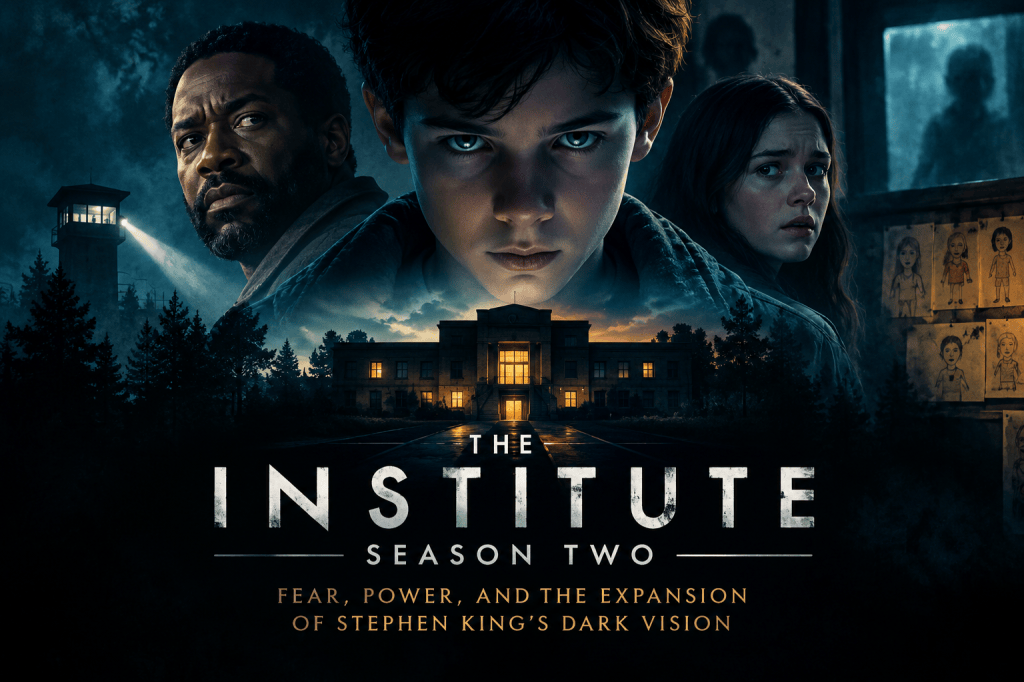
The arrival of the second-season trailer for The Institute signals a significant expansion of one of the more unsettling recent adaptations of Stephen King’s fiction. The series began from a premise that transforms the familiar language of science fiction into an examination of power, childhood, surveillance, coercion, and institutional violence. Children possessing unusual mental abilities are removed from their homes and placed inside a secluded facility where adults claim that their suffering serves a greater purpose. Such a premise immediately creates a conflict between stated necessity and lived experience. The children are told that their confinement protects humanity, yet every aspect of their existence suggests exploitation. The second season therefore enters a story already constructed around a profound moral contradiction: how far can an institution go in the name of preventing catastrophe before the institution itself becomes the greater threat?The new trailer carries significance because the first season established a world in which fear operates through systems rather than through a single monster. The Institute does not frighten merely because of secret rooms, armed guards, medical procedures, or supernatural abilities. Fear emerges from the realization that the people controlling the children possess resources, information, authority, and patience. The children are surrounded by adults who understand the machinery of the facility far better than they do, creating an atmosphere in which resistance appears nearly impossible. Season two can therefore deepen the central conflict by moving beyond confinement and toward consequence. Once children understand the nature of the organization holding them, the question changes from whether they can survive to whether they can expose, resist, or destroy the system responsible for their suffering.That shift gives the new season an opportunity to expand the meaning of King’s story beyond conventional horror.
At its core, The Institute examines the relationship between power and vulnerability. The children possess abilities that make them extraordinary, yet those same abilities make them targets. Their difference grants them no freedom because an institution has discovered a way to transform exceptional human potential into a resource. The children are therefore caught inside a paradox. Their gifts make them powerful enough to matter but vulnerable enough to be controlled. Such a contradiction provides the foundation for a story about exploitation, fear, and resistance.Stephen King’s fiction has repeatedly returned to children confronting systems created by adults. His young protagonists often encounter forces that refuse to recognize childhood as a protected condition. Instead, childhood becomes a period in which individuals can perceive truths that adults have learned to ignore. In The Institute, that idea becomes especially severe because the children are not merely witnesses to adult corruption. They are the subjects of a program designed by adults. Their bodies, minds, memories, and abilities become objects of study. The horror therefore emerges from the destruction of trust between generations.The second season can deepen that generational conflict by showing what happens after knowledge replaces innocence. A child who knows that an adult authority figure has lied no longer occupies the same psychological world as a child who merely suspects something is wrong. Knowledge creates responsibility. Once the children understand the scope of the Institute’s purpose, escape becomes only the first stage of resistance. The larger challenge concerns what they do after freedom becomes possible. Do they expose the organization? Do they seek revenge? Do they attempt to rescue others? Do they destroy the machinery that created them as prisoners? Each possibility carries moral consequences.This makes the trailer more than a collection of suspenseful images. A trailer for a second season must communicate escalation without revealing every consequence of the previous story. The strongest images therefore function as promises. They suggest that familiar characters will face unfamiliar threats, that relationships established during the first season will be tested, and that the world beyond the Institute may become just as dangerous as the facility itself. The movement from confinement toward confrontation creates a broader dramatic field. The first season asks what happens inside the walls. The second can ask what happens when those walls no longer contain the conflict.The distinction between inside and outside matters enormously. The Institute’s power depends upon secrecy. Its authority grows because ordinary society does not fully understand what happens behind closed doors. Once information escapes, the organization becomes vulnerable. Yet exposure does not necessarily produce justice. Institutions with enormous resources can manipulate public perception, destroy evidence, intimidate witnesses, and create competing explanations. The children therefore cannot assume that truth alone will protect them. They must determine how truth can become power.That question gives the series relevance beyond its supernatural premise. Modern societies contain countless structures whose authority depends upon specialized knowledge. Hospitals, laboratories, governments, corporations, schools, intelligence agencies, and research organizations all operate through systems that ordinary people cannot always observe directly. Most such institutions serve legitimate purposes, but the concentration of knowledge can also create opportunities for abuse.
The Institute exaggerates that dynamic through supernatural abilities, yet the underlying concern remains recognizable: what happens when ordinary people become dependent upon institutions they cannot fully examine?The horror becomes stronger because the Institute does not regard itself as evil in a simple sense. Its representatives believe that their work serves humanity. The children are sacrificed because the adults believe the sacrifice prevents something worse. That reasoning creates one of the oldest moral problems in speculative fiction: whether a terrible act becomes acceptable when the person committing the act claims to prevent a greater disaster. King’s work repeatedly demonstrates the danger of such reasoning because power can redefine necessity according to its own interests.Season two can therefore explore the corruption of necessity. A small number of people may genuinely believe that the Institute’s work saves lives, but once that belief becomes unquestionable, almost any action can be defended. Torture becomes research. Confinement becomes protection. Surveillance becomes prevention. Manipulation becomes guidance. Violence becomes sacrifice. Language transforms wrongdoing into duty. The most frightening aspect of such a system is not that everyone involved must be cruel. The greater danger comes from ordinary people convincing themselves that cruelty has become necessary.That idea gives the series a deeper thematic foundation than a straightforward battle between heroes and villains. The Institute represents a structure of reasoning as much as a physical location. Its walls contain children, but its ideology extends beyond those walls. The organization survives because enough people accept its assumptions. Destroying a building therefore cannot automatically destroy the system. The children must confront the beliefs that made the Institute possible.The second season also has the opportunity to broaden the supernatural mythology surrounding the children. Their abilities create the surface-level mystery of the series, but their deeper importance concerns identity. A person who possesses extraordinary mental power may begin to question whether such power defines who they are. The Institute treats ability as a measurable resource. The children experience ability as part of themselves. The difference between those perspectives creates a fundamental conflict over personhood.For the Institute, a child becomes a subject. For the child, the self remains a person. That difference appears simple, yet the entire horror of the series grows from the refusal of the institution to accept it. When human beings become subjects of a program, their individuality can disappear behind numbers, records, tests, observations, and predictions. King’s story therefore transforms supernatural ability into a metaphor for any human quality that powerful organizations seek to measure and control.The children also challenge the assumption that youth equals helplessness. Their age makes them vulnerable, but their abilities make them dangerous. This duality gives the series its dramatic tension. The adults underestimate the children because they possess conventional authority. The children underestimate themselves because they have been taught that authority belongs to adults. The conflict therefore involves a gradual redistribution of power. Every act of resistance becomes an assertion that the children possess agency even when the institution denies that agency.The concept of agency becomes especially important in a second season because audiences already understand the central premise. Repeating the first season’s cycle of capture, fear, escape attempts, and punishment would reduce the story’s potential.
Expansion requires transformation. The children must become more knowledgeable, more coordinated, and more capable of making choices. Their relationships should also become more complicated as survival begins to compete with trust.Fear can unite people, but fear can also divide them. When several young people experience imprisonment together, each person may respond differently. One may seek escape at any cost. Another may believe that cooperation offers a better chance of survival. Another may become attracted to the promise of safety offered by authority. Another may simply want to return home. Those differences can create conflict without requiring artificial hostility. The strongest ensemble stories understand that people exposed to the same danger do not necessarily develop the same response.The series can also deepen the relationship between the children and adults who oppose the Institute. The first season established the importance of figures outside the facility, especially those who gradually recognize that something deeply wrong is occurring. Season two can test whether those adults understand the children as people rather than merely victims. Rescue creates its own ethical problem. A person who saves someone from one form of control can accidentally impose another form of control if they refuse to respect the survivor’s choices.That possibility becomes especially compelling because the children possess abilities that adults may fear. A rescuer might sympathize with a child while simultaneously worrying about what that child can do. Such fear can produce a new form of paternal authority. The children may therefore discover that freedom does not mean entering a world without control. Freedom may mean learning how to identify control even when control arrives disguised as protection.This theme connects The Institute to a broader tradition of speculative storytelling in which young people become threats to established power because they possess knowledge or abilities that adults cannot contain. Yet King’s approach tends to complicate that tradition. His children are not simply heroic symbols of innocence. They can experience anger, fear, selfishness, confusion, and resentment. Their humanity matters because the story becomes less about perfect young heroes defeating evil adults and more about damaged young people trying to recover a sense of self.The second season can therefore use trauma without allowing trauma to become the entirety of the characters. Survival stories sometimes reduce characters to what happened to them. A stronger narrative asks what survivors choose to become afterward. The children of The Institute have experienced profound violations of trust and autonomy, but their future should not be determined solely by those experiences. Their recovery can involve friendship, humor, anger, curiosity, love, and a renewed desire to experience ordinary life.Ordinary life becomes particularly meaningful after confinement. A school corridor, a family kitchen, a public park, a bedroom, or a simple conversation can carry enormous emotional weight after prolonged institutional control. Such moments remind viewers that the children are not merely supernatural subjects. They are young people who should have been allowed to grow without fear. The contrast between ordinary childhood and the Institute’s controlled environment intensifies the horror because the audience understands exactly what has been stolen.The series also gains strength from the tension between the ordinary world and supernatural danger.
The Institute exists inside a recognizable society, yet most people remain unaware of its existence. That contrast allows the show to create a disturbing double reality. Families continue their routines while children suffer somewhere beyond public awareness. Cars travel highways, schools open, people shop, workers commute, and television programs continue while another world exists behind restricted doors. Horror becomes more powerful when extraordinary violence occurs alongside ordinary life.The second season can expand that contrast by bringing the consequences of the Institute into public spaces. Once the hidden conflict becomes visible, the story’s atmosphere may change. Secrecy creates one form of fear; exposure creates another. A child who once feared being discovered may later fear being recognized. A person who once wanted the world to know the truth may discover that public attention brings danger of its own.Such a development would also allow the series to examine the power of media and public perception without becoming dependent upon exposition. If evidence of the Institute reaches ordinary people, questions immediately arise concerning credibility. Who will believe the children? Who will dismiss them? Who will attempt to exploit their story? Who will seek proof? Who will fear the abilities themselves? The struggle over truth can become nearly as important as the struggle for physical freedom.Another major strength of the series lies in the atmosphere created by King’s original premise. The Institute is fundamentally about intrusion. Private space disappears. Personal boundaries become meaningless. The mind itself becomes accessible to external authority. Such fear differs from the more familiar horror of physical attack because the threatened territory is internal. A person can hide from a monster behind a door, but what happens when the threat can enter thought itself?That question gives the supernatural abilities a disturbing dimension. Telepathy and related powers are often presented as gifts, but The Institute turns them into sources of vulnerability. The ability to perceive thoughts can destroy privacy. The ability to influence minds can destroy consent. The ability to move objects or manipulate environments can attract fear from people who cannot understand the source of the power. Extraordinary ability therefore becomes both liberation and imprisonment.The Institute understands that contradiction and exploits it. The children are told, directly or indirectly, that their abilities make them valuable. That message can create shame because the same qualities that distinguish them from others also cause their imprisonment. The institution therefore controls not only the children’s bodies but their interpretation of themselves. If a child begins to believe that their gift makes them dangerous, then the Institute no longer needs physical force to maintain control. Fear becomes internalized.Breaking that psychological control may become one of the defining struggles of season two. Escape from a building can happen through a door. Escape from an identity imposed by an institution requires much more. The children must learn to understand their abilities according to their own values rather than according to the definitions imposed upon them by researchers and administrators.
Such development can give the season a strong emotional foundation beneath its suspense.The series also has an opportunity to explore the consequences of power among the children themselves. Once they understand that their abilities can affect other people, moral questions emerge. Should they use force against their former captors? Should they manipulate minds to secure freedom? Should they punish those who harmed them? Does possessing power create an obligation to exercise restraint? These questions prevent the story from becoming a simple revenge narrative.King’s fiction frequently finds terror in the realization that extraordinary power does not automatically produce wisdom. A person can possess enormous ability while remaining frightened, immature, angry, or confused. The children therefore face a difficult transition from victimhood toward agency. They must decide what kind of people they want to become after discovering that they possess powers adults were willing to exploit.The second season can make that journey especially compelling by refusing easy moral answers. Revenge may feel justified. Mercy may feel impossible. Trust may appear foolish. Isolation may appear safer. Cooperation may require vulnerability. Every choice can produce consequences. Such ambiguity creates richer drama than a simple division between good and evil.The trailer’s larger promise therefore rests upon escalation of both scope and meaning. A second season cannot merely become louder. It must become deeper. More danger alone does not guarantee stronger storytelling. The most effective expansion occurs when external conflict reflects internal transformation. If the children face greater threats while also becoming more conscious of who they are, the story gains depth rather than merely scale.The same principle applies to the adults. Figures associated with the Institute should not become one-dimensional villains simply because the children now understand their role. The most disturbing antagonists are often those who possess understandable motives but make morally indefensible choices. A researcher may believe that a dangerous future requires sacrifice. A guard may believe obedience protects innocent people. An administrator may believe secrecy prevents panic. Such motives do not excuse abuse, but they make the system more frightening because the system can reproduce itself through ordinary human reasoning.This aspect of The Institute reflects one of King’s most enduring concerns: evil does not always announce itself as evil. Sometimes evil arrives dressed as duty. Sometimes cruelty speaks in the language of science. Sometimes oppression calls itself protection. Sometimes fear becomes an excuse for control. The Institute’s power comes from its ability to transform these contradictions into a functioning system.Season two therefore has the potential to become an examination of how systems survive after their victims begin to resist. The children may defeat individual enemies without destroying the ideas that sustain the organization. They may escape one facility while discovering that the program exists elsewhere. They may expose one group of administrators while realizing that the broader network remains intact. Such possibilities would expand the story without abandoning its central premise.The larger world of the series can also become more mysterious.
The Institute’s activities imply that extraordinary abilities have existed beyond the walls of one facility. That suggestion creates opportunities for new characters, new forms of power, and new questions concerning the origin and purpose of the children. Expansion should remain disciplined, however. The danger of broadening a supernatural story lies in replacing mystery with excessive explanation. The unknown can often be more frightening than a complete answer.A second season should therefore preserve some uncertainty. The audience does not need every question answered immediately. Fear thrives when viewers understand enough to recognize danger but remain uncertain about the full extent of that danger. The Institute itself benefits from this approach because secrecy forms part of its identity. Revealing too much too quickly could weaken the sense of hidden power that makes the premise compelling.The same restraint should govern the depiction of the children’s abilities. Powers become less frightening when they function as simple solutions. If a character can solve every problem through supernatural force, suspense disappears. The most effective stories establish limits, costs, emotional consequences, or uncertainty. The children should remain vulnerable even as their abilities grow. Power without vulnerability produces spectacle; power combined with vulnerability produces drama.That balance may determine whether season two succeeds. The first season established the emotional foundation. The second must demonstrate that the characters can evolve without losing the qualities that made the story compelling. Greater scope should not erase intimacy. Larger threats should not replace character development. More supernatural mythology should not overwhelm the human story.The title The Institute itself remains significant because the institution represents more than a building. The word suggests organization, authority, expertise, research, and permanence. A temporary group of villains would create a different kind of story. An institute suggests continuity. It suggests that the problem existed before the current characters arrived and may continue after they leave. That implication gives the story a sense of history without requiring endless exposition.The children therefore confront something larger than the adults immediately surrounding them. They confront an idea that has become embedded within a system. Such systems are difficult to defeat because individuals can be replaced.
If one administrator falls, another may take the position. If one facility closes, another may open. If one experiment ends, another may begin. The true conflict concerns whether the underlying belief in sacrifice can be destroyed.This also explains why the second season has the potential to broaden the series from horror into a more expansive examination of power. Horror provides the atmosphere, supernatural abilities provide the mechanism, and the children provide the emotional center. Beneath those elements lies a question that applies far beyond fiction: who possesses the authority to decide that another person’s suffering serves a greater purpose?The Institute answers that question through force. Season two can challenge that answer through resistance.The most compelling form of resistance may not involve physical destruction alone. The children can resist by naming what happened to them, by trusting one another, by refusing imposed identities, by protecting other victims, and by choosing what kind of people they want to become. Such acts matter because authoritarian systems depend upon making victims feel powerless and isolated.
Community becomes a form of rebellion.Friendship consequently carries unusual weight in the story. The children have been separated from family and placed among strangers who share their unusual circumstances. Bonds formed under confinement can become a source of strength, but they can also become sources of fear because betrayal carries enormous consequences. Season two can explore whether trust remains possible after people have been manipulated for so long.That emotional question may prove more important than any new supernatural threat. Viewers invest in suspense when they care about the people facing danger. The greater the emotional connection, the more frightening uncertainty becomes. A chase matters because someone we care about may be caught. A confrontation matters because a friendship may be destroyed. A sacrifice matters because the person making the sacrifice possesses a future worth protecting.This is where King’s influence remains especially powerful. His horror often functions best when extraordinary events reveal ordinary human truths. Monsters matter because people fear loss. Supernatural forces matter because people fear helplessness. Impossible events matter because they expose familiar weaknesses. The Institute follows that tradition by using supernatural children to examine vulnerability, trust, authority, and the abuse of power.Season two therefore arrives with an unusual burden. The audience already understands the premise, the danger, and the existence of the Institute. The new task is to demonstrate why the story still matters after that knowledge has been established. The answer cannot simply be more secrets. The answer must be consequence. Characters must change. Relationships must evolve. Choices must matter. The world must respond.If the season achieves those goals, the trailer’s promise of escalation can become something more substantial than another chapter of supernatural suspense. The story can evolve into a study of what happens after victims recognize the system that harmed them. Recognition creates anger. Anger creates resistance. Resistance creates choice. Choice creates responsibility. That progression gives the series a dramatic path beyond escape.The Institute’s greatest threat may therefore no longer be the children themselves. The greater threat may be the possibility that the children will understand their own power and refuse to accept the definitions imposed upon them. Once that happens, the relationship between captor and captive changes fundamentally. The institution can no longer rely upon ignorance. It must confront people who understand the nature of the system.That confrontation promises to give the second season its strongest dramatic foundation. The children are no longer simply trying to survive an unknown nightmare. They know what the nightmare represents. They know that adults created it. They know that their abilities made them valuable to the people controlling them. Most importantly, they can begin to recognize that their value does not originate from their abilities. Their worth exists before anyone measures, studies, or exploits them.That idea may ultimately define the meaning of The Institute. The series presents extraordinary children inside a system that treats them as resources, but the story repeatedly pushes toward a more human understanding of identity. A person cannot be reduced to a gift, a test result, a prediction, or a function.
A child cannot become acceptable only after becoming useful. The Institute’s deepest error lies in confusing human potential with human ownership.Season two now has the opportunity to turn that error into the foundation of a larger conflict. The children can fight not merely for survival but for the right to define themselves. The adults around them can be forced to confront the consequences of choices made under the language of necessity. The institution can be challenged not merely as a place but as an idea. And the audience can be asked to consider the uncomfortable possibility that the most dangerous monsters are not always creatures with supernatural powers.Sometimes the most frightening force is a system that convinces ordinary people that cruelty has become necessary.That remains the central promise of The Institute as season two approaches. Beneath the supernatural abilities, hidden laboratories, secret programs, frightened children, and escalating threats lies a story about power and the human temptation to sacrifice others for an imagined greater good. The new season can expand the suspense, deepen the mythology, and broaden the world, but its greatest strength will remain the same question that made the premise so disturbing from the beginning: what happens when people with power decide that another person’s freedom matters less than their own vision of the future?The children now know the answer.The challenge ahead is whether they can change it.


Leave a comment