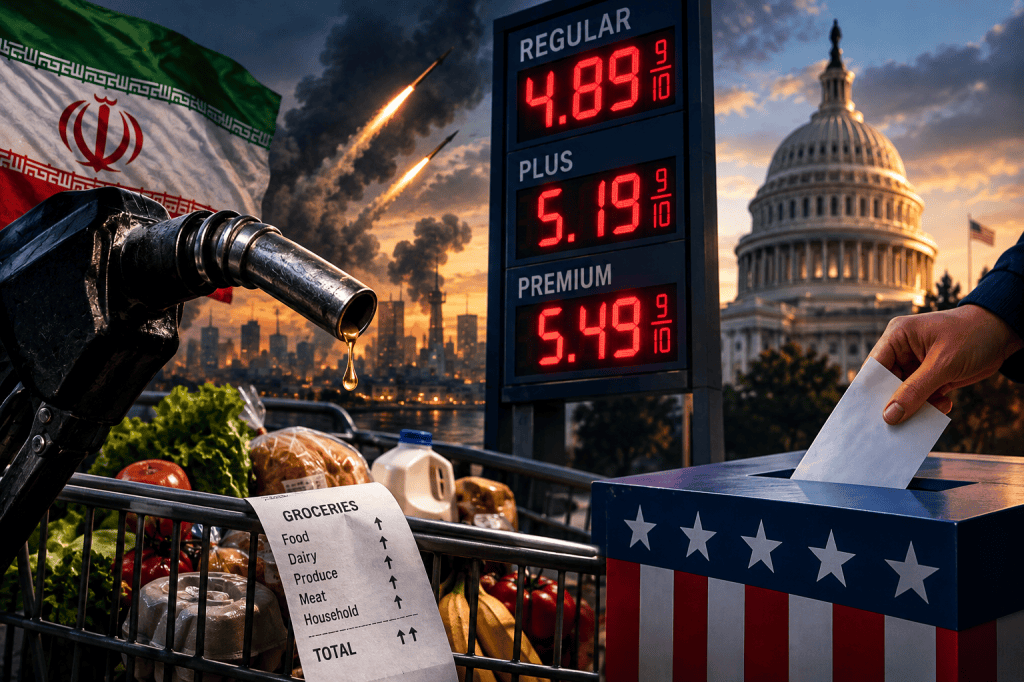
An analysis of how the conflict with Iran has fused with the struggle for control of Congress
The most momentous development in American campaigning this autumn is not another poll, however meticulously fielded or breathlessly publicized. Surveys oscillate within margins of error, and any single reading can be dismissed as mere noise by partisans eager to discount unwelcome tidings. The more profound development is one of kind rather than degree: foreign policy and the domestic campaign, two spheres that strategists customarily endeavor to quarantine from one another, have collided with unmistakable force. The Iran war is bleeding directly into the midterm contest, and neither party can any longer treat the conflict as a remote abstraction managed by specialists in distant theaters of operation.
Consider the peculiar architecture of persuasion now assembled by President Trump. He is campaigning on the proposition that the war is indispensable to American security, a claim that invokes the gravest responsibilities of the commander in chief and implicitly casts skeptics as negligent guardians of the homeland. Simultaneously, he is assuring voters that the economic hardship produced by hostilities, particularly the elevated cost of fuel, is merely temporary, a transient inconvenience destined to dissipate once the strategic labor has been accomplished. These two assertions, one of paramount necessity and one of ephemeral discomfort, are designed to operate in tandem. The first justifies sacrifice; the second minimizes the invoice. Whether voters will accept both halves of this bargain, or will instead scrutinize the arithmetic of the second half with the sharpness that household budgets invariably induce, constitutes the foremost uncertainty of the coming weeks.
This analysis proceeds from a simple observation with intricate ramifications. The question confronting the electorate is migrating away from whether Americans endorse the war and toward whether the costs of the war are tolerable for ordinary families. That migration, subtle in its inception, carries profound consequences for both parties, for the contested districts that will determine control of Congress, and for the durability of any wartime consensus. What follows examines the Nebraska rally that crystallized the tension, the controversy concerning Los Angeles and San Diego, the White House’s subsequent clarification, the pocketbook mechanics linking hostilities to household distress, the historic precedents that illuminate the present predicament, and the scenarios that may unfold before and after the November balloting.
Foreign policy has historically occupied an ambiguous station in midterm contests. Scholars of voting behavior have long observed that these contests turn predominantly on domestic grievances: the condition of the economy, the standing of the occupant of the White House, and the perennial tendency of that occupant’s party to forfeit seats. Overseas controversies seldom dominate, because ordinary citizens perceive distant events through a filter of proximate concerns, and strategists accordingly default to the maxim that voters reward competence at home rather than adventurism abroad. Wars constitute the exception to this regularity, though only when their consequences penetrate the textures of daily existence.
The Iran conflict appears to have crossed precisely that threshold. Fuel prices, food costs, and inflation are now discussed alongside the imperatives of security rather than as discrete matters belonging to separate conversations. That juxtaposition is the decisive feature of the present moment, because juxtaposition invites causation: once a voter perceives a link between the bombing abroad and the bill at the register, the two phenomena become inseparable in memory and in judgment.
This fusion is the genuine novelty. For a considerable period, the architecture of public debate permitted a tidy division of labor. Hawks and doves argued about strategy, deterrence, and alliance obligations, while economists and pundits argued about prices, wages, and monetary policy. The collision erases the partition. A motorist standing at a fuel pump now confronts, in the glowing digits of the price display, a quantified expression of strategic decisions made in Washington, and no quantity of oratory can fully disaggregate the two.
Research into voter cognition has repeatedly demonstrated that citizens assign disproportionate weight to experiences that are frequent, visible, and unavoidable. Few commodities satisfy those three criteria as thoroughly as gasoline, whose price is displayed on towering signs at intersections across the country, and whose fluctuations are discussed at kitchen tables and in workplace break rooms with an enthusiasm normally reserved for athletic rivalries. A war whose consequences are measured in cents per gallon therefore enjoys no insulation from scrutiny; the war has been translated into the one denominator that every driver comprehends.
The scholarly literature on retrospective voting, associated most famously with Morris Fiorina, holds that citizens evaluate incumbents chiefly by assessing recent performance rather than by parsing platforms. Under that framework, a war is judged not solely by its strategic merits but by its observable aftermath, including what the aftermath has done to living standards. If the aftermath includes pain at the pump and at the grocery store, the retrospective calculus turns hostile regardless of the elegance of the underlying strategy.
Attribution of blame complicates the picture. Voters do not automatically assign responsibility for price increases to the party in power; they must be persuaded that a chain of causation exists. Here the administration has, through its own rhetoric, furnished a considerable portion of that chain. By describing economic pain as the temporary byproduct of a necessary war, the President has conceded the connection that opponents would otherwise labor to establish. Having acknowledged that the war and the prices are linked, he has obliged himself to defend both, and has surrendered the option of insisting that costs arise from unrelated forces.
At his rally in Nebraska, President Trump characterized the war as a “small price to pay,” a phrase that, as reported by the Associated Press and other outlets, instantly became the focal point of coverage. Phrases of this variety acquire disproportionate influence precisely because they compress a complex argument into a portable, quotable, and easily contested formulation. Whatever the speaker intended, the phrase now functions as a Rorschach test, and each audience projects onto the phrase its own assumptions about who pays, how much, and for what.
Begin with the grammar. A price is paid by someone, and the construction “small price to pay” conspicuously omits the identity of the payer. The omission is not accidental; the idiom has long been a staple of leaders who ask others to absorb burdens. When a speaker at a podium describes a cost as small, the adjective carries an implicit subtext: small to whom? A senior official insulated from fluctuations in fuel prices can regard a few additional dollars per fill-up with serene equanimity, whereas an hourly worker commuting long distances in an aging vehicle may experience an identical increase as a meaningful subtraction from discretionary income.
The adjective “small” performs further labor. The word shrinks the burden in order to magnify the benefit, supplying listeners with a ratio in which an enormous security dividend outweighs a trivial inconvenience. Ratios of this kind are persuasive only if the audience accepts both the numerator and the denominator. The numerator, the magnitude of the security gain, rests on contested forecasts about Iranian intentions and capabilities. The denominator, the magnitude of the cost, is verifiable by anyone with a bank statement. Asymmetric verifiability thus favors critics: they can point to receipts, while proponents must ask for trust.
The venue matters as well. Nebraska is a state whose conservative bedrock is interrupted by a competitive House seat in the Omaha area, and rally crowds in such places tend to comprise the most committed supporters, for whom the language of resolve resonates. Yet modern rallies are never addressed solely to those present. Every sentence is engineered for amplification through broadcast clips, social platforms, and opposition research, so that a remark designed to galvanize loyalists is simultaneously consumed by undecided citizens and by adversaries who will recontextualize the remark in advertising. This dual audience produces a perennial hazard: language calibrated for the faithful may alienate the persuadable.
Equally significant is the companion assurance that economic pain is temporary. Temporariness is a promise about the future, and promises about the future carry a distinctive vulnerability: the calendar adjudicates them. If prices recede before voters cast ballots, the promise appears prophetic and the “small price” framing appears vindicated. If prices persist or climb, the same promise becomes an exhibit in the opposition’s case, evidence that the administration either misjudged conditions or minimized them for expedient purposes. The President has therefore wagered credibility upon the trajectory of energy markets, a domain notoriously resistant to executive command.
Fuel markets respond to forces far beyond Washington’s control: the decisions of producing nations, the behavior of traders anticipating disruptions, the insurance premiums attached to maritime transit, and the refining constraints that dictate how crude oil becomes pump gasoline. A war involving a major petroleum-producing region injects uncertainty into every one of those channels simultaneously. Predicting the duration of price elevation under such conditions is hazardous even for specialists, and a politician who stakes a campaign on the prediction assumes risk that no rally applause can underwrite.
The rally acquired a second controversy when Trump made remarks suggesting that Los Angeles and San Diego could potentially face attack. California officials responded immediately and forcefully, rejecting what they perceived as a cavalier invocation of their constituents’ safety. The White House subsequently clarified that the comments referred to the danger that would exist if Iran obtained nuclear capability, rather than advocating or anticipating attacks on American cities. Between the remark, the reaction, and the clarification lies an instructive study in how contemporary campaigns metabolize ambiguity.
Words uttered by a head of state occupy a category distinct from ordinary punditry. A commentator who speculates about attacks on coastal cities is offering an opinion; a president who does so is potentially disclosing intelligence assessments, shaping adversary perceptions, and inducing anxiety among millions of residents. The weight of the office transforms speculation into event, and the audience’s interpretive framework shifts accordingly. Californians hearing their two most prominent coastal metropolises named in connection with potential attack are unlikely to parse subjunctive clauses with the patience of a seminar.
The selection of these cities carries its own resonance. Los Angeles is among the most populous urban agglomerations in the country, a hub of ports, aerospace manufacturing, and entertainment industries, while San Diego hosts one of the largest concentrations of naval installations in the Pacific. Any strategist conjuring images of threats to the homeland would find these locales intuitively prominent, and this intuitive prominence is exactly why the remark reverberated.
California officials, many of them Democrats, possessed both a sincere and a strategic motive to push back. The sincere motive is evident: elected representatives are charged with reassuring constituents, and a remark that destabilizes public composure demands correction. The strategic motive is equally apparent. California is the largest reservoir of Democratic votes and harbors numerous competitive House districts, so any controversy that places the President in conflict with the state’s leadership serves opposition interests by mobilizing a motivated base and by rendering the administration’s war message contentious in the nation’s most populous state.
The episode exposes a delicate dilemma confronting any administration that defends a war as preventive. To justify hostilities and their burdens, officials must dramatize the danger that would loom absent action. Yet dramatizing danger to American cities risks producing alarm that curdles into blame: if cities are imperiled, voters may reason, perhaps the war itself has heightened the peril. Threat narratives are double-edged instruments; they sharpen the case for resolve while simultaneously supplying evidence for those who argue that escalation endangers the very citizens it purports to protect.
Contemporary media ecosystems exacerbate this dilemma. A clarification issued hours or days afterward seldom travels as far as the initial remark, because outrage spreads more rapidly than nuance. Clips excised from context circulate among millions, while the context-restoring statement circulates among the already attentive. Thus even a perfectly reasonable explanation arrives with a handicap, and the original impression may persist in the memory of inattentive consumers long after elaborate corrections have been archived.
The administration’s explanation deserves careful analysis on its own terms. According to the White House, the comments concerned the threat that would exist if Iran possessed nuclear capability, not a call for attacks upon American cities. Understood in that light, the remark is a familiar variant of preventive reasoning: an adversary armed with nuclear weapons could threaten distant targets, therefore denying the adversary such weapons is a defensive imperative. That argument has a long pedigree in strategic discourse, and proponents can invoke the argument without embarrassment.
Nevertheless, the logic of the clarification reveals the character of the entire campaign case. The danger invoked is prospective, contingent upon events that have not occurred and may never occur; the costs invoked by critics are present, measurable, and borne now. Persuasion in campaigns confronts a persistent asymmetry between vivid, concrete burdens and abstract, averted catastrophes. The citizen paying more at the pump knows exactly what the war has cost; the citizen asked to credit the war with preventing a nuclear-armed adversary must accept a story about a world that was never permitted to materialize.
Psychologists describe this phenomenon through the lens of loss aversion, the finding by Daniel Kahneman and Amos Tversky that losses loom larger than equivalent gains. Averted disasters are experienced, if at all, as non-events; they leave no residue in the daily ledger. Hence defenders of preventive war confront a perennial difficulty: success, when achieved, is invisible, while expense is conspicuous.
The clarification also illustrates a recurrent maneuver: speaking to two audiences through one speech and then repairing the damage when the audiences diverge. Rally attendees hear unflinching strength; the broader public and the press hear menace; the subsequent statement endeavors to preserve the first impression while dissolving the second. This pattern is neither unprecedented nor confined to one party, but the cost accumulates. Each clarification subtly teaches observers that the speaker’s initial words require translation, and the need for translation erodes the authority of the original utterance.
Credibility, in this context, operates as a depletable resource. A leader who must repeatedly clarify encounters diminishing returns, as skeptical audiences begin discounting explanations as reflexive damage control and sympathetic audiences begin discounting criticism as manufactured outrage. The result is a polarization of interpretation: supporters accept the clarification as the authentic meaning, opponents regard the original remark as the revealing slip, and the persuadable middle, uncertain whom to believe, may simply become more disaffected with the entire spectacle.
What the episode ultimately demonstrates is that the war’s justification, however earnestly articulated, cannot be insulated from the circumstances of the campaign. Every statement about threats, whether intended as strategic explanation or as electioneering flourish, is received within an atmosphere charged by price anxiety and partisan suspicion. An argument about nuclear danger that might command deference in a quiescent season is instead interrogated, parsed, and weaponized in the closing stretch before a midterm.
The argument is migrating beyond the simple inquiry “Do you support the war?” toward a more demanding interrogation: “Is the cost of the war acceptable to ordinary Americans?” This transition is of enormous importance, since binary approval questions mostly measure partisan identity, whereas cost questions measure lived experience. A respondent can endorse the objective of denying Iran nuclear capability while simultaneously concluding that the price of pursuing that objective, as currently exacted, exceeds what the objective is worth.
Scholarship on wartime opinion supports the claim that tolerance for costs is neither fixed nor automatic. John Mueller’s studies of the Korean and Vietnam conflicts documented a steady erosion of support as casualties accumulated, while later research by Christopher Gelpi, Peter Feaver, and Jason Reifler argued that tolerance depends heavily upon citizens’ expectations of ultimate success. Where voters believe a war is winnable and worthwhile, they endure considerable pain; where they doubt either condition, the same pain becomes intolerable. Economic burdens, though distinct from battlefield casualties, plausibly follow an analogous logic.
Apply that insight to the present situation. The administration’s promise that pain is temporary is, in essence, an attempt to manufacture expectations of success and brevity simultaneously. If voters trust that promise, the cost-acceptance question resolves favorably. If voters distrust the promise, the question resolves unfavorably and the war’s defenders must pivot to a harder case: that the war merits sustained sacrifice despite uncertain duration. That alternative case is defensible, yet the case demands a candor about hardship that the “small price” formulation was designed to avoid.
A cost-centered framing also redistributes interpretive power. Questions of grand strategy intimidate laypeople, who may defer to authorities on matters of nuclear proliferation and deterrence. Questions of household finance intimidate no one; every adult possesses expertise on the subject of personal grocery bills. Consequently, the migration toward cost transforms the electorate from a deferential audience into a panel of competent adjudicators, each equipped with firsthand evidence that no briefing can rebut.
Both parties are adapting. Republican strategists have every incentive to recast cost as investment, to emphasize that sacrifice purchases security, and to attribute price pressure to the adversary’s aggression rather than to American decisions. Democratic strategists, for their part, have incentive to emphasize who is paying, to dramatize the distributive consequences, and to insist that the burden falls disproportionately upon working families while the architects of the war remain insulated. Each framing contains partial truth, and the contest between them will determine which interpretation prevails in the minds of the persuadable.
Fuel prices, food costs, and broader inflation form the connective tissue of this contest. These three phenomena are not independent: diesel prices influence the expense of transporting produce; fertilizer and packaging costs track energy markets; and rising transport expense propagates through supply chains until the consumer confronts the increase on every shelf. The next section examines these transmission mechanisms in detail.
To comprehend why a distant war can alter the price of gasoline in an American suburb, one must trace the mechanisms of transmission with some care. Crude oil trades on integrated markets in which expectations matter as much as the barrels themselves. When hostilities involve a region that supplies a considerable share of the world’s petroleum, or that borders the maritime corridors through which that petroleum travels, traders price in the probability of disruption long before any tanker is actually delayed. The price at the pump thus embodies not only present scarcity but also anticipated peril.
Shipping adds a second channel. Insurers recalculate premiums for vessels traversing contested waters, carriers reroute to avoid danger, and longer voyages consume extra fuel and time. Every one of these adjustments raises the delivered cost of energy and of the countless goods that travel alongside energy. The costs are modest at each step yet cumulative across the chain, and they arrive in consumer prices with a delay that complicates attribution.
Refining constitutes a third channel. Crude oil of differing grades must be matched to refineries engineered for particular specifications, and disruptions that deprive refiners of their preferred feedstock compel costly substitutions. Changes in fuel blends between summer and winter, inventories drawn down by anxious buyers, and strategic reserves that governments may or may not release further complicate the arithmetic.
These mechanisms carry an unwelcome implication for any administration seeking to promise a swift return to lower prices: the variables lie largely outside executive control, and numerous among them respond to sentiment rather than to measurable supply. Even a decisive military outcome need not instantly restore comfortable pricing, because insurers, traders, and refiners adjust cautiously, wary of renewed volatility. Markets, like wounded creatures, recover more slowly than the circumstances that injured them.
The dimension of timing deserves emphasis. Midterm voting occurs on a fixed date that the war’s trajectory cannot postpone. Should hostilities abate in the weeks preceding the balloting, prices might not retreat quickly enough to alter lived experience by Election Day. A promise that pain is temporary can therefore be accurate and yet useless to a campaign, since voters render verdicts upon their current circumstances rather than upon forecasts of improvement.
Distribution matters as well. Fuel burdens fall unevenly across the country: residents of sparsely populated and exurban areas drive longer distances, depend upon trucks and larger vehicles, and possess few alternatives to private automobiles, whereas dense urban dwellers can substitute transit and walking. Because sparsely populated and exurban constituencies contain many of the voters upon whom Republicans rely, a price shock can paradoxically concentrate hardship among the President’s own coalition. Conversely, California, with its elevated baseline fuel costs and long commutes, offers Democrats an apt setting for arguments about pump prices.
Food costs enter the discussion through channels that are less visible but no less potent. Modern agriculture is an energy-intensive enterprise: diesel powers tractors and harvesters, methane supplies the feedstock for nitrogen fertilizer, and refrigerated trucks carry perishable produce across vast distances. When energy prices climb, the expense of growing, processing, packaging, and delivering food climbs in sympathy, and the increase surfaces at supermarkets in the form of higher tags on staples.
Inflation, the umbrella category, aggregates these pressures into a single anxiety. Economists distinguish headline inflation, which includes volatile energy and food components, from core inflation, which excludes them, yet households make no such distinction; a family experiences the price of the entire basket. A war that elevates the most volatile components therefore inflicts upon citizens a sensation of eroding purchasing power that technical refinements cannot dispel.
Inflation carries a distinctive emotive resonance in American memory. The experience of rapidly climbing prices in the early 2020s, when the average price of gasoline exceeded five dollars a gallon during the summer of 2022, left lasting impressions on the electorate. Voters who endured that period possess a heightened sensitivity to any resurgence, and the word “transitory,” invoked liberally in that era, acquired an unfortunate afterlife. Politicians who dismiss price pressures as temporary now invite the retort that similar reassurances were issued before and proved premature.
The household ledger offers a useful metaphor. Every family maintains, whether in a spreadsheet or in anxious mental arithmetic, a running balance of obligations against income. Fuel and food occupy the least discretionary lines of that ledger, the lines that cannot be deferred or abandoned. When those lines expand, the squeeze falls upon categories that families can control: savings, recreation, and delayed purchases. The sacrifice invoked in the phrase “small price to pay” thus materializes as foregone vacations, depleted reserves, and postponed repairs, each a quiet private grievance that accumulates until Election Day.
Lower-income households bear the sharpest burden, because essentials consume a larger proportion of their budgets. A fifty-dollar increase in monthly expenses may be a nuisance to a household of comfortable means and a catastrophe to a household living paycheck to paycheck. Campaigns that grasp this gradient will tailor messages to the families most acutely wounded, and the administration’s insistence upon the smallness of the price will sound most discordant precisely in the places where the price is largest.
Here the convergence of security and economy achieves its fullest expression. The administration contends that the war protects Americans; opponents will contend that the war is taxing Americans, in the colloquial rather than the statutory sense, through a levy imposed at gas stations and grocery registers without any vote of Congress. Whether that characterization persuades will depend on whether prices remain elevated and whether voters conclude that the burden was foreseeable, avoidable, or fairly distributed.
History furnishes no perfect analogue, yet numerous episodes illuminate the interplay between war, energy, and fortunes at the ballot box.
The oil embargo that followed the 1973 Arab-Israeli war produced long queues at filling stations, rationing schemes, and a pervasive sense of helplessness. Although the 1974 midterms were dominated by the Watergate scandal, the energy crisis contributed to an atmosphere of economic malaise that compounded the governing party’s difficulties.
The Iranian Revolution of 1979 triggered a second oil shock, and the subsequent hostage crisis fused foreign humiliation with economic discomfort in a manner that contributed to the defeat of President Jimmy Carter in 1980. The resonance of Iran in this chapter of American memory is difficult to ignore, for the country has previously demonstrated that events in Tehran can reverberate through American gasoline lines and American ballots.
The Gulf War of 1991 produced a swift military victory and a brief price spike, and President George H. W. Bush enjoyed extraordinary popularity in its aftermath. Yet that popularity evaporated as attention shifted to a sluggish economy, and Bush lost reelection in 1992. The episode teaches that battlefield success confers only a perishable credit.
Iraq offers the more discomfiting analogy for the present administration. The war began under broad support, sustained by a rally effect and by confidence in swift success. As the conflict lengthened, casualties rose, and the justifying premises were contested, public tolerance eroded, and the 2006 midterms delivered Democratic majorities in both chambers of Congress. Gasoline prices in that period were also climbing, which amplified discontent.
Three lessons emerge. First, rally effects decay: enthusiasm for military action tends to dissipate as costs become tangible. Second, expectations about duration are decisive: wars promised as brief and then prolonged generate resentments out of proportion to their intrinsic burdens. Third, economic discontent is a multiplier, converting latent unease about a war into concrete behavior at the ballot box.
Caution is warranted, however. Each of these episodes unfolded amid distinct circumstances: different party alignments, different media ecosystems, different energy economies. The United States is today a far larger producer of petroleum than in 1973 or 1979, which cushions some effects while leaving the price mechanism, which is set in worldwide markets, largely intact. Historic analogies illuminate patterns without dictating outcomes, and any forecast that treats the past as destiny commits an error of category.
The assurance that economic pain is temporary deserves sustained attention, because the assurance carries the entire burden of reconciling the war’s costs with the electorate’s patience. Three questions govern whether the assurance will be believed: whether the claim is plausible, whether the messenger is trusted, and whether the timeline is specific enough to be tested.
Plausibility depends upon the conduct of the war. If hostilities are narrowing, if shipping corridors remain open, and if producing regions display resilience, the claim gains credence. If hostilities broaden, if retaliation threatens maritime traffic, or if adversaries demonstrate capacity to disrupt supply, the claim loses its footing. The administration cannot unilaterally determine these conditions, since an adversary possesses a vote in how long a war endures.
Trust in the messenger is mediated by partisanship. Supporters extend generous credit to assurances from leaders they admire, while opponents regard the same assurances with reflexive suspicion. The decisive population is the narrow slice of voters who lack firm loyalties and who evaluate claims on their face. For this group, the unfolding experience of prices at the pump will outweigh any rhetoric, and the vocabulary of temporariness will be judged against the evidence of receipts.
Specificity is the third variable, and here the administration faces a delicate choice. A vague promise of ultimate relief cannot be falsified but also cannot reassure. A precise promise, such as relief by a stated date, offers reassurance but invites a verdict. Politicians understandably prefer vagueness, yet voters facing monthly bills often demand the very precision that campaigns avoid. The tension between reassurance and accountability will tighten as Election Day nears.
Opponents will probably not contest the possibility that prices eventually decline; they will instead emphasize the intervening cost, asking what families should do in the meantime and why any family should shoulder expenses for a war whose conclusion remains undefined. This shifts the contest from prediction to empathy, a terrain on which a challenger can excel because empathy requires no forecasting skill.
The narrative of temporary pain also confronts the sunk-cost problem. The longer pain persists, the greater the temptation to prolong the war in order to justify sacrifices already imposed, and the more voters may suspect that temporariness was a promise never intended to be kept. Leaders who stake their credibility on brevity thus create incentives that run counter to the very candor that sustained conflicts require.
These dynamics are shaping decisions in campaign headquarters across the country. Control of the House and Senate will hinge on a limited number of contested districts and states, many of them populated by moderate, ideologically unattached voters who are neither enthusiasts of the war nor reflexive opponents. In those places, the pocketbook consequences of conflict may outweigh doctrinal positions.
For Republican candidates, the war presents a genuine dilemma. Those aligned closely with the President benefit among base voters who prize resolve, yet they risk alienating swing constituents who dread inflation. Candidates in competitive districts must therefore calibrate: embrace the objective of preventing a nuclear-armed Iran while distancing themselves from the glib minimization of costs. Expect to hear explicit expressions of sympathy for struggling families, paired with insistence that the adversary, not Washington, bears responsibility for hardship.
Democratic candidates confront a different calibration problem. Condemning the war wholesale invites accusations of weakness, while endorsing the war forfeits the most potent line of attack. The most promising course may be to focus on competence and cost: to question the administration’s planning, its candor about duration, and its preparation for economic consequences, without rejecting the proposition that Iran should not obtain nuclear capability. This posture lets challengers accommodate both hawkish and dovish constituencies while concentrating fire on the credibility of the “temporary” assurance.
California occupies a distinctive position. The state’s officials have already demonstrated willingness to confront the administration over the Los Angeles and San Diego remarks, and the state’s elevated fuel costs and enormous population render the state an apt showcase for arguments about the pump. Yet California’s contests are rarely decided by a single issue, and Democrats cannot assume that indignation will translate into turnout. The controversy offers an organizing theme, not a guaranteed result.
Turnout represents another variable. Midterm electorates are smaller and more intensely motivated than those in years when the White House is also at stake, and intense motivation frequently attaches to grievance. Voters who feel the war in their wallets may be more inclined to vote than voters who feel the war only through news coverage. If the cost question mobilizes the aggrieved while the security question fails to mobilize the reassured, the asymmetry could advantage the party out of power, a pattern consistent with decades of midterm experience.
Independents, who outnumber those identifying with either party in many surveys, tend to evaluate wars through a pragmatic lens, weighing visible results against visible costs. They are wary of grand narratives and receptive to simple tests: Are prices coming down? Are Americans safer? Is the end in sight? A campaign that cannot answer those three questions affirmatively will struggle to persuade them.
Forecasting is hazardous, yet disciplined scenario analysis can clarify the stakes. Consider three trajectories, each defined by the interaction of battlefield developments and price behavior between now and the balloting.
In the first, hostilities de-escalate and energy markets calm. Prices retreat gradually, and the administration can credibly claim vindication: the pain was temporary and the war achieved its purposes. Even in this favorable scenario, however, the lag between improved conditions and improved perceptions may limit the benefit, and opponents will emphasize the costs already endured. The Nebraska phrase would be remembered as a gamble that happened to succeed rather than as a statement of untroubled wisdom.
In the second, hostilities persist at moderate intensity and prices remain elevated but stable. Voters adapt psychologically to the new baseline, a phenomenon economists label hedonic adaptation, yet adaptation breeds resentment rather than acceptance when no end is visible. This scenario favors the opposition modestly, as the temporary label curdles into a euphemism, and the administration must increasingly justify the war on grounds of principle rather than promise.
In the third, hostilities escalate, perhaps through retaliation against shipping or the widening of the theater, and prices climb further. Here the temporary assurance collapses, the cost-acceptance question resolves decisively against the administration, and the controversy over remarks about American cities acquires retrospective significance as an early indication of a danger the administration seemed unprepared to confront. Such a trajectory would transform a difficult campaign season into a referendum on the war’s wisdom.
Beyond November, the consequences extend further. A Congress controlled by the opposition would possess the power to investigate, to hold hearings, to condition appropriations, and to compel testimony regarding war aims and costs. Such oversight, even absent legislative victories, would shape public understanding by furnishing a forum in which the administration’s claims face adversarial examination. Conversely, a strong showing by the governing party would be interpreted as a mandate for resolve, emboldening the administration and discouraging internal dissent.
Allies and adversaries also scrutinize American campaigns. Iranian leaders will read the midterm results as an indicator of American staying power; an adversary persuaded that domestic patience is fraying may elect to prolong the conflict, betting that attrition will accomplish what arms cannot. The campaign’s outcome thus feeds back into the war’s course, completing a circuit in which domestic politics shapes strategy and strategy shapes domestic politics.
The collision between war and campaign that now defines the autumn is neither fortuitous nor ephemeral. The collision reflects an enduring truth about democratic governance: leaders who wage war must eventually render accounts to citizens who bear the burdens.
President Trump has constructed an argument that pairs the gravity of security with the lightness of temporary cost. The Nebraska rally crystallized that pairing in a phrase, and the subsequent controversy over Los Angeles and San Diego demonstrated how fragile the pairing can become when words outrun an audience’s tolerance. The White House’s explanation, that the remarks addressed the danger that would exist if Iran acquired nuclear capability, may satisfy supporters, yet the explanation cannot erase the underlying asymmetry between averted, invisible dangers and present, visible expenses.
The deeper question is whether the pairing can withstand contact with household reality. The cost of fuel, the price of groceries, and the broader sensation of inflation are not abstractions; they are lived facts that arrive weekly, accompany every errand, and resist rebuttal.
Opponents, for their part, must resist the temptation to assume that grievance guarantees victory. Voters weigh security against expense with greater subtlety than strategists often credit, and a candidate perceived as indifferent to genuine threats will forfeit trust no matter how persuasively that candidate critiques prices.
The most reliable prediction is a modest one: the decisive question of the campaign has shifted. The inquiry is no longer whether Americans endorse the war in the abstract but whether they judge the war’s burdens worth bearing in their own kitchens and driveways.
How voters answer will determine not merely control of Congress but the latitude that any administration enjoys when that administration asks citizens to sacrifice for objectives they cannot see. In that sense, the contest of this autumn is a referendum on an enduring democratic wager: that the public will endure present hardship in exchange for promised security, provided that the promise is credible and the hardship, in truth, temporary.


Leave a comment