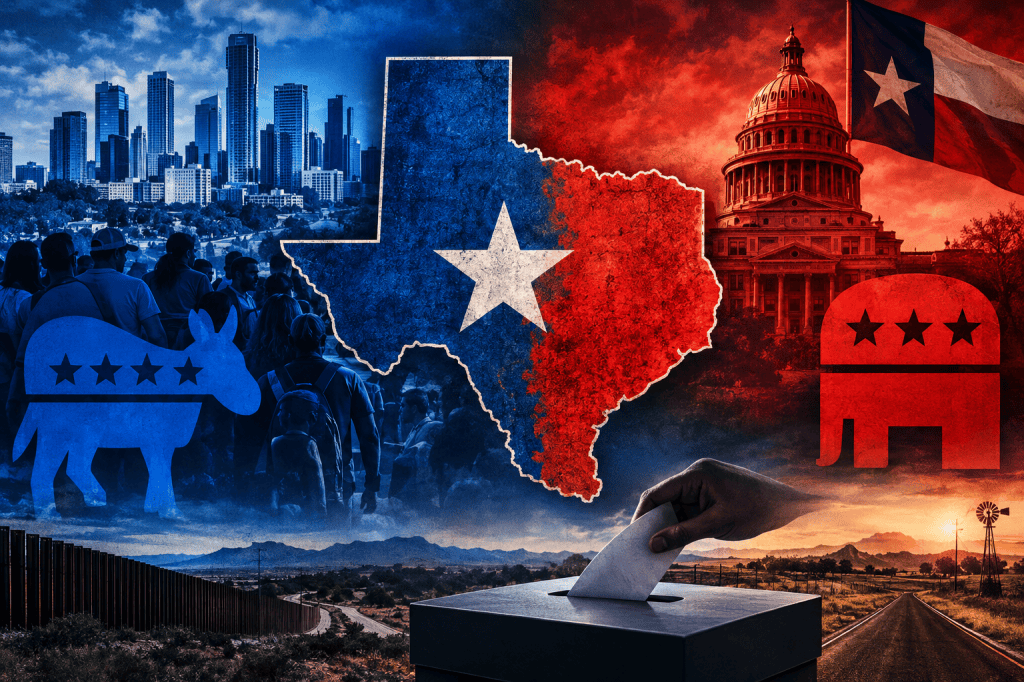
For nearly two decades, commentators, consultants, and campaign strategists have propagated an unrelenting prophecy: that demographic transformation, metropolitan expansion, and generational replacement would inexorably deliver Texas into the Democratic column. The prophecy has acquired the durability of mesquite and the reliability of a West Texas weather forecast, because every election cycle since 2012 has produced exuberant predictions, extravagant fundraising solicitations, and unmistakably disappointing returns. Yet the opposite conclusion, that Texas remains an impregnable Republican fortress immune to contestation, collapses under scrutiny as thoroughly as the blue-wave hypothesis. The truth inhabits a more uncomfortable and far more consequential terrain. Texas is neither turning blue nor remaining permanently red; Texas is becoming a battleground, a jurisdiction where heterogeneous coalitions of unprecedented size compete across a landscape reshaped by migration, urbanization, and meticulous partisan engineering.The word “battleground” demands rigorous definition, because careless usage has drained the term of analytic force. A battleground state is not a state that Democrats will inevitably win, nor a state that Republicans will narrowly lose; the designation describes a jurisdiction in which both parties must expend extraordinary resources, in which marginal shifts among particular constituencies determine outcomes, and in which neither coalition can presume permanent advantage. By that standard, Texas in 2010 was a Republican stronghold, and Texas in 2026 is something fundamentally different, even though Republicans still prevail in nearly every statewide contest. The margin of victory has oscillated wildly, from roughly twenty points in the 2014 governor’s race to under three points in the 2018 Senate race, and back to double digits in 2022 and 2024. Such volatility, juxtaposed against the stability of the Republican statewide winning streak, reveals a system under tension rather than a system at rest.Understanding that tension requires historical excavation, because the present configuration of Texas partisanship rests upon sedimentary layers deposited across nearly two centuries. The Republic that won independence at San Jacinto, the Confederate commonwealth that seceded in 1861, the one-party Democratic fiefdom that persisted through the mid-twentieth century, and the Republican hegemony consolidated after 1994 each bequeathed institutions, grievances, and habits of mind that continue to constrain contemporary competition. A prophecy that ignores such inheritance resembles an architectural plan that ignores bedrock.
The sections that follow trace the long arc of Texas partisan history, dissect the machinery that sustains Republican dominance, examine the demographic and geographic forces eroding that dominance, and explain why the likeliest destination is neither blue nor red but perpetual contestation.Texas political memory begins in a revolution that was simultaneously a rebellion against Mexican centralization and a defense of chattel slavery, a duality that scholars of the antebellum Southwest have documented extensively. The victory of Sam Houston’s irregular army at San Jacinto in April 1836 produced an independent republic whose elites immediately sought absorption into the American union, and the annexation of December 1845 accelerated the migration of enslavers, cotton planters, and Upper South farmers whose ideological preferences would define the state’s character for generations. By 1861, a secession convention dominated by slaveholding delegates voted 166 to 8 to abandon the Union, and a subsequent referendum ratified that decision by a wide margin, though pockets of German Unionist resistance in the Hill Country and North Texas demonstrated that dissent had never been wholly extinguished. Even at the founding of the Confederate commonwealth, then, Texas harbored geographically concentrated minorities whose loyalties diverged sharply from the dominant orthodoxy, a pattern that recurs with remarkable consistency.Reconstruction supplied the first great experiment in biracial democratic governance, and the experiment’s destruction supplied the foundational trauma of Texas partisanship. The Republican governor Edmund J. Davis, a Unionist veteran who presided from 1870 to 1874, established a state police force, expanded public schooling, and enfranchised formerly enslaved men, provoking vitriolic opposition from former Confederates who denounced his administration as tyrannical despotism. When Richard Coke’s Democratic insurgency prevailed in the 1873 election and Davis was compelled to relinquish office in January 1874, the Redeemers inaugurated a regime that would endure, with only intermittent challenge, for more than a century. The Constitution of 1876, drafted in a climate of fiscal retrenchment and visceral hostility toward executive power, deliberately weakened the governor, shortened legislative sessions, and fragmented administrative authority across a bewildering array of independently elected officials, a design whose consequences linger in the plural executive and biennial legislature of the present day.
Subsequent decades witnessed repeated, spirited, and ultimately thwarted efforts to dislodge the Democratic establishment. The Farmers’ Alliance, born in Lampasas County in 1877, mobilized indebted cotton growers against railroads, merchants, and bankers, and the Populist Party that emerged from the Alliance’s cooperative movement captured nearly a quarter of the gubernatorial ballots in 1894. Governor James Stephen Hogg, who won office in 1890 as a reformist Democrat, co-opted much of the Populist program by establishing the Railroad Commission in 1891, demonstrating a strategy that Texas conservatives would deploy repeatedly: absorb the insurgent energy, then neutralize the insurgent organization. Having defeated the Populists, the Democratic establishment turned to institutional suppression. The poll tax enacted in the early twentieth century, the white primary entrenched by statute in 1923, and the elaborate registration obstacles that accompanied both measures reduced Black and Mexican American participation to negligible levels while simultaneously discouraging poor whites whose economic grievances might have fueled further insurgency.Litigation gradually dismantled the apparatus. In Smith v. Allwright in 1944, the Supreme Court, responding to a challenge brought by the Houston dentist Lonnie Smith, invalidated the white primary; Sweatt v. Painter in 1950 compelled the integration of the University of Texas Law School; and Hernandez v. Texas in 1954 established that the systematic exclusion of Mexican Americans from juries violated the Fourteenth Amendment. Each decision originated in Texas, and each testified to the stubborn determination of minority litigants who recognized that the courthouse might succeed where the ballot box had been foreclosed. Meanwhile, the Democratic monopoly was itself fracturing along ideological lines. Texas had briefly supplied Herbert Hoover with a victory in 1928, when the Catholicism of Al Smith repelled evangelical Protestants, and the conservative “Texas Regulars” bolted against Franklin Roosevelt in 1944. Governor Allan Shivers, leading the so-called Shivercrats, endorsed Dwight Eisenhower in 1952, and the Texas electorate delivered the state to the Republican general in both 1952 and 1956. The monolith had begun to crumble decades before Republicans possessed the organizational capacity to exploit the cracks.The transformation of Texas from Democratic redoubt to Republican stronghold was neither sudden nor inevitable but a protracted, contingent, and frequently reversible process. John Tower’s victory in the 1961 special election to fill Lyndon Johnson’s vacated Senate seat marked the first Republican triumph in a statewide contest since Reconstruction, yet Tower’s narrow coalition of suburban professionals, oil executives, and disaffected conservatives could scarcely have foretold a durable majority. Johnson himself, after ascending to the presidency following the assassination of John F. Kennedy in Dallas in November 1963, shepherded the Civil Rights Act of 1964 and the Voting Rights Act of 1965 through Congress and carried Texas by an overwhelming margin that November. The liberal wing of the Democratic Party, symbolized by Senator Ralph Yarborough, remained formidable, and in 1966 Barbara Jordan became the first Black member of the Texas Senate since the nineteenth century, later advancing to Congress in 1972 with an eloquence that captivated the entire country.
The conservative Democrats who dominated state government, nevertheless, were drifting inexorably toward the Republican organization that Richard Nixon’s Southern strategy cultivated. Nixon swept Texas in 1972 by a crushing margin, though Jimmy Carter recaptured the state narrowly in 1976 by combining Black, Mexican American, and rural white voters in a coalition that already appeared anachronistic. Bill Clements’s slim victory in the 1978 governor’s race, the first Republican gubernatorial triumph since Reconstruction, signaled that the realignment had penetrated the highest levels of state politics, even though Democrat Mark White ousted Clements four years later. Ronald Reagan’s landslides in 1980 and 1984 established a template of Sunbelt conservatism fusing anti-tax sentiment, religious traditionalism, military patriotism, and hostility toward Washington bureaucracy, and the template resonated powerfully in the booming suburbs of Dallas, Houston, and San Antonio.Texas Democrats retained residual strength through the 1980s and early 1990s, largely because incumbency, courthouse patronage networks, and the personal popularity of figures such as Lloyd Bentsen and Bob Bullock sustained downballot loyalty long after presidential allegiance had evaporated. The defection of Congressman Phil Gramm to the Republican Party in 1983 foreshadowed the migration of countless conservative officeholders, and Ann Richards’s election as governor in 1990, a triumph of populist humor and organizational discipline, represented the last great exhalation of the old coalition. Her defeat in 1994 by George W. Bush, the son of a transplanted New England patrician, inaugurated a new epoch. By 1998 Republicans controlled every statewide office, and since 1994 no Democratic candidate has prevailed in any statewide race, a streak whose length justifies the label of hegemony even as the same streak conceals the narrowing of recent margins.Consolidation of Republican control over the state legislature in 2002 enabled the most audacious gerrymandering gambit in modern American history.
Majority Leader Tom DeLay orchestrated a mid-decade congressional redistricting in 2003, circumventing the settled convention that district lines were redrawn only after the decennial census, and the resulting map produced a Republican majority in the congressional delegation in 2004, ending a century of Democratic dominance. The Supreme Court’s 2006 decision in LULAC v. Perry upheld the map in most respects but invalidated one district for diluting Latino voting strength, a ruling that exemplified the judiciary’s ambivalent oversight of partisan manipulation. Subsequent maps, drawn after the 2010 and 2020 censuses, continued the practice of distributing Democratic voters into the minimum number of heavily packed districts while cracking competitive communities, and Texas’s extraordinary population growth, which earned the state four additional House seats in 2010 and two more in 2020, was channeled disproportionately to Republican benefit despite the fact that minority residents supplied nearly all of that growth. A further mid-decade remapping in 2025, undertaken amid a nationwide escalation of redistricting warfare, sought to expand the Republican advantage yet again, confirming that the party’s leaders regard the demographic trends as sufficiently threatening to warrant continuous institutional defense.The sustained Republican advantage derives not solely from voter preference but from a sophisticated architecture of electoral rules, administrative practices, and campaign infrastructure that collectively raise the cost of Democratic mobilization. Texas imposes among the most restrictive registration regimes in the country, forbidding online registration, requiring registration thirty days before an election, and criminalizing certain forms of voter-registration assistance. After the Supreme Court’s 2013 decision in Shelby County v. Holder neutralized the preclearance formula of the Voting Rights Act, Texas officials announced within hours that a strict photographic identification law, previously blocked as discriminatory, would immediately take effect. Lower courts repeatedly found that the law burdened Black and Latino voters disproportionately, yet the litigation consumed years, and the statute governed multiple election cycles before judicial remedies arrived in diluted form.
Further legislation followed with relentless regularity. The omnibus election measure of 2021, enacted after Democratic legislators fled to Washington and later to other jurisdictions in an unsuccessful attempt to deny a quorum, curtailed drive-through voting, restricted extended-hours balloting that Harris County had pioneered, and enhanced the authority of partisan poll watchers. A parallel assault targeted the administrative autonomy of the state’s largest counties, with the legislature stripping Harris County of its elections administrator and the attorney general’s office pursuing prosecutions of alleged fraud that produced remarkably few convictions relative to their publicity. Defenders of such measures invoke electoral integrity and public confidence, and the argument deserves a fair hearing, since genuine anxieties about administrative competence animate many conservative voters; critics reply that the empirical record of fraud is vanishingly slight and that the burdens fall disproportionately upon populations that vote Democratic.
Whatever the merits of each side, the cumulative effect is to render Texas one of the most difficult states in which to convert latent support into counted ballots.The financial and organizational infrastructure of Texas conservatism compounds these institutional advantages. Wealthy donors, energy-sector magnates, and ideologically committed foundations have constructed an interlocking network of think tanks, advocacy organizations, and campaign operations whose capacity dwarfs anything the Democratic Party has assembled within the state. Governor Greg Abbott, whose 2014 victory over Wendy Davis exceeded twenty points, has accumulated a war chest regularly exceeding fifty million dollars, and such resources permit sustained saturation advertising in every major media market. Republican primary voters, meanwhile, exert a disciplining influence upon officeholders, since the real contest in most districts is decided in March, and officials who deviate from orthodoxy on immigration, taxation, or social controversies confront insurgent challengers from the right. This primary dynamic generates an official class considerably more conservative than the general electorate, a distance that Democratic strategists regard as an exploitable vulnerability and that Republican strategists address through ceaseless mobilization of the base.Democratic efforts to breach the fortress have been plagued by strategic miscalculation, organizational discontinuity, and a persistent inability to sustain investment between presidential cycles. Battleground Texas, the organization launched in 2013 by veterans of the Obama campaigns, promised to replicate the sophisticated voter-contact operations that had transformed Colorado and Virginia, yet the group’s collapse after Abbott’s blowout victory illustrated the folly of expecting rapid transformation. The national Democratic apparatus alternately lavished attention and neglect upon Texas, funding extravagant Senate campaigns in some years and abandoning downballot races in others. Such inconsistency forfeited the cumulative benefits of patient organizing, benefits that Republicans harvested through decades of consistent precinct-level work, and the neglect prompted recurrent complaints from Texas Democrats that outsiders mistook the state for a mirage rather than a long-term investment.Beneath the institutional architecture, immense demographic forces are rearranging the Texas electorate with a pace and magnitude that no previous generation has witnessed. The state’s population exceeded twenty-nine million at the 2020 census, having grown by nearly four million in a single decade, and Latino residents supplied roughly half of that expansion while Asian American and Black populations also expanded substantially and the non-Hispanic white population remained nearly stagnant. Latinos now constitute approximately forty percent of all Texans, a share comparable to the white population, and the cohort that will soon surpass the white plurality is far younger, with median ages well below those of any other major group. These figures underpin the blue-wave hypothesis, and the hypothesis would be unassailable if demographic composition translated automatically into electoral outcomes.
Texas, however, has long demonstrated that population and power diverge dramatically. Latino turnout in the state ranks among the lowest of any major electorate in the country, depressed by the youth of the population, the large share of noncitizen residents, the registration barriers described above, and the historic reluctance of both parties to invest in sustained outreach. Millions of Texans who are eligible to vote simply do not, and the pattern is especially pronounced among younger Hispanic residents and recent immigrants. Consequently, projections that extrapolate population shares into vote shares systematically overstate Democratic prospects, and the repeated failure of such projections has chastened experienced analysts. The demographic transformation is real, relentless, and politically consequential, but the translation into victories requires mobilization that neither party has yet achieved consistently.Migration complicates the demographic picture further. Texas has absorbed immense inflows of domestic migrants from California, New York, Illinois, and Florida, drawn by employment opportunities, relative affordability, and the absence of a state income tax, and the political preferences of these newcomers defy simple generalization. Some arrivals, particularly young professionals settling in Austin and Dallas, lean decidedly Democratic, while others, fleeing high taxes and restrictive pandemic policies elsewhere, reinforce Republican strength in exurban counties such as Collin, Williamson, and Montgomery. Technology firms, financial institutions, and corporate headquarters relocating to Texas create wealthy, college-educated, professionally oriented communities whose partisan allegiances have become notoriously unstable since 2016. The state is simultaneously absorbing the liberal professionals of the coasts and the conservative refugees of blue-state governance, and the net partisan effect remains considerably smaller than either optimists or pessimists acknowledge.
Religious and generational dynamics introduce additional uncertainty. The evangelical Protestantism that anchored Republican strength for four decades is gradually declining as a share of the population, and the rising proportion of religiously unaffiliated Texans, concentrated among the young, constitutes a countervailing force. Yet Latino Catholics and Pentecostals have proven receptive to Republican messaging on abortion, family, and religious liberty, and the assumption that cultural conservatism among Latinos would remain politically latent has been repeatedly refuted. Younger Texans of all backgrounds express decidedly more progressive attitudes on environmental policy, firearms regulation, and reproductive rights than their elders, but such attitudes translate unevenly into partisan behavior, since many young voters distrust both parties and abstain. The demographic engine propels Texas toward a more diverse and potentially more competitive future while declining to specify the direction that competition will take.No region better illustrates the perils of demographic determinism than the Rio Grande Valley, the borderland stretching from Brownsville to Laredo where Mexican Americans constitute overwhelming majorities and where Democratic loyalty once seemed unshakable. Hillary Clinton carried Starr County, a community of roughly sixty thousand residents on the river’s northern bank, by approximately sixty points in 2016. Four years later, Joe Biden’s margin there plummeted to single digits, and in 2024 Donald Trump captured the county outright, achieving the first Republican presidential victory in a jurisdiction that had last supported a Republican in the nineteenth century. Neighboring Zapata County had flipped even earlier, and across the entire borderland, Democratic margins collapsed by tens of thousands of votes, undermining the proposition that Latino identity predicts partisan allegiance.Explanations for the shift are multifaceted and contested. Economic anxieties, particularly regarding inflation and the energy sector’s importance to border employment, undoubtedly mattered, as did the Trump campaign’s emphasis on cultural conservatism, border enforcement, and law enforcement careers that provide stable livelihoods for thousands of borderland families.
Many Valley residents work in Border Patrol, customs enforcement, and local policing, and such occupational ties generate sympathies that coastal analysts rarely appreciate. Evangelical and charismatic congregations proliferating across the region cultivated socially conservative sensibilities, while Democratic organizations, overstretched and frequently absent between elections, ceded the terrain of community engagement. Analysts who attributed these results to racism within the Latino community, or to simple ignorance, mistook a rational and heterogeneous electorate for a monolith.The Valley’s trajectory carries significance far beyond the border, because the same fallacy infected Democratic expectations everywhere. Latinos in Texas are not a unitary political bloc but a diverse assemblage that includes fifth-generation Tejano families, recent Venezuelan and Central American refugees, entrepreneurs in Houston’s burgeoning commercial districts, and professionals in Dallas–Fort Worth, and their voting patterns vary dramatically by region, class, religion, and national origin. The assumption that shared ethnicity would produce shared partisanship, an assumption the Democratic Party embraced with remarkable consistency, ignored a century of evidence that immigrant groups gravitate toward both parties as circumstances evolve. Irish Catholics, Italians, and Jews, once reliably Democratic, have long since fragmented in their preferences, and no compelling reason suggests that Latinos will behave differently.
Nonetheless, the Valley’s rightward movement does not foreclose a Democratic revival, and the oscillations of the past decade suggest a volatile electorate rather than a permanent realignment. Latino voters have demonstrated willingness to reward and punish both parties according to perceived performance on economic management, immigration, public safety, and healthcare, and the same voters who supported Trump in 2024 had backed Democrats in 2018 and 2020. Policy controversies, including the Republican state government’s deployment of razor wire and floating barriers along the Rio Grande, the disastrous failure of the electric grid during Winter Storm Uri in February 2021, and the horrifying massacre at Robb Elementary School in Uvalde in May 2022, have periodically alienated moderate Latino voters even as other issues attracted them. Texas Latinos have become the quintessential swing constituency, and constituencies that swing are precisely the defining feature of battleground terrain.If the border illustrates Democratic vulnerability, the suburbs of the great metropolitan regions illustrate Republican vulnerability, and the tension between the two geographic trends defines the contemporary battleground. The four largest counties, Harris, Dallas, Bexar, and Tarrant, together with Travis and Fort Bend, contain a majority of the state’s population and have shifted dramatically toward Democrats across the past quarter century. Harris County, home to Houston, was reliably Republican until 2008, voted Democratic in the Obama and Clinton elections, and in 2018 elected Lina Hidalgo, a twenty-seven-year-old immigrant with no prior electoral experience, to the county judgeship, an upset that presaged a generation of Democratic breakthroughs in the courthouse.
Fort Bend County, a diverse suburb southwest of Houston with large Indian American, Black, and Latino populations, supported Biden in 2020 after decades of Republican loyalty, and Tarrant County, long the bellwether of Texas conservatism, came within a few thousand votes of flipping.The 2018 election cycle provided the most vivid demonstration of suburban volatility. Beto O’Rourke’s insurgent campaign against Senator Ted Cruz, an unprecedented effort that raised nearly eighty million dollars and visited every one of the state’s two hundred fifty-four counties, fell short by merely 2.6 points, the narrowest statewide margin in decades. Democrats captured twelve seats in the Texas House of Representatives, flipped two congressional districts in the Dallas and Houston suburbs, and won numerous judgeships and county offices, achievements that seemed to confirm the blue-wave thesis. Educated suburban women, repelled by the Trump presidency, defected from Republican candidates in numbers that stunned experienced operatives, and the same patterns appeared in Atlanta, Phoenix, and Northern Virginia. Texas had, for the first time in a generation, appeared genuinely competitive.Subsequent elections tempered the euphoria without eliminating the underlying trend. Trump carried Texas by roughly five and a half points in 2020, an improvement from his 2016 margin of nine points that nonetheless represented a substantially narrower advantage than Republicans enjoyed under previous nominees. Governor Abbott defeated O’Rourke by approximately eleven points in 2022, and in 2024 Trump won by almost fourteen points while Cruz defeated Representative Colin Allred by roughly eight and a half points, results that appeared to vindicate Republican resilience. Yet closer examination reveals that the 2024 outcome resulted principally from Republican gains among Latinos and working-class voters, gains that more than offset continued Democratic progress in the educated suburbs, and that the magnitude of the swing demonstrated the fluidity of coalition boundaries. Voters in the Dallas–Fort Worth and Houston suburbs remained considerably more Democratic than a decade earlier, even as the Valley moved sharply in the opposite direction.
The resulting geography resembles an exchange rather than a conquest. Democrats are accumulating votes in places where Republicans once ran unchallenged, including Collin, Denton, Williamson, and Hays counties, while Republicans are accumulating votes in places where Democrats once dominated, including Hidalgo, Cameron, and Webb counties. Exurban and rural Texas, comprising dozens of counties where Republican margins routinely exceed seventy-five percent, provides a vast reservoir of conservative votes that offsets Democratic gains in the metropolitan cores. Because turnout and enthusiasm fluctuate dramatically from cycle to cycle, the outcomes depend on the relative mobilization of each reservoir, and the competition resembles trench warfare along an evolving front rather than a decisive offensive. Both coalitions have discovered that victories in one theater invite counterattacks in another, and the symmetry of that exchange exemplifies the battleground condition.
Skeptics reasonably object that a state which Republicans have won in every statewide election for thirty years, often by double digits, can hardly be called a battleground. The objection confuses outcomes with conditions. A battleground is defined by the structure of competition, by the willingness of both parties to invest, by the plausibility of rapid movement in either direction, and by the sensitivity of results to campaign quality, candidate selection, and national environment. Measured by those criteria, Texas has crossed a threshold since 2018. Republican officials now campaign defensively in suburban districts previously regarded as safe, spend lavishly to shore up Latino support on the border, and enact legislative measures whose principal purpose is to protect incumbents against anticipated demographic erosion. Democratic organizations, however fitfully, invest in voter registration, candidate recruitment, and local infrastructure that did not exist before the Obama era. Such behavior would be inexplicable if both sides regarded the outcome as predetermined.The comparison with other once-solid states reinforces the point. Virginia, Colorado, and Nevada passed through a battleground phase before drifting toward Democratic dominance, and Georgia and Arizona transformed from Republican bastions into razor-thin competitors within a decade, but the paths differed substantially, and none of those states possessed Texas’s enormous size, geographic diversity, or entrenched partisan machinery. Florida, conversely, was an archetypal battleground for twenty years and has since moved decisively rightward, demonstrating that competitive status does not guarantee a Democratic future. Texas may follow any of these trajectories, or none, because the state’s scale makes generalization hazardous. The population of Texas exceeds that of most European countries, and the diversity of its economic regions, from the petrochemical corridor of the Gulf Coast to the technology clusters of Austin, from the cattle ranches of the Panhandle to the maquiladora-linked cities of the border, ensures that no single narrative can capture the whole.
Issue politics, moreover, increasingly scramble the partisan alignments that structured the previous generation. The Supreme Court’s 2022 decision in Dobbs v. Jackson Women’s Health Organization allowed Texas to enforce a near-total ban on abortion, building upon the controversial Senate Bill 8 of 2021 that had empowered private citizens to sue anyone assisting an abortion, and the resulting mobilization of suburban women contributed to Democratic gains elsewhere even as Republicans retained statewide power. Energy policy complicates matters further, since the state’s dominance in wind and solar production, alongside its traditional petroleum economy, forces both parties to navigate contradictory constituencies. The grid failures during Winter Storm Uri, which killed hundreds of Texans and exposed the perils of deregulated infrastructure, produced a genuine bipartisan reckoning but little electoral punishment, a result that confirmed the persistence of tribal loyalties while hinting at latent dissatisfaction. Hurricane Harvey in 2017 had previously demonstrated how catastrophic flooding could unite Houstonians across partisan divisions, and each such crisis reveals the shared vulnerabilities that partisan rhetoric obscures.Candidate quality and campaign strategy, finally, matter more in a contested state than in a lopsided one. Beto O’Rourke’s charismatic outsider campaign mobilized unprecedented turnout in 2018, yet his strategic missteps in 2022, particularly his embrace of mandatory firearm buybacks, handed Republicans a potent line of attack. Ted Cruz, once the target of Democratic fury, narrowly survived in 2018 and prevailed more comfortably in 2024, partly through adroit exploitation of border anxieties. Intraparty conflicts further shape outcomes, since the bruising Republican primaries that pit establishment figures against firebrand insurgents, and the Democratic primaries that pit progressive activists against moderate pragmatists, determine the quality of the nominees who face the electorate in November. A state where such variables decide outcomes is by definition a state where outcomes remain unsettled.Projecting the Texas electorate across the coming decade demands epistemic humility, because the variables involved interact in complex and unpredictable ways. Should Latino turnout rise substantially and Latino Democratic loyalty stabilize, the state could tip toward Democrats with surprising speed, as Georgia did in 2020. Should Republicans retain and deepen their gains among Latino and working-class voters while limiting suburban erosion, the party could extend its statewide streak for another generation, as Florida Republicans have done.
Should neither coalition achieve decisive mobilization, Texas will remain what the preceding sections have described: a state in which the margin oscillates between low single digits and low double digits depending on the national environment, the candidates, and the intensity of mobilization.Several structural features favor the third outcome. The sheer size of the Republican base, anchored in rural and exurban communities that continue to grow, guarantees that Democrats cannot win without extraordinary turnout among their own coalition. The institutional barriers to voting, the gerrymandered legislative and congressional districts, and the vast financial advantages enjoyed by Republican campaigns impose persistent handicaps on Democratic efforts. Conversely, the relentless growth of metropolitan populations, the youth of the Latino electorate, and the steady arrival of college-educated newcomers guarantee that Republicans cannot rely upon complacency. Each party possesses the capacity to inflict damage upon the other, and neither possesses the capacity to eliminate the opposition, a configuration that political scientists identify with durable competitive equilibrium.The historical record, rightly read, counsels against both triumphalism and despair. The Populists of the 1890s believed that economic grievance would overwhelm Democratic hegemony, and they were wrong; the Republicans of the 1960s believed that Tower’s election heralded imminent realignment, and they were also wrong, since three more decades elapsed before the realignment matured. Each prediction contained a kernel of truth about long-term forces but erred disastrously about timing, mechanism, and magnitude. The prophets of an imminent blue Texas commit the same error, mistaking the direction of a current for the speed of a river, and the defenders of eternal red Texas commit the opposite error, mistaking the present configuration for an immutable law. Texas history is a chronicle of apparent permanence repeatedly shattered by forces that few contemporaries foresaw, from the collapse of the Redeemer order to the evaporation of the Solid South to the rise of the Valley’s Republican counties.What the evidence supports, therefore, is a more demanding and more interesting claim than either partisan camp prefers.
Texas is not turning blue, because the machinery of conservative power remains formidable, the Republican base remains enormous and motivated, and demographic change does not translate mechanically into Democratic votes. Texas is not permanently red, because the suburbs are moving, the cities are expanding, the Latino electorate is volatile, the population is churning, and the old assumptions about regional loyalty are dissolving. Texas is becoming a battleground, a place where elections will be decided by persuasion and mobilization rather than by habit and inheritance, where margins will fluctuate with the quality of candidates and the temper of the moment, and where the future of American politics will be contested with growing ferocity. A state that has been Mexican, Confederate, Democratic, and Republican in turn has never stayed anything for long, and the next chapter, whatever color the maps ultimately assume, will be written by the citizens who show up to vote.


Leave a comment