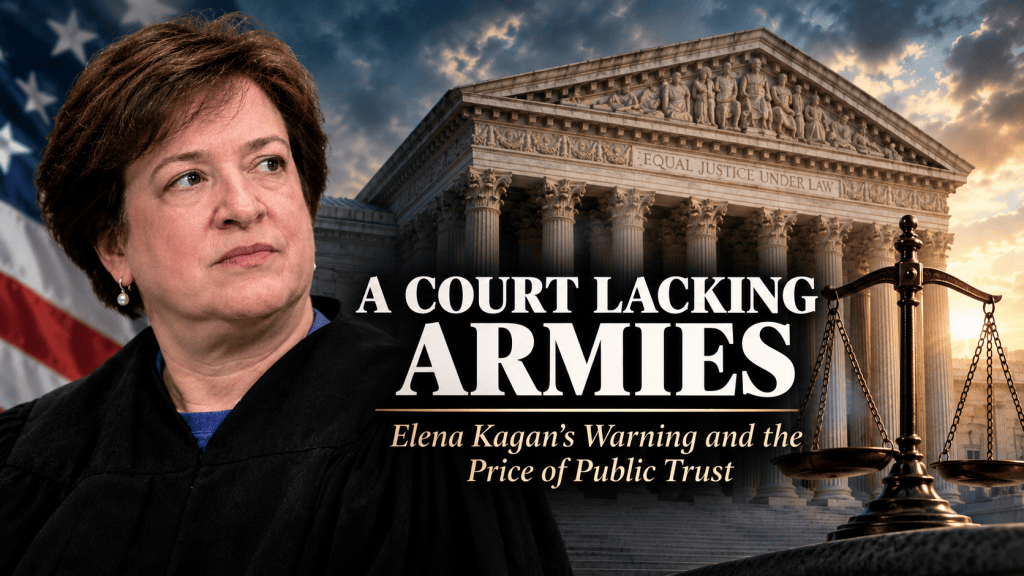
Great powers have always rested upon armies, treasuries, and bureaucracies, yet the most momentous adjudicator of American governance commands none of those instruments, possessing solely the fragile, perishable, and incalculably precious currency of public belief, and Justice Elena Kagan has spent four years warning that her own colleagues are squandering that currency faster than any bench can replenish. Her contention, stripped of rhetoric and distilled to elementary terms, holds that the Supreme Court preserves the public acceptance upon which all of that body’s extraordinary power depends only by behaving like a court, by performing the sober, rule-bound, precedent-respecting labor that ordinary Americans cannot mistake for partisan maneuvering or for the indulgence of private predilections. In September 2022, speaking in New York barely three months after the Court extinguished the federally recognized right to abortion, Kagan observed that jurists manufacture rightful-standing difficulties for themselves whenever they drift from recognizably lawful labor and appear instead to operate as extensions of the partisan struggle or as imposers of their own tastes. She took pains to emphasize that she was addressing neither a single ruling nor a string of outcomes she happened to dislike, and that her anxiety concerned the manner of judging rather than the content of any particular verdict.
She further cautioned that courts appear partisan and squander their standing when they needlessly overturn precedent and decide more than the dispute before them demands, particularly when changes in membership produce abrupt transformations in American law.Kagan, appointed by Barack Obama in 2010 after serving as dean of Harvard Law School and as the government’s chief advocate before the Court, enjoys a reputation as a consensus builder who courts colleagues across ideological lines, and this reputation lends her warnings a gravity that sharper-tongued dissenters cannot command. In the summer of 2026 she returned to the theme before lawyers and jurists from the far-western appellate region, conceding frankly that the present Court is very conservative while denying that this body functions as a puppet of the current administration, and she renewed her endorsement of a panel of retired judges empowered to enforce the ethics code that the Court adopted in 2023 amid a storm of controversy over undisclosed trips and gifts. Her willingness to concede inconvenient evidence, rather than to indulge the bleakest narratives of the Court’s fiercest detractors, distinguishes her intervention from the polemics that routinely circulate through the commentariat, and this distinction explains why her warning deserves sustained, meticulous, and unsentimental scholarly examination.
The olligarch defends her warning, contending that her diagnosis rests upon a durable pattern revealed across eight centuries of Anglo-American experience, a pattern in which courts lacking armies and treasuries endure solely by public consent, and in which consent erodes whenever robed officials behave as though ballot-box victories had conferred upon them a license to legislate. Marshaling more than twenty historic episodes, from Magna Carta to Dobbs, the argument proceeds chronologically, examining catastrophic overreach, instructive restraint, and the persistent temptation of every ideologically homogeneous bench to mistake personal convictions for the commands of law. Scholarly honesty nonetheless demands that the constraint present, in a spirit of genuine sympathy, the strongest objections that conservative jurists and their scholarly allies have raised, because a warning worth heeding must survive assault by the most formidable adversaries available, and because a defense that ignores the best counterarguments is merely advocacy masquerading as scholarship.Alexander Hamilton, in the seventy-eighth Federalist essay of 1788, described the judiciary as the least dangerous of the three branches precisely because that branch commands neither the purse nor the sword, wielding only the faculty of judgment and therefore depending, for the execution of every ruling, upon the cooperation of coordinate officials and the acquiescence of the governed. This architecture of dependence furnishes the indispensable premise of Kagan’s warning, since a body incapable of compelling obedience by force must cultivate obedience by persuasion, and persuasion collapses whenever audiences conclude that the persuader is merely another partisan advancing a platform in disguised vestments. Hamilton’s insight, formulated during the ratification debates, has acquired extraordinary urgency in an era when the Court resolves questions of staggering consequence for commerce, family life, voting administration, and executive power, and when public deference can no longer be presumed.Eight centuries ago, the barons who extracted Magna Carta from King John at Runnymede in 1215 articulated the still-revolutionary conviction that sovereigns answer to law, and Edward Coke sharpened that conviction in 1610, when, in Dr. Bonham’s Case, he suggested that common-law judges might disregard parliamentary enactments repugnant to reason, thereby provoking the ire of King James, who dismissed Coke from the bench in 1616. Both episodes demonstrate that the notion of a judge independent of the sovereign is a hard-won invention rather than an inborn endowment, and that this invention survives only so long as the public regards judges as expounders of law rather than as instruments of faction. Kagan’s formulation restates an ancient insight in contemporary idiom: rightful standing is earned through consistent demonstrations of principled self-restraint and squandered through demonstrations of the opposite.The opposing camp does not dispute that insight, for Chief Justice John Roberts affirmed in 2022 that censure of rulings is entirely appropriate, yet maintained that mere disagreement over an opinion furnishes no ground for impugning the Court’s rightful standing.
The quarrel between the two jurists is therefore narrower than rhetoric suggests, since the question dividing them concerns not whether public trust matters but which behaviors imperil that trust, and whether the dissatisfaction now swirling around the Court reflects genuine misconduct or merely the ordinary resentment that accompanies unwelcome outcomes. Roberts has consistently emphasized that judges must not be treated as partisan combatants, that elected branches should not dictate the content of law to the bench, and that unpopular rulings are an inevitable feature of any adjudicative system; Kagan accepts each of those premises, yet insists that the appearance of partisan motivation, once established, imposes costs that no amount of protestation can fully repair.Disaggregated, Kagan’s caution contains three analytically separable claims, and a rigorous evaluation requires that each be examined on independent terms. The first concerns appearance: when the public perceives the justices as advancing private policy preferences, confidence declines, and confidence represents the Court’s sole reservoir of power. The second concerns precedent: when a change in personnel suffices to overturn established doctrine, the public infers that law is merely the temporary residue of whichever faction last captured the appointments machinery, and infers further that the next appointment may erase the present settlement. The third concerns scope: when the justices resolve questions more sweeping than the controversy requires, they intrude upon domains reserved for legislatures and expert agencies, thereby provoking suspicion that the bench is governing rather than adjudicating.These claims are logically independent yet empirically entangled. A Court may honor the third counsel while violating the second, as when a cautious bench narrowly overturns an entrenched precedent; a Court may honor the second while violating the first, as when a bench scrupulously preserves precedent yet resolves every disputed matter along unmistakably partisan lines. Kagan’s warning becomes most piercing where all three failures converge: a freshly remade bench, supported by a reliable bloc bound by ideology, overrules a long-standing doctrine, reaches questions the parties never needed resolved, and thereby projects the image of a policy-making body in robes. Importantly, none of the three claims requires that the Court follow public opinion. Kagan herself acknowledged that, by design, the Court sometimes does that which most Americans dislike; her worry is that, if the Court loses all connection to public sentiment over time, the result becomes perilous for democracy. Her standard is therefore categorically distinct from applause. She asks whether the bench is acting like a court, a phrase she has used repeatedly, by which she means reasoning from text, structure, and precedent in ways that observers of every persuasion can recognize as lawful craft, even when they lament the destination.
.John Marshall’s opinion in Marbury v. Madison, delivered in 1803, supplies an instructive illustration of how a prudent chief justice can aggrandize the bench’s reach while appearing to retreat from confrontation. Facing a Jeffersonian administration that despised the Federalist midnight judges appointed in the dying hours of John Adams’s presidency, Marshall declared that William Marbury had been wronged by the holding back of his commission, yet he ruled that the Court lacked jurisdiction to afford a remedy, because the statutory provision conferring such jurisdiction exceeded the boundaries of the founding charter. The ruling announced the momentous doctrine that courts may invalidate enactments inconsistent with the supreme law, and the craftsmanship lay in the outcome: Jefferson’s partisans suffered no concrete defeat, because Marbury received no commission, yet the Court secured a precedent of incalculable consequence.The aftermath demonstrates how swiftly a bench that appears partisan provokes retaliation. In 1804 the House impeached Justice Samuel Chase, a stalwart Federalist who had lectured grand juries on the evils of Jeffersonian democracy and presided over prosecutions of Jeffersonian pamphleteers under the Adams-era speech laws, all amid conspicuous partisan fervor, and the Senate declined to convict him in 1805, establishing the enduring understanding that mere disagreement over a judge’s rulings and rhetoric does not amount to removable misconduct. That outcome represents a precious achievement of restraint, but the episode nonetheless reveals that a bench perceived as an arm of one faction provokes assaults from the other, and that survival depends upon the willingness of the opposing party to honor norms the bench itself has strained.A darker lesson emerges from Worcester v. Georgia, decided in 1832, in which Marshall’s Court held that Georgia lacked power to extend state statutes over Cherokee territory. President Andrew Jackson, according to a famous though possibly embellished remark, dared Marshall to enforce the judgment, and whatever the truth of the anecdote, the Cherokee were driven westward along the Trail of Tears, proving that a bench’s pronouncements possess only as much force as executive power and public sentiment choose to lend. Kagan’s insight is that the safest protection against such impotence is the accumulation of public esteem in advance of the crisis, since esteem cannot be conjured on the morning that a president defies a ruling. This is also the point at which the opposing side may rightly object, as later passages explain, that Worcester shows a Court being correct and powerless simultaneously, so that esteem is neither necessary nor sufficient for righteous adjudication.
Dred Scott v. Sandford, decided in 1857, remains the supreme cautionary tale of a bench overreaching. Chief Justice Roger Taney’s opinion held that people of African descent, whether enslaved or free, could never belong to the American polity as members empowered to sue in the courts of the Union, and that Congress lacked power to bar slavery from the territories, thereby voiding the Missouri Compromise. Taney hoped to settle the slavery controversy permanently by decree from the bench; he could have disposed of the dispute narrowly, by deferring to the Missouri courts’ view of Scott’s status, yet he decided far more than the controversy demanded, which is precisely Kagan’s third failure. The ruling inflamed the North, galvanized the Republican party, handed Abraham Lincoln a powerful theme, and hastened the secession crisis, and historians widely regard the decision as the gravest self-inflicted wound in the Court’s annals.The decades after the Civil War disclose a complementary pathology, the bench’s retreat before aggrieved Southern pressure. In Ex parte McCardle, decided in 1869, the Court acquiesced when Congress, anxious that the justices might invalidate Reconstruction, repealed the statute granting appellate jurisdiction over a habeas case already argued. The Slaughter-House Cases, decided in 1873, drained the Fourteenth Amendment’s privileges clause of nearly all meaning. The Civil Rights Cases, decided in 1883, struck down the 1875 statute forbidding discrimination against Black travelers and patrons in inns, theaters, and railroads, over the lone dissent of John Marshall Harlan. Plessy v. Ferguson, decided in 1896, blessed the separate-facilities doctrine, again over Harlan’s solitary protest that the founding charter tolerates no caste among Americans.The pattern merits careful reading by both sides. These rulings were not unpopular among the dominant public of their era; they matched the prevailing sentiments of the powerful. The opposing side may therefore argue that such cases demonstrate the danger of a Court too responsive to public opinion, not too aloof from the crowd, and that Kagan’s rule risks counseling deference to whatever the crowd currently demands. This objection misreads her standard. She asks whether judges are acting like courts, not whether they are following polls, and these decisions fail that test spectacularly, since they displaced the text of the Reconstruction Amendments in favor of prejudice and convenience. A bench acting like a court would have honored the plain pledges of that charter irrespective of the preferences of passing multitudes, and the later disrepute of these rulings confirms that fidelity to law, rather than fidelity to the crowd, ultimately earns durable esteem. Lochner v. New York, decided in 1905, struck down by a five-to-four vote a state statute restricting the working hours of bakers, reading into the Fourteenth Amendment a liberty of contract that the text nowhere announces. Oliver Wendell Holmes protested in dissent that the founding charter does not embody any particular economic theory. For roughly three decades thereafter, courts invalidated a considerable number of protective statutes, and a generation of reformers concluded that judges were replacing the considered judgments of elected legislatures by their own laissez-faire convictions. Here is Kagan’s first failure in its purest form, the image of robed officials imposing private economic preferences under the guise of interpreting the founding charter.The consequences materialized in 1937. After the Court invalidated core measures of the New Deal, including the Schechter Poultry and Butler rulings of 1935 and 1936, President Franklin Roosevelt, fresh from a landslide reelection, proposed to enlarge the Court by up to six justices, one for each serving member who had reached seventy and declined to retire. The Senate rejected the plan, yet the Court’s own conduct changed at remarkable speed. Owen Roberts joined the bench’s more flexible wing in West Coast Hotel v. Parrish, upholding a state minimum wage law, and the Court soon sustained the Wagner Act. The celebrated turnabout of that spring rescued the bench from enlargement but at the price of a lingering suspicion that the justices had yielded to threats.Numerous lessons follow. First, a bench perceived as imposing an economic or ideology-driven program provokes grave threats to survival, and contemporary advocates of enlarging the bench, whatever their motives, draw upon the precedent of 1937 as a template.
Second, the Court that survived did so by retreating, which proves that self-correction is possible. Third, and importantly for the opposing side, the retreat itself can be characterized as a surrender to pressure rather than a vindication of principle. Defenders of the Lochner-era justices have long argued that they were honoring a genuine, if contestable, understanding of liberty. The decisive point for Kagan’s argument, however, is that the public’s perception, not the justices’ self-understanding, determines the fate of the bench, and perceptions are shaped by whether the reasoning appears to originate in law or in the justices’ own convictions.The strongest objection to Kagan’s warning deserves separate treatment, because the finest moments in the Court’s history involved defying overwhelming local and sometimes countrywide sentiment. Brown v. Board of Education, decided unanimously in 1954 under Chief Justice Earl Warren, shattered the separate-facilities doctrine and provoked a vast campaign of resistance. In 1956 roughly one hundred members of Congress signed a manifesto denouncing the ruling, and Southern governments pursued massive resistance. Cooper v. Aaron, decided in 1958 after the governor of Arkansas obstructed integration at an Arkansas high school and President Eisenhower dispatched army paratroopers to enforce the order, saw all nine justices sign an opinion affirming that the Court’s reading of the supreme law binds the states.Subsequent decades, the opponent may continue, supplied even sharper proof that a Court earns respect partly by enduring unpopularity. The Warren Court’s reapportionment, school-prayer, and police-procedure rulings, including Baker v. Carr in 1962, Engel v. Vitale in 1962, and Miranda in 1966, spawned billboards demanding the Chief Justice’s impeachment and handed Richard Nixon in 1968 a campaign theme about judges. If standing depended upon avoiding the appearance of policy-making, the argument runs, the Warren Court would have lost standing. Moreover, detractors on the right contend that the Warren era, and Roe v. Wade in 1973, validated precisely the conduct that Kagan now deplores, namely the imposition of progressive preferences from the bench, so that the present conservative bloc is merely playing by rules the left established.The reply has three components. First, Kagan has expressly disclaimed any rule against unpopular rulings, and Brown’s survival confirms her distinction between disliked outcomes and partisan conduct. The decision was unanimous, grounded in extensive argument, and authored by a bench whose members included appointees of both parties, since Eisenhower, a Republican, placed Warren and William Brennan on the Court. Cross-ideology concord is the most potent signal available that law, rather than faction, produced the result. Second, the claim that the left began the practice of policy-making by judges proves too much, for if the Warren Court’s excesses justify present excesses, the cycle has no terminus, and every future bloc may invoke the last one’s sins as warrant. Third, the Warren-era backlash, though genuine, was substantially softened by the Court’s continued public esteem, which suggests that a reservoir of trust, once filled, can absorb considerable controversy. The danger arises when the reservoir is drawn down by the perception of partisan capture and then tested by yet another divisive ruling.Two twentieth-century episodes, set side by side, illuminate the relationship between public acceptance and the character of a ruling. In the Korematsu case of 1944, the Court sustained the wartime exclusion of Japanese Americans from the West Coast, deferring to military and executive judgments and scarcely scrutinizing the evidence. Chief Justice Roberts, in 2018, declared that Korematsu was gravely wrong from the day the ruling issued, an admission that vindicates the long-standing scholarly consensus.
The episode is relevant to Kagan’s warning because deference to the elected branches, which conservatives often champion, can be a failure of judging when the Court abandons the duty to examine rather than merely ratify.In July 1974 the Court issued the Watergate tapes ruling, unanimously ordering President Nixon to surrender recordings of his conversations. The three justices Nixon had appointed joined the ruling, Chief Justice Warren Burger authored the opinion, and William Rehnquist recused himself. Nixon resigned less than a month later. The ruling remains perhaps the most spectacular demonstration that a bench lacking armies can command obedience from the most powerful officeholder in the land, and the unanimous agreement, cutting across the appointing presidents’ preferences, was the ingredient that rendered resistance unthinkable. Had the vote divided five to four along the lines of the appointing party, the public might well have regarded the order as one more partisan salvo, and the outcome would have been very different.The opposing side may observe that unanimous agreement is a rare luxury and cannot serve as a general standard, since the most contested questions of American life are precisely those on which reasonable jurists disagree. This is correct, and Kagan does not demand unanimous agreement. Yet the comparison clarifies her concern about the Court’s most momentous recent rulings, which have tended to divide according to the party of the appointing president in a pattern that observers find difficult to attribute to coincidence. A bench whose chief controversies track partisan allegiance loses the shield of unanimous agreement that protected the Watergate ruling and must therefore labor harder, through the transparency and modesty of its reasoning, to persuade the public that the division reflects honest disagreement over law.Bush v. Gore, decided in December 2000 by a five-to-four vote, halted the Florida recount and thereby effectively resolved an election for the presidency. The per curiam opinion rested upon the Fourteenth Amendment’s guarantee of even-handed treatment, yet the same opinion declared that the reasoning applied only to the present circumstances, a narrowing disclaimer that many scholars regarded as an unspoken admission that the logic would not be applied consistently in the future. The division among the justices tracked the partisan division of the electorate. Justice John Paul Stevens, dissenting, warned that the true loser was the public’s trust in the judge as an even-handed guardian of the rule of law. Some observers have described the present moment as the most serious threat to the Court’s rightful standing since that decision.The episode matters for two reasons. This demonstrates that when the justices determine the outcome of a bitterly contested struggle for power, along lines that correspond to their appointing parties, the public reasonably suspects partisan motives, and the suspicion attaches regardless of the sincerity of the justices’ reasoning. The episode also supplies the best survey evidence for the opposing side. Survey researchers, most notably James Gibson and his colleagues, found that the Court’s reservoir of goodwill proved remarkably resilient after the 2000 decision, suggesting that the American public extends considerable trust to the bench and that apocalyptic predictions about collapsing esteem are exaggerated.
Kagan’s reply would likely emphasize that resilience does not mean the bench is beyond harm. A reservoir of goodwill drains when withdrawals outrun contributions, and the decades since 2000 have brought a sequence of withdrawals, including confirmation battles of extraordinary savagery, rulings reversing long-settled doctrine, and disputes over the ethics of particular justices. Moreover, the resilience that Gibson identified depended upon the public’s belief that the bench decides by law and not by preference, which is precisely the belief that Kagan fears the bench is now jeopardizing.The decision in Dobbs v. Jackson Women’s Health Organization, delivered in June 2022, overruled both Roe v. Wade of 1973 and Planned Parenthood v. Casey of 1992, extinguishing the federally recognized right to abortion after nearly half a century. Kagan, joining Justices Breyer and Sotomayor, dissented, expressing sorrow for the Court and for the many millions of American women who lost a basic protection. Chief Justice Roberts concurred only in the judgment upholding Mississippi’s fifteen-week ban and refused to join the broader holding, authoring a separate opinion that described the ruling as a serious jolt to the lawful order. The ruling thus fulfilled, in almost didactic fashion, the requirements of Kagan’s second warning, since the chief change between Casey and Dobbs was the composition of the bench. In the weeks following the ruling, a Gallup survey recorded that only about one quarter of Americans expressed confidence in the Court.Defenders of Dobbs offer arguments that deserve serious consideration. Roe’s reasoning was censured not only by conservatives but by distinguished supporters of abortion rights, including the scholar John Hart Ely and Justice Ruth Bader Ginsburg, who suggested that a narrower rationale would have been sturdier. Precedent, moreover, is not inexorable. Brown overruled Plessy, West Coast Hotel overruled Adkins, and no one now laments those reversals. Returning the question to state legislatures, the argument continues, restores democratic control on a topic where the founding charter says nothing expressly and where voters in every state can now shape policy. From this perspective, Dobbs expresses the very restraint that Kagan ostensibly prizes, because the ruling withdraws the bench from a contest the bench never should have entered.The reply requires distinguishing between the correction of historic error and the replacement of old judges’ views by new judges’ views. Brown overruled Plessy after decades of scholarly, civic, and juristic ferment, and after the factual premises of the separate-facilities doctrine had collapsed under scrutiny. West Coast Hotel followed a charter crisis and a changed understanding of economic life. In Dobbs, by contrast, the dissenters and the Chief Justice insisted that nothing had changed except the personnel, and that conviction, if accurate, transforms the doctrine of stare decisis into a hollow incantation.
The deeper issue is whether the Court’s stewardship of precedent possesses any meaning beyond the preferences of the current ruling bloc. If a conviction that earlier judges erred suffices to overrule, then every doctrine remains perpetually vulnerable to the next appointment, and Kagan’s phrase about the entire body of American law being up for grabs becomes a prediction rather than a figure of speech.Kagan’s third claim, concerning scope, finds the sharpest illustrations in the Court’s recent regulatory rulings. In West Virginia v. EPA, decided in 2022, a six-justice bloc invoked the major questions doctrine to block the agency charged with protecting the environment from pursuing a broad strategy for reducing power-plant emissions, reasoning that Congress must speak in exceptionally clear terms before delegating decisions of vast economic and civic significance. Kagan’s dissent charged that the Court had named the bench the decision maker on climate policy, in place of Congress and the expert agency to which Congress had entrusted the task. She accused the six-justice bloc of embracing textualism selectively, abandoning the method precisely when the statutory words pointed toward a result the bloc disfavored.In Loper Bright Enterprises v. Raimondo, decided in 2024, the Court overruled the 1984 Chevron decision, terminating the doctrine under which courts deferred to reasonable agency readings of ambiguous statutes. Kagan again dissented, warning that the ruling transferred to judges a vast measure of technical regulatory policy, ranging from drug-safety standards to thresholds for clean air and water, that judges lack the expertise and democratic control to resolve. The convergence between these dissents and her public remarks is unmistakable. A bench that decides more than necessary, and that does so in a direction congruent to the justices’ leanings toward restrained regulation, courts the very suspicion she describes.The opposing view is formidable and deserves due consideration.
Textualists contend that interpreting statutes is the archetypal task of courts under Article III and the Administrative Procedure Act, and that Chevron deference was a surrender of the duty to say what the law is. The major questions doctrine, on this account, safeguards the lawmaking power that the founding charter vests exclusively in Congress, preventing the executive branch from claiming sweeping powers on the strength of ancient, ambiguous provisions. Seen thus, the Court’s rulings are not instances of policy making but of separation-of-powers enforcement, and the true offenders are Congress, which has abandoned lawmaking responsibilities, and executive agencies, which have seized upon the vacuum. This argument does not lack force, but the dispute remains one about method, and Kagan’s complaint is that the method has been applied unevenly, a charge that can be tested only by examining whether the same justices apply the same interpretive discipline when the outcome cuts against their preferred policy.The recent confrontation between the Court and the presidency furnishes a laboratory for Kagan’s theory. In Trump v. Anderson, decided in March 2024, all nine justices agreed that Colorado could not remove Donald Trump from the ballot under the Fourteenth Amendment’s insurrection clause. Yet Sotomayor, Kagan, and Jackson concurred only in the judgment, objecting that the Court’s opinion had reached beyond the question presented to dictate how Congress must enforce the clause. The concurrence exemplifies Kagan’s third precept in action: a bench should decide what the controversy demands and refrain from legislating by dictum. In July of that year, the immunity ruling granted former presidents broad protection for acts taken in office, and Kagan joined Sotomayor’s dissent, which warned that the ruling placed the occupant of the highest office beyond the reach of prosecution.The picture grows more complicated in the most recent period, and honest analysis must register this complexity. Six justices ruled against President Trump on tariffs, and the president responded by condemning Roberts and the others, and by calling the votes of two of his own appointees, Gorsuch and Barrett, an embarrassment to their families. The ruling is potent evidence for the opposing side, because a bench dominated by Republican appointees that rebuffs a Republican president on his signature economic policy is not obviously a partisan instrument. Kagan has said as much, telling the western gathering that the Court is indeed very conservative but is not a puppet of the current administration. Her fairness on this point strengthens her trustworthiness, for a skeptic who concedes the evidence against her thesis deserves a hearing that a polemicist does not.Meanwhile, Justice Ketanji Brown Jackson remarked in May 2026, after the Court struck down a district drawn to empower Black voters in Louisiana and weakened the Voting Rights Act, that the Court risked being seen as partisan. The juxtaposed tariffs ruling and voting-rights ruling suggest a subtler diagnosis than the crude one preferred by the Court’s fiercest detractors. The bench may be genuinely independent of any president while remaining correlated, on questions of governance and doctrine, to the pledges of the movement that selected the justices. Whether this correlation amounts to partisanship or merely reflects the sincere application of a distinctive philosophy of jurisprudence is a question on which reasonable observers diverge. Kagan’s warning is that, from the vantage of the ordinary American, the distinction may prove academic.
The urgency is heightened by the physical atmosphere surrounding the bench. Chief Justice Roberts has described as wrenching the experience of driving past barricades erected around the Court’s building, and Kagan and Barrett, appearing together before a House panel in July 2026, discussed the threats now confronting the justices. These facts complicate the picture in an instructive way. Hostility toward the Court is partly the product of genuine partisan anger, partly the product of provocation by commentators eager to profit from outrage, and partly the product of the Court’s own conduct. A prudent bench cannot control the first two, but can influence the third, and addressing the part that lies under the justices’ control is not an admission of fault but a sensible exercise of stewardship.The conservative response to Kagan’s warning is neither frivolous nor monolithic, and a fair account must present this response in the strongest form. Roberts has contended that the Court’s rightful standing cannot be made hostage to the applause accorded rulings, and he has lamented, as recently as May 2026, that the public does not grasp that the justices are not simply part of the partisan process. He has drawn a line between censure of rulings, which he regards as proper, and attacks on the judges themselves, which he regards as corrosive. Justice Amy Coney Barrett, in 2021, insisted that the Court is not composed of partisan hacks and urged observers to examine her opinions to see that her philosophy, rather than her party, determines her votes.Justice Clarence Thomas has offered perhaps the most provocative counterpoint. In 2021 he suggested that the justices themselves bear blame for shifting perceptions of the Court, by taking on roles that properly belong to elected officials. This observation produces a startling convergence between Thomas and Kagan, for both agree that a bench exceeding the proper role loses public esteem, and they disagree only about which rulings represent the excess. For Thomas and like-minded originalists, Roe, Casey, and a series of expansive reproductive, regulatory, and police-procedure doctrines were the overreaching, and Dobbs began the work of retrenchment. For Kagan, Dobbs, Loper Bright, and West Virginia are the overreaching. Each camp denounces policy making by judges on the other side while insisting that the camp’s own rulings merely apply the law.Three further conservative arguments deserve mention. First, a sizable fraction of the Court’s cases are decided unanimously or by cross-ideology alliances, so that the image of a perpetually divided bench is a distortion produced by the high visibility of the most contentious disputes. Second, public perceptions of the Court are shaped by media narratives and partisan leaders eager to mobilize voters, so that declining confidence may reflect polarization in American society rather than any misbehavior by the justices. Third, the appointments machinery, including the Senate’s 2016 blockade of Merrick Garland and the rapid 2020 confirmation of Barrett, turned the Court’s composition into a partisan prize in ways that the justices did not control. This third argument is perhaps the most telling, because observers have noted that Barrett’s confirmation was arguably the most partisan of any member of the Court. If the perception of partisan capture springs from the selection process rather than from the justices’ conduct, then Kagan’s exhortation to judges, while salutary, addresses only half the problem, and the other half lies in the Senate and the executive mansion.Kagan’s warning gains breadth when placed alongside the experience of other polities in which courts became objects of factional struggle. In the late Roman Republic, the composition of the standing jury-courts that tried senators accused of corruption became the chief prize in a bitter contest. Gaius Gracchus transferred the juries to the equestrian order in 121 BC, and Sulla restored them to the senators decades later, each shift reflecting the victorious faction’s confidence that control of the courts meant control of the Republic. Cicero, who prosecuted Verres before a jury of senators and later lamented the decay of the republic’s ancient safeguards, understood that when courts become spoils, the rule of law becomes the rule of whoever commands the spoils. The Republic’s ultimate collapse into the rule of Caesar and Augustus testifies to the consequences.Weimar Germany furnishes a bleaker parallel. The statistician Emil Julius Gumbel documented in the 1920s that German courts, staffed largely by judges trained under the empire and hostile to the new republic, treated right-wing violence against opponents indulgently, while punishing left-wing violence severely.
The 1924 treason hearing of the Munich putschists, which produced strikingly light sentences, became emblematic. The republic’s defenders lost confidence in the courts, the courts’ conservative sympathizers felt vindicated in their loyalty to an older order, and when the republic faced the gravest of crises, the bench offered no bulwark. The lesson is not that American judges resemble Weimar’s, which would be an irresponsible exaggeration, but that perceived favoritism destroys the protective function of courts precisely when they are most needed.In the twenty-first century, Hungary and Poland have supplied contemporary cautionary examples from the reverse direction. After 2010, Viktor Orbán’s government expanded and repopulated Hungary’s highest charter court, and after 2015 Poland’s governing party seized control of that country’s highest charter court, in each case justifying the intervention as a democratic correction of an unaccountable, ideologically biased bench. These episodes demonstrate how arguments about overreach by judges, even when partly sincere, can furnish a pretext for subordinating courts to the ruling party. The relevance for the opposing side is considerable: conservatives who deplore the Warren and Roe legacies must reckon with the possibility that enthusiasm for curbing courts is a double-edged blade. The relevance for Kagan’s side is equally sobering, since the surest defense against capture is a bench that visibly refuses to behave as the instrument of any faction, so that attempts to cow or pack the bench appear to the public as the assaults on law that they are.The stakes of this debate extend well beyond American borders. For generations, reformers in fragile democracies have pointed to the Supreme Court as proof that an unelected bench can restrain presidents and legislatures lacking recourse to violence, and diplomats have urged emerging governments to emulate the model. A model that appears to serve a faction exports a poisoned lesson, namely that courts are merely weapons, to be seized by whoever holds the levers of appointment. Strongmen abroad have every incentive to point toward American confirmation battles as evidence that their own interference is simply ordinary statecraft, and each fresh spectacle of partisan combat over the Court hands such leaders a ready shield of rhetoric. In this sense, the preservation of the Court’s rightful standing is not merely a domestic concern but an instrument of American influence overseas, as vital to Washington’s persuasive power as any alliance or armory.An unfortunate feature of contemporary debates is the assumption that a detractor of the Court must favor radical restructuring. Kagan’s proposals, by contrast, are strikingly modest. She has reiterated her support for appointing a panel of retired judges to enforce the ethics code adopted in 2023, which she characterized as largely a non-event for the justices themselves. The proposal is conservative in the proper sense of that word, because this would bolster the bench’s self-governance through an arrangement analogous to those used in lower courts, rather than subjecting the justices to Congress or the executive. The adoption of an enforceable ethics regime would address the chief public grievance of recent years, the sense that justices accept lavish gifts and travel from wealthy benefactors lacking transparent oversight, and this would do so while leaving the Court’s size, jurisdiction, and tenure untouched
Her deeper recommendations concern the behavior of judges rather than the design of the courts. She counsels that justices decide narrowly when narrow grounds suffice, that they honor precedent unless genuinely compelling reasons require departure, that they explain their rulings in a manner persuasive to those who disagree, and that they refrain from reaching for sweeping pronouncements. Notably, these are precisely the virtues that Roberts himself once articulated. At his 2005 confirmation hearing he espoused a minimalist creed, promising to prefer narrow rulings and to respect stare decisis, and the gap between that creed and some of the Court’s more expansive recent rulings is the subject of much commentary. If Roberts’s aspirations of 2005 and Kagan’s counsel of 2022 converge, the dispute between them is a dispute over implementation rather than over aims, and implementation can be improved through the justices’ own conduct, lacking recourse to amendments of the founding charter or statutory disruptions.The opposing side may respond that exhortations about behavior are cheap and that no justice believes that his or her own rulings are overreaching, so that the counsel of restraint will always be applied to the other side’s decisions. This is a fair psychological observation. The answer is that norms, though imperfectly self-enforced, shape behavior at the margins, and that transparency measures, such as explaining emergency orders and disclosing gifts, convert abstract exhortations into observable obligations. A bench that publicly binds the justices to narrow rulings and transparent reasoning summons the public to hold them to that standard, and standards that can be observed, tested, and invoked tend to be obeyed more faithfully than virtues that remain private resolutions.The strongest objections to Kagan’s thesis can be distilled into five contentions, each of which warrants a direct response. The first is that perception diverges from fact, so that a bench may decide impeccably yet suffer from a hostile public-relations environment. This is true, and this implies that justices bear a duty not merely to behave well but to appear to behave well, which is precisely the duty her warning articulates. Reputation is a proper object of care for any bench, and Hamilton’s observation that the judiciary depends on public acquiescence converts reputation from an indulgence into a requirement. The second objection is that her warning is self-fulfilling: by proclaiming that the Court risks losing rightful standing, she hastens the erosion she deplores. The objection carries genuine weight, since rhetoric about crisis can generate crisis. Yet silence carries a price too, because a justice who observes a genuine danger and says nothing abdicates the duty of candor. Moreover, Kagan has been scrupulously careful to disclaim any assault on colleagues’ sincerity, to affirm friendships across the divide of ideology, and to concede points, such as the Court’s independence from the current administration, that cut against the bleakest narratives.The third objection is that the left’s own historic enthusiasm for expansive power in judges, from the Warren Court through Roe, undermines her trustworthiness. This argument contains genuine historic truth and should chasten partisans on every side. This does not, however, refute her thesis, which applies evenly to every wing: judges on any wing who replace law by preference imperil the bench. Indeed, her warning is better understood as a plea that progressive and conservative judges alike abjure the temptation, and her willingness to censure Court actions that conservatives applaud no more demonstrates bias than a conservative’s censure of Roe demonstrates the opposite.
The fourth objection is that precedent is not sacrosanct, and that overruling mistaken decisions is an honorable function of judging. Brown stands as the enduring proof. The reply, advanced above, is that the justification for overruling must be stronger than the conviction that predecessors erred, since otherwise every settlement remains temporary. A rule requiring exceptional reasons for overruling, applied consistently by judges of every persuasion, protects the steadiness that law requires while refusing to freeze error in place. The fifth objection is that the Court’s recent independence, notably the tariffs ruling, belies the picture of partisan capture. This evidence is genuine and Kagan has acknowledged this. The proper inference is that the bench’s reputation is neither lost nor secure, that the Court’s standing hangs in the balance, and that the balance may tip depending on how the justices handle the coming decade’s contentious disputes.Across eight centuries of Anglo-American history, a consistent pattern emerges. Courts that persuade by reasoning, that restrain their aims to the controversies before them, that honor precedent while correcting errors patiently and by evidence, and that command broad, cross-ideology assent for the most momentous rulings accumulate a reserve of trust that sustains them through crises. Courts that appear to serve a faction, whether Taney’s slaveholding South, the Lochner-era champions of laissez-faire, or any contemporary movement, eventually confront retaliation, from the impeachment of Chase to the enlargement threat of 1937 to the capture of courts in Budapest and Warsaw. Elena Kagan’s warning stands squarely inside the lineage that runs from Hamilton to Holmes to the unanimous Court that confronted Nixon.
The opposing perspectives, rendered here at full strength, enrich rather than refute that lineage. Roberts is right that disliked outcomes do not themselves impeach the Court’s standing. Barrett is right that a philosophy of judging differs from a party platform. Thomas is right that bench overreach, wherever this occurs, erodes esteem. Textualists are right that interpreting statutes is the heart of the judging task, and defenders of Dobbs are right that precedent cannot last forever. The Court’s recent rulings against a president of the party that appointed the dominant bloc prove that independence persists. None of these truths, however, dissolves the force of Kagan’s core concern, which is that the appearance and the substance of lawful, restrained, evenhanded judging must be jointly maintained, because the Court’s only army is the public’s belief.The finest historic precedents counsel hope as well as vigilance. The Court recovered from Dred Scott, from Plessy, from Lochner, and from the shadows of Bush v. Gore, and each recovery required justices who recognized the danger and reformed their conduct. The present moment demands no less. If the justices embrace the narrowness, transparency, and respect for precedent that Kagan urges, and if the appointments machinery ceases to treat the bench as a prize, the reservoir of public trust may refill. If they do not, the lessons of Rome, Weimar, and Runnymede suggest that the nation will discover, too late, how much depended upon the quiet and unglamorous craft of acting like a court.


Leave a Reply